For over three millennia along the narrow, sun-drenched ribbon of the lower Nile valley, there flourished a civilization of sublime aesthetic harmony, obsessive monumental permanence, and profound cosmic order: Ancient Egypt. Defined by the Greek historian Herodotus as the “Gift of the Nile,” Egypt harnessed the rhythmic annual inundation of the sacred river to build the most stable and enduring culture in human history. From the unification of the Two Lands under Narmer around 3100 BCE to the golden death mask of Tutankhamun and the sandstone hypostyle halls of Karnak, Egyptian civilization fused sacred pharaonic kingship with architectural immortality.
The Hydraulic Pulse of the Nile and the Concept of Ma’at
Unlike the violent, unpredictable floods of the Tigris and Euphrates, the Nile rose with miraculous annual regularity. Every July, fed by monsoon rains in the Ethiopian highlands, the river spilled over its banks, submerging the floodplain in rich, mineral-laden volcanic silt known as kemet (“the Black Land”). By October, the waters receded, leaving moist, hyper-fertile soil that required minimal plowing before seeds were cast.
This ecological predictability shaped the Egyptian metaphysical worldview. Where Mesopotamia viewed the universe as volatile and hostile, Egypt perceived the cosmos as inherently harmonious, cyclical, and eternal. At the philosophical heart of Egyptian statecraft was Ma’at—the cosmic principle of truth, balance, order, and cosmic harmony, personified as a goddess wearing an ostrich feather.
The Pharaoh was not merely an earthly monarch; he was the living incarnation of Horus on earth, and upon death, he merged with Osiris, ruler of the underworld. The supreme duty of the king was to maintain Ma’at and repel Isfet (chaos, violence, and disorder) through ritual, justice, and cosmic equilibrium.
Hieroglyphic Script: The Words of the Gods
Developed synchronously with Sumerian cuneiform, Egyptian writing arose around 3200 BCE, recorded on stone temple walls and light, portable rolls of papyrus manufactured from reeds harvested in the Nile marshes. The Egyptians called their script medu netjer—”the words of the gods”—which the Greeks translated as hieroglyphs (“sacred carvings”).
Hieroglyphic script was a sophisticated tripartite writing system combining:
- Ideograms / Logograms: Signs representing the actual object depicted.
- Phonograms: Signs representing one, two, or three consonants (uniliteral, biliteral, triliteral signs), functioning without written vowels.
- Determinatives: Non-spoken semantic classifying symbols appended to word endings to clarify meaning (e.g., a walking pair of legs for verbs of motion).
For daily administrative, commercial, and legal records, scribes developed cursive scripts: first Hieratic, and later Demotic. Forgotten for fourteen centuries following the rise of Christianity, the script was famously cracked in 1822 by French philologist Jean-François Champollion using the bilingual trilingual inscriptions of the Rosetta Stone.
The Age of Pyramids: Architectural Eternity at Giza
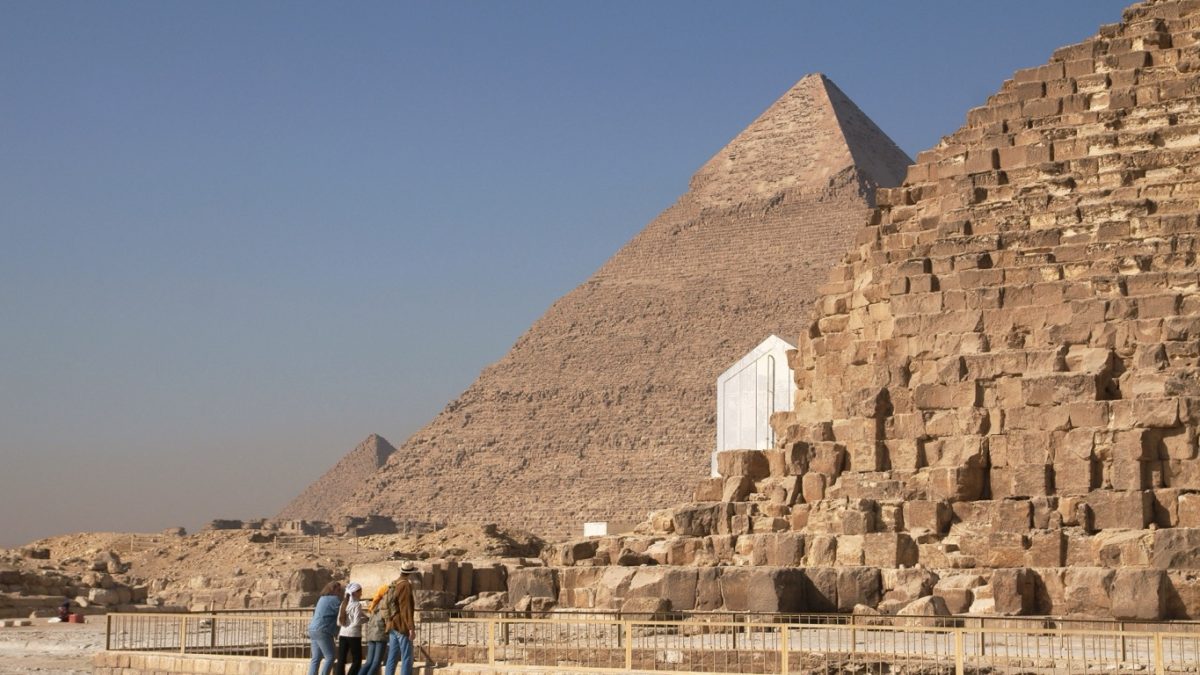
The zenith of Egyptian monumental engineering arrived during the Old Kingdom’s Fourth Dynasty (c. 2613–2494 BCE). On the rocky limestone plateau of Giza, southwest of modern Cairo, Pharaoh Khufu (Cheops) erected the Great Pyramid—a staggering geometric mountain of stone that remained the tallest man-made structure on earth for over 3,800 years.
The physical statistics of Khufu’s pyramid remain breathtaking:
- Composed of approximately 2.3 million quarried limestone and granite blocks, averaging 2.5 tons each, with monumental granite roof lintels over the King’s Chamber weighing up to 80 tons.
- Its base covers 13 acres (53,000 square meters), oriented to true geographic north with an astonishing precision margin of error less than four minutes of arc (1/15th of a degree).
- Built not by enslaved foreign legions, as Hollywood myth suggests, but by a well-fed, highly organized national workforce of skilled masons and seasonal peasant farmers who viewed the construction as a sacred state-building patriotic endeavor.
The Journey of the Soul: The Book of the Dead and Judgment
Egyptian culture was profoundly animated by a quest to overcome biological death. The human being was understood as a composite of physical and spiritual entities: the physical body (khat), the life-force shadow (ka), the unique personality (ba), and the immortal spirit (akh). Preservation of the physical body through the meticulous seventy-day ritual of mummification was essential, providing an eternal anchor for the wandering soul.
In the afterlife, the deceased entered the Hall of Two Truths before Osiris and forty-two divine judges. In the climactic Weighing of the Heart ritual, the heart (ib), seat of human conscience and deeds, was placed on a golden balance counterpoised against the feather of Ma’at. If the heart was light with virtue, the soul was welcomed into the eternal reed paradise of the Aaru; if weighed down with sin, it was devoured by Ammit, the monstrous “Devourer of the Dead.”
Ancient Egypt gifted humanity an enduring architectural standard of monumentality, the invention of papyrus paper, early solar calendrical mathematics (365-day year), advanced medicine, and a transcendent vision of justice that echoed across the Mediterranean world for millennia.