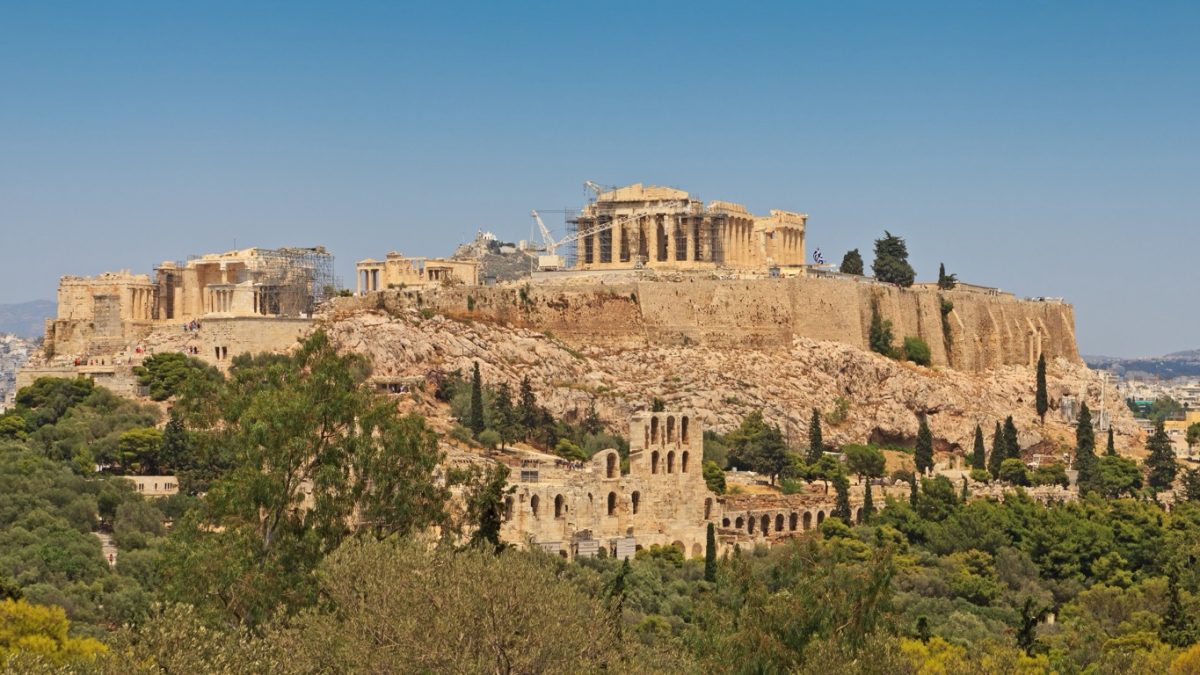
Rising dramatically above the rugged, sun-drenched limestone peninsulas and azure archipelagos of the Aegean Sea, classical Greek civilization ignited a luminous intellectual and political awakening that permanently charted the course of Western philosophy, science, aesthetics, and political theory. In the fifth century BCE, amidst the triumphant defense of Hellas against the mighty Persian Empire, the citizen-soldiers of Athens invented the radical experiment of Demokratia (rule by the people), transformed the open civic marketplace of the Agora into the world’s crucible of rational philosophical inquiry, and crowned the Acropolis with the sublime golden proportions of the Parthenon.
The Geography of Fragmentation: The Birth of the Polis
Unlike the vast, unified river valley civilizations of Egypt, Mesopotamia, and China, the Greek mainland is fragmented by jagged limestone mountain ranges, arid valleys, and treacherous maritime coastlines. Only twenty percent of the land was arable. This rugged topography rendered centralized continental despotism virtually impossible.
Instead, Greek civilization organized itself into hundreds of fiercely independent, sovereign city-states: the Polis (plural: poleis). Each polis was an intimate civic cosmos comprising an urban core, surrounding agrarian hinterlands, an elevated defensible sanctuary (the Acropolis), and an open public assembly square (the Agora). Bound by a shared Homeric mythology, Olympian religion, and the Panhellenic Olympic Games, the poleis nevertheless developed wildly divergent social systems: from the austere, militarized communal barracks of oligarchic Sparta to the maritime, cosmopolitan, and intellectual ferment of democratic Athens.
The Radical Anatomy of Athenian Democracy
The Athenian political system was not an indirect representative democracy, but a direct, participatory democracy where sovereign citizens personally debated, voted upon, and executed state policy. The institutional evolution progressed through three crucial legislative milestones:
- Solon (594 BCE): Abolished debt slavery (seisachtheia), established property-based civic classes, and opened judicial courts to all free male citizens.
- Cleisthenes (508 BCE): Dismantled aristocratic clan power by reorganizing the Athenian population into ten cross-regional artificial tribes (phylai) mixing hill, plain, and coast, creating the Council of 500 (Boule).
- Ephialtes and Pericles (462–429 BCE): Stripped the aristocratic Areopagus council of judicial veto power and instituted public salaries for state officials and jurors, allowing poor citizens (the rowers of the Athenian naval fleet, the thetes) to participate actively in daily governance.
The ultimate sovereign body was the Ekklesia (Assembly of Citizens), which convened forty times a year on the rocky hill of the Pnyx. Every adult male citizen possessed the sacred right of Isegoria (equal right to address the assembly) and Isonomia (equality before the law). To prevent entrenched corruption and elite dynasties, over ninety percent of public magistrates—including tax assessors, city inspectors, and the Boule—were selected not by popularity contests, but by statistical lottery using the marble allotment machine known as the Kleroterion:
To purge dangerous, ambitious demagogues who threatened the constitution, citizens gathered annually to cast inscribed pottery sherds (ostraka) to exile individuals for ten years without confiscating property—the mechanism of Ostracism.
The Socratic Revolution: From Myth to Reason (Logos)
While the Ionian pre-Socratics (Thales, Anaximander, Heraclitus) sought the primary physical substrate (arche) of nature, fifth-century Athens witnessed the momentous turning of rational inquiry inward toward human ethics, justice, and the soul: the Socratic Revolution.
Disdaining financial gain and political office, Socrates walked barefoot through the Agora, engaging statesmen, poets, and craftsmen in relentless dialectical cross-examination (the Elenchus or Socratic Method). By exposing the hidden contradictions and unexamined assumptions of dogmatic belief, Socrates proclaimed that “the unexamined life is not worth living.” Condemned to death by hemlock poisoning in 399 BCE on trumped-up charges of impiety and corrupting the youth, Socrates chose martyrdom over compromise with intellectual dishonesty.
His brilliant disciple, Plato, founded the Academy—the western world’s first university. In works such as The Republic, Plato formulated the Theory of Forms, arguing that the material world perceived by sensory illusion is merely an imperfect shadow of transcendent, unchanging mathematical and philosophical archetypes (exemplified in the Allegory of the Cave). Plato’s greatest pupil, Aristotle, founded the Lyceum, systematizing human knowledge across empirical biology, formal syllogistic logic, physics, ethics, and political theory.
The Golden Proportions of the Acropolis and the Tragedy of Empire
Under the democratic leadership of Pericles, using surplus tribute from the maritime Delian League, Athens transformed the Acropolis into an immortal architectural testament to reason and beauty. Chief architect Iktinos and sculptor Phidias erected the Parthenon (447–432 BCE), dedicated to Athena Parthenos.
The Parthenon is an absolute masterpiece of subtle optical refinement. To correct the optical illusions of human vision, its builders incorporated deliberate, mathematically calculated curvature: the stylobate floor arches upward toward the center, the outer columns tilt imperceptibly inward, and each fluted column swells slightly in the middle (entasis), breathing living grace into lifeless marble:
Yet Athenian hubris contained the seeds of its own destruction. Transforming an alliance of liberated Aegean islands into a tyrannical, tributary empire, Athens provoked the devastating Peloponnesian War (431–404 BCE) against the military juggernaut of Sparta. Thucydides, the father of scientific historiography, chronicled the moral collapse of Athenian democracy in his harrowing account of the Melian Dialogue: “The strong do what they can and the weak suffer what they must.”
Though defeated militarily, classical Greece conquered the mind of humanity. Its legacy of democratic citizenship, rigorous philosophical skepticism, Euclidean geometry, theatrical catharsis (Aeschylus, Sophocles, Euripides), and civic architecture forms the unshakable foundation of the modern intellectual cosmos.