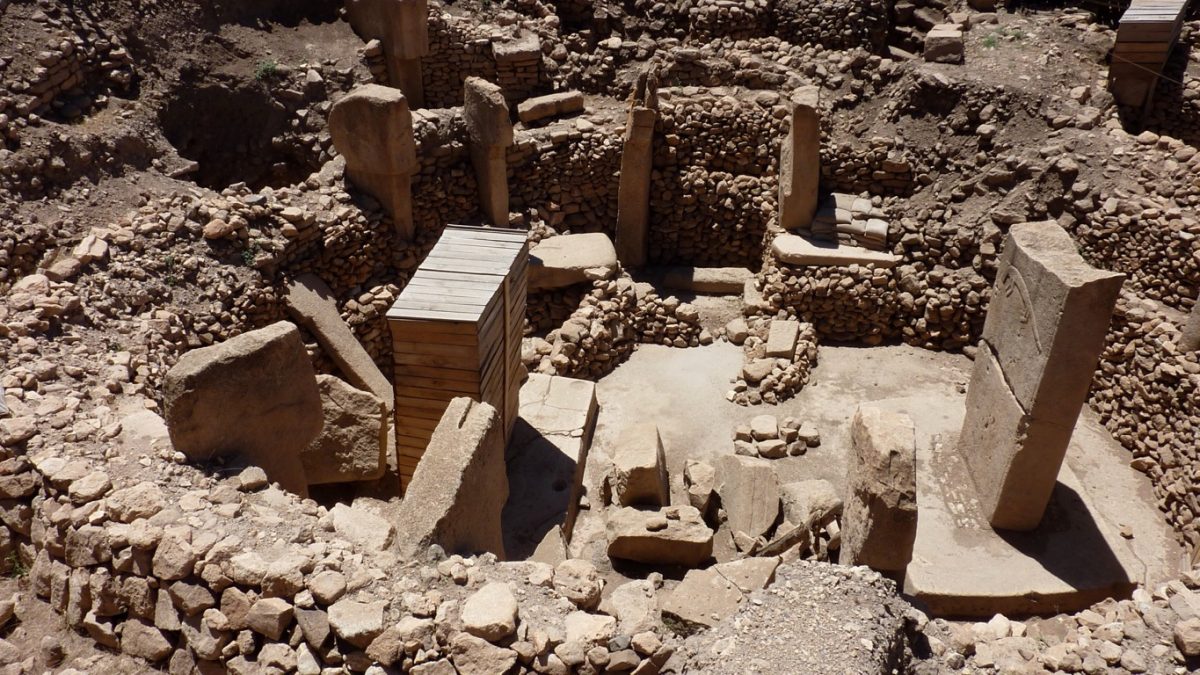
Perched atop an arid limestone ridge in southeastern Anatolia, twelve kilometers northeast of the modern city of Şanlıurfa, lies Göbekli Tepe—the oldest monumental temple complex yet discovered on planet Earth. Dating to approximately 9500 BCE, its colossal T-shaped megaliths were carved, hauled, and erected by hunter-gatherers six millennia before the Great Pyramid of Giza and seven millennia before Stonehenge. The excavation of this extraordinary sanctuary by German archaeologist Klaus Schmidt beginning in 1994 permanently overturned the founding dogma of anthropology: it proved that sacred communal ritual and spiritual hunger did not follow the agricultural revolution, but were the very engine that ignited it.
The Inversion of Childe’s Materialist Paradigm
For most of the twentieth century, the consensus model of human cultural evolution was dictated by the materialist theory of Australian archaeologist V. Gordon Childe. In Childe’s formulation of the Neolithic Revolution, technological necessity dictated ideology:
- Climatic warming at the termination of the Younger Dryas forced humans to cultivate wild cereals.
- Farming generated food surpluses, compelling mobile foragers to establish permanent sedentary villages.
- Sedentary density necessitated social stratification, division of labor, and institutional governance.
- Only after these economic foundations were secured did priesthoods, temple architecture, and organized religion emerge as ideological superstructures.
Göbekli Tepe reversed this causal sequence. In Schmidt’s celebrated formulation: “First came the temple, then came the city.” The monumental enclosures of Göbekli Tepe contain zero domestic architecture, no hearths, no permanent residential huts, and no evidence of domesticated grains or animals. Instead, zooarchaeological analysis of over 100,000 bone fragments reveals the remains of wild gazelles, aurochs, wild boars, and red deer. Thousands of mobile foragers mobilized across regional distances to quarry twenty-ton megaliths using flint hand-axes, drawn together by a shared cosmological vision.
Architecture of the Sacred: Megaliths, Carvings, and Acoustic Space
The site comprises at least twenty circular and oval enclosures, designated Enclosures A through H in the main excavation basin. At the center of each circle stand two colossal T-shaped pillars reaching up to 5.5 meters in height and weighing up to twenty metric tons, surrounded by a perimeter wall embedded with smaller radial pillars:
- Anthropomorphic Megaliths: The T-shaped pillars represent stylized, abstracted human figures. Carved in low relief along the stone flanks are draped garments, loincloths of animal skins, belts fastened with intricate buckles, and slender arms terminating in five-fingered hands meeting above the navel. Their lack of facial features suggests ancestors, spirits, or cosmological deities beyond the realm of individual mortal identity.
- Zoomorphic Iconography: Carved directly onto the megalithic surfaces in high and low relief is a menagerie of dangerous, liminal creatures: snarling leopards, striking vipers, predatory vultures, boars, foxes, and venomous scorpions. Notably absent are docile game animals; these stones served as talismans of primal metaphysical power.
- The Skull Cult: Deep within the enclosure strata, physical anthropologists discovered modified human crania bearing deliberate carving marks, drilling, and ochre pigmentation—the earliest physical evidence of a specialized Neolithic skull cult, celebrating lineage, ancestor veneration, and the threshold between mortality and eternity.
The Birth of Farming as a Ritual Necessity
How did the construction of Göbekli Tepe catalyze the birth of agriculture? Genetic analysis conducted by the Max Planck Institute for Plant Breeding Research in Cologne revealed that the ancestral progenitor of all modern domesticated einkorn wheat (Triticum monococcum) grows wild on the volcanic slopes of Mount Karaca Dağ—a mere thirty kilometers from Göbekli Tepe.
To feed hundreds of stonecutters, masons, and sculptors over months of intense collective labor, and to supply the mass celebratory feasts accompanying the seasonal temple rites (evidenced by massive stone vats showing chemical traces of fermented wild barley beer), nomadic bands faced an existential caloric threshold. They could no longer rely on sporadic foraged yields. They were forced to systematically protect, cultivate, and propagate wild grasses:
Deliberate Inhumation and the Dawn of Time
Perhaps the most enigmatic feature of Göbekli Tepe is its intentional burial. Around 8000 BCE, after centuries of active ritual use, the circular enclosures were not abandoned to natural erosion; they were systematically backfilled and entombed beneath thousands of cubic meters of limestone rubble, sediment, and animal bones. The builders buried their own gods, constructing a high artificial mound (tepe) that protected the megaliths for ten millennia.
Göbekli Tepe stands as the cosmic threshold of human history. It marks the momentous crossing point where our Paleolithic ancestors ceased merely to inhabit nature, and began deliberately to re-engineer stone, consciousness, and the landscape in search of the transcendent.