Along the silt-laden torrents of the Yellow River (Huang He) in northern China, there coalesced an intellectual and political tradition defined by dynastic continuity, ancestor veneration, and bureaucratic moral governance that has endured for more than three thousand years. Across the Bronze Age crucible of the Shang (c. 1600–1046 BCE) and Zhou (1046–256 BCE) dynasties, ancient China forged the foundational pillars of East Asian civilization: the logographic Chinese script etched upon divination oracle bones, monumental piece-mold bronze metallurgy, and the revolutionary metaphysical doctrine of the Mandate of Heaven (Tianming).
The Loess Cradle: The Yellow River as Mother and Sorrows
Northern Chinese agriculture developed upon the vast, wind-blown deposits of fine yellow sediment known as loess. Blown eastward from the Gobi Desert over millennia, loess soil is porous, highly fertile, and easily worked with simple digging sticks. However, the Yellow River is one of the most volatile hydrologic systems on earth, carrying a sediment load exceeding sixty percent by weight during summer flash floods.
Because the river periodically breached its earthen levees, drowning hundreds of square miles and shifting its delta hundreds of kilometers across the North China Plain, it earned the somber moniker “China’s Sorrow.” Survival compelled early Chinese communities to unite under centralized water-control initiatives—giving rise to the legendary figure of Yu the Great, who tamed the primordial deluge not through brute dams, but by channeling rivers into natural sea conduits, earning the right to establish China’s mythical first dynasty, the Xia.
Oracle Bones: Divination and the Genesis of Chinese Script
In 1899, Qing dynasty scholar Wang Yirong fell ill with malaria and was prescribed “dragon bones” by a traditional apothecary. Before grinding the fossils into medicinal broth, Wang noticed archaic inscriptions carved into their surfaces. These were the long-lost Oracle Bones (Jiaguwen) of the Shang Dynasty, excavated from the ruins of their final capital at Anyang (Yinxu).
The oracle bones—primarily bovine shoulder blades (scapulae) and turtle plastrons—functioned as a sacred communications technology between the living Shang king and the supreme ancestral deity, Di (Shangdi):
- A royal diviner polished the bone, drilled shallow pits on the reverse side, and posed a question: “Will the harvest be bountiful?” or “Should the king launch an expedition against the Fang tribe?”
- A red-hot bronze rod was thrust into the pit. The rapid thermal shock caused the bone to crack with a sharp popping sound, producing T-shaped fissures interpreted as the ancestors’ divine response.
- Scribes incised the inquiry, the crack analysis, and the actual historical outcome directly onto the bone using bronze knives.
The oracle bone script represents the direct, linear ancestor of modern Chinese characters. Unlike alphabetic or syllabic scripts of the Near East that transcribed fleeting spoken sounds, Chinese characters were logographic—each graph representing a discrete unit of meaning (morpheme). This allowed diverse linguistic groups across a continental empire to communicate through a shared, eternal written medium that remained readable across millennia.
The Ritual Majesty of Piece-Mold Bronze Metallurgy
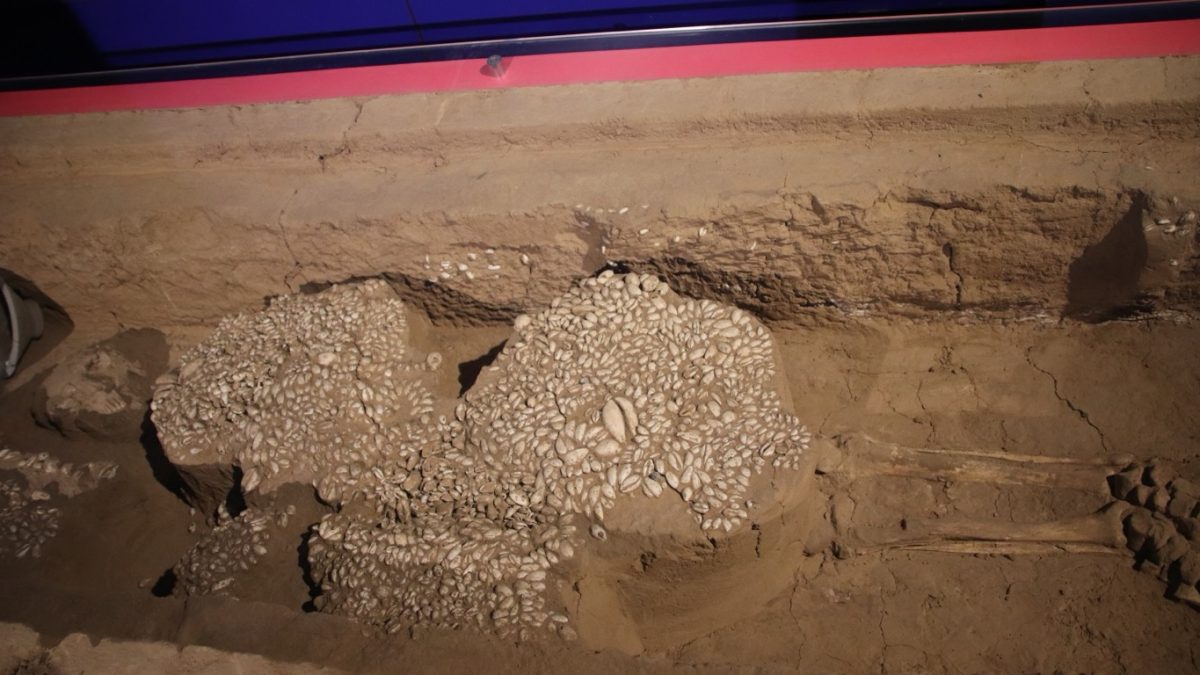
While Western metallurgical traditions developed lost-wax casting for weaponry and personal ornaments, Shang China created the complex piece-mold casting technique to manufacture massive, monumental bronze ritual vessels (ding, gui, jue) weighing up to eight hundred kilograms. Craftsmen constructed clay models, carved intricate negative relief matrices into clay sections, assembled the interlocking molds around a central core, and poured molten bronze at 1100°C.
These vessels were adorned with the hypnotic, zoomorphic Taotie motif: an abstracted, ferocious frontal mask featuring prominent bulging eyes, curled horns, fangs, and gaping jaws. Used in state ancestral banquets to boil meats and warm fermented grain wine, these bronzes were not decorative luxuries; they were sacred talismans of political legitimacy and spiritual communion. Possession of the legendary Nine Tripod Cauldrons (Jiuding) symbolized supreme sovereignty over “All Under Heaven” (Tianxia).
The Mandate of Heaven and the Hundred Schools of Thought
In 1046 BCE, King Wu of the western Zhou frontier march defeated the corrupt Shang monarch Di Xin at the decisive Battle of Muye. To justify the overthrow of a legitimate dynasty, the Duke of Zhou formulated the defining philosophy of Chinese statecraft: the Mandate of Heaven (Tianming).
The Mandate dictated that sovereignty was not an inherent, immutable birthright. Heaven (Tian), as the moral cosmos, bestowed the right to rule upon the most virtuous ruler (“Son of Heaven”). If a monarch became tyrannical, corrupt, and negligent of the common people’s welfare, Heaven expressed its displeasure through astrological portents, earthquakes, floods, and famine:
When the Zhou disintegrated into the warring chaos of the Spring and Autumn and Warring States periods (771–221 BCE), competitive existential struggle stimulated the Hundred Schools of Thought:
- Confucianism (Kongzi): Advocated social harmony through filial piety (xiao), benevolence (ren), and ritual propriety (li), viewing the state as an extended moral family.
- Daoism (Laozi): Preached harmony with the flowing cosmic order (Dao) through spontaneous non-action (wu wei) and natural simplicity.
- Legalism (Han Feizi, Shang Yang): Rejected moral sentimentality, arguing that state survival in total war demanded absolute monarchical authority, ruthless codified laws, universal military conscription, and agricultural mobilization.
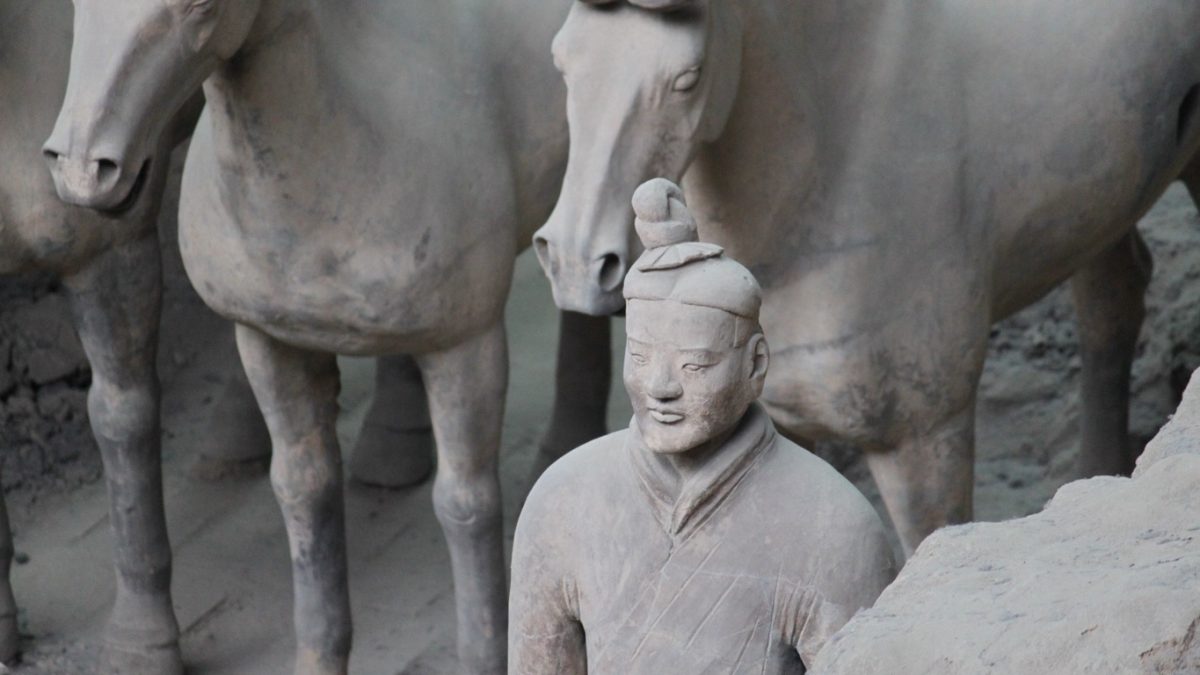
In 221 BCE, the militaristic state of Qin applied ruthless Legalist doctrines to conquer all six rival kingdoms. The First Emperor, Qin Shi Huang, standardized weights, measures, currency, axle widths, and the Chinese script, connected frontier ramparts into the early Great Wall, and was buried with the silent terracotta legion at Xi’an. From the Yellow River emerged a civilization whose civil bureaucratic philosophy, reverence for literature, and moral statecraft continue to anchor the Middle Kingdom today.