Centuries before the Industrial Revolution transformed the landscapes of Western Europe, Song Dynasty China (960–1279 CE) underwent an astonishing economic, technological, and commercial transformation that historians term the “Song Economic Revolution.” Thriving in bustling inland and coastal metropolises like Kaifeng and Hangzhou, Song society harnessed movable-type printing, magnetic mariner’s compasses, hydraulic blast furnaces, and the world’s first government-issued fiat paper currency (Jiaozi), pioneering the modern market economy.
The Hydraulic Agriculture and the Champa Rice Miracle
The foundation of the Song transformation was an agrarian revolution. In the early eleventh century, Song agronomists imported drought-resistant, early-ripening strains of Champa rice from central Vietnam. Unlike native varieties requiring 150 to 180 days to mature, Champa rice matured in merely sixty to ninety days and thrived on higher, terrace-sloped soils.
This biological innovation allowed Chinese farmers to harvest two or even three crops a year from the same paddies. Supported by government-financed water management—including pedal-powered chain pumps, extensive canal dykes, and mechanized sluice gates—agricultural yields exploded across the Yangtze River valley. China’s total population doubled from approximately 50 million in 960 CE to over 100 million by 1100 CE, fueling unprecedented urban migration.
The Great Inventions: Printing, Gunpowder, and Navigation
Song China perfected three of the “Four Great Inventions” that fundamentally reshaped world history:
- Movable-Type Printing: Around 1040 CE, the artisan Bi Sheng invented movable type fabricated from baked clay characters set in an iron frame with pine resin and wax. Though woodblock printing remained dominant for complex logographic texts, the proliferation of private publishing houses dramatically lowered book prices, fostering mass literacy, civil service exam preparation, and the rapid dissemination of agricultural treatises.
- The Magnetic Mariner’s Compass: While magnetic lodestones had been used for geomancy (feng shui), Song polymath Shen Kuo (1031–1095 CE) first documented magnetic declination in his Dream Pool Essays. Song shipbuilders adapted floating magnetized iron needles into gimbaled nautical compasses, enabling Chinese oceanic junks with watertight bulkheads to sail open waters across Southeast Asia, India, and the Persian Gulf.
- Gunpowder Metallurgy: Song military engineers transformed early alchemical formulas of saltpeter, sulfur, and charcoal into weaponized gunpowder, developing explosive fire lances (huo qiang), cast-iron bombs, and crude proto-cannons used to defend walled cities against northern nomadic sieges.
The Market Revolution and the Invention of Paper Money
As domestic commerce intensified across canal networks, merchants faced a logistical crisis: traditional copper coinage (qian) was prohibitively heavy for wholesale transactions. A transaction of several thousand copper coins weighed hundreds of pounds, requiring cartloads of metal that attracted bandits.
In the Sichuan basin, merchant guilds initially issued private deposit receipts backed by stored copper reserves. In 1024 CE, recognizing the immense fiscal potential, the Song imperial court assumed monopolistic control and issued the world’s first true paper fiat currency: the Jiaozi:
Paper currency accelerated transaction velocity, integrated distant provincial markets, and stimulated specialized cash-crop production (tea, silk, porcelain). State-run iron foundries produced over 125,000 tons of pig and wrought iron annually by 1078 CE—a level of metallurgical output that Europe would not match until the eve of the Industrial Revolution in the late eighteenth century.
Neo-Confucianism and Literati Governance
Unlike earlier aristocratic dynasties, the Song transformed the civil service examination system (Keju) into the primary avenue for social mobility and imperial appointment. Under the philosophical influence of Zhu Xi and the Neo-Confucian synthesis, the ruling elite was no longer defined by hereditary noble lineages, but by moral cultivation, mastery of classical literature, and aesthetic refinement.
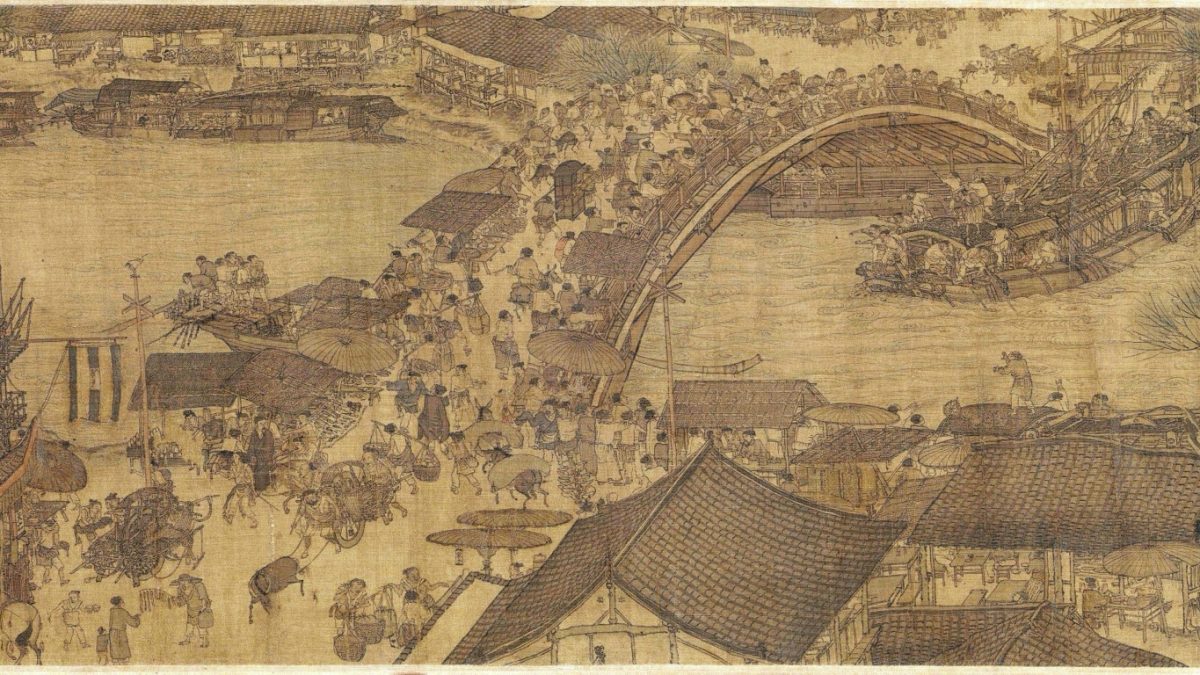
This Shi Da Fu (scholar-bureaucrat) class cultivated the “Four Arts of the Literati”: playing the guqin zither, mastering go (weiqi), practicing refined calligraphy, and painting evocative ink-wash landscapes (shan shui). Masterworks like Zhang Zeduan’s panorama Along the River During Qingming Festival depict Kaifeng as a bustling, cosmopolitan hive of tea houses, merchant inns, street entertainers, and arched canal bridges—a vibrant urban civilization that represented the high-water mark of pre-industrial human organization.