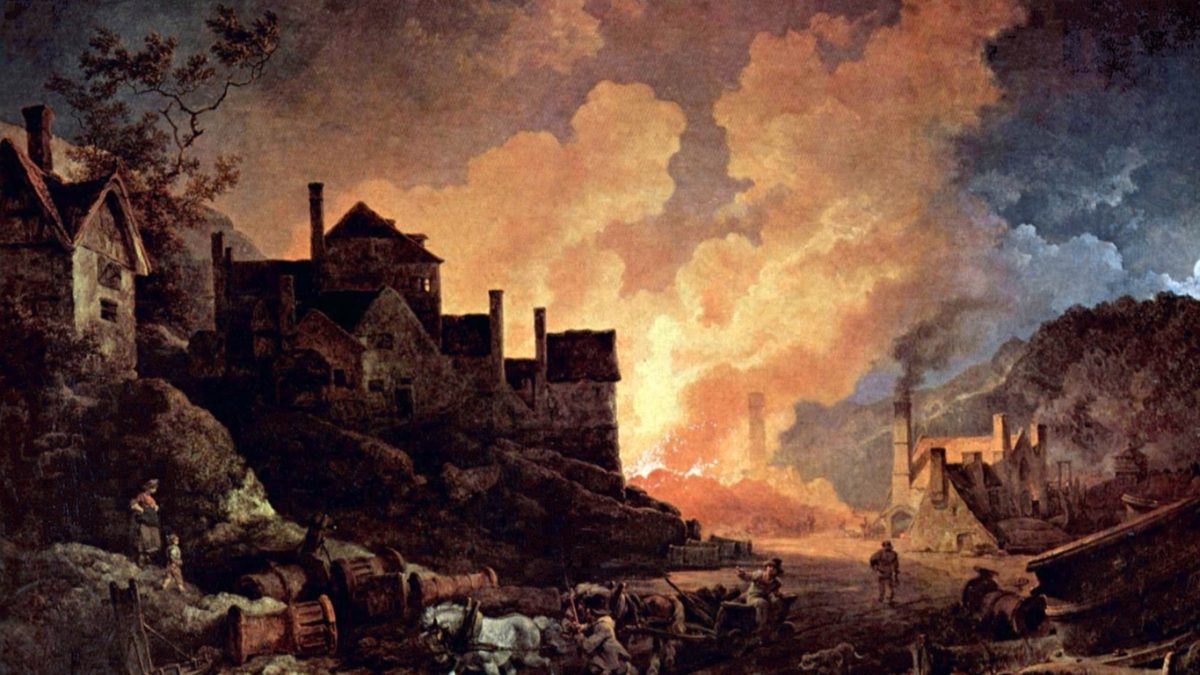
For nearly ten thousand years following the Neolithic Revolution, human societies remained constrained by a biological energy budget: the muscle power of draft beasts, the labor of human hands, and the intermittent flow of wind and running water. In mid-eighteenth-century Great Britain, that ecological ceiling was permanently shattered by the Industrial Revolution. By unearthing millions of years of fossilized solar energy locked in subterranean coal seams and converting thermal heat into mechanical kinetic work through the steam engine, humanity inaugurated an age of machine production, global railroads, and rapid urbanization.
The Ecological Breakthrough: Coal, Iron, and James Watt
By 1700, Western Europe faced severe ecological exhaustion: widespread deforestation had created an acute timber famine, threatening both household heating and the charcoal fuel needed for iron smelting. Britain sat upon vast deposits of subterranean coal, but deep coal mines repeatedly flooded with groundwater.
In 1712, Thomas Newcomen developed an atmospheric steam pump, but it consumed catastrophic amounts of fuel. In the 1760s, Scottish instrument-maker James Watt devised a transformative mechanical breakthrough: the separate condenser. By condensing steam in a dedicated cold chamber while keeping the main piston cylinder permanently hot, Watt reduced fuel consumption by seventy-five percent.
Teaming with Birmingham industrialist Matthew Boulton, Watt subsequently adapted the engine with planetary gears to produce continuous rotary motion. The thermodynamic conversion of thermal energy into mechanical work was mathematically formalized:
Concurrently, ironmasters like Abraham Darby used purified coked coal instead of charcoal to smelt high-grade pig iron, while Henry Cort invented the puddling and rolling processes, unleashing rivers of cheap, durable wrought iron to build bridges, locomotives, and factory skeletons.
The Mechanization of Textiles: The Factory System
The first industry to experience complete mechanization was cotton textiles. Britain imported raw cotton grown by enslaved labor in the American South, processing it through an accelerating cascade of mechanical inventions:
- John Kay’s Flying Shuttle (1733): Doubled weaver output, creating a yarn bottleneck.
- James Hargreaves’ Spinning Jenny (1764): Enabled a single operator to spin multiple spools simultaneously.
- Richard Arkwright’s Water Frame (1769): Harnessed waterwheels to spin strong warp yarns, giving birth to the first centralized water-powered spinning mills.
- Samuel Crompton’s Spinning Mule (1779) and Edmund Cartwright’s Power Loom: Fully mechanized textile production, shifting manufacturing forever from dispersed rural cottage outworkers to centralized urban steam factories.
The factory system radically reordered human psychology and temporal existence. Workers accustomed to natural rhythms of dawn and dusk, seasons, and agricultural festivals were disciplined into the unyielding tyranny of the factory clock, performing repetitive twelve-to-fourteen-hour shifts beneath deafening machinery, breathing toxic cotton lint.
Shrinking Space and Time: Steam Locomotives and Ocean Liners
The marriage of high-pressure steam and rolling iron transformed transportation geography. In 1804, Cornish engineer Richard Trevithick constructed the first steam locomotive; in 1829, George Stephenson’s Rocket captured international imagination by achieving an astonishing thirty miles per hour on the Liverpool and Manchester Railway.
Railroads dissolved geography: inland agricultural hinterlands were bound tightly to deep-water ports; national standardized time zones were invented to prevent railway collisions; and perishable foodstuffs, mail, and millions of passengers traversed continents in days instead of weeks. Upon the oceans, iron-hulled steamships fitted with screw propellers (pioneered by Isambard Kingdom Brunel’s SS Great Britain) made transatlantic crossings reliable regardless of prevailing trade winds.
The Great Urban Migration and Social Upheaval
Industrialization drove the most massive demographic migration in human history. Cities like Manchester, Birmingham, Leeds, and Sheffield exploded from modest market towns into soot-blackened industrial metropolises within decades. Manchester swelled from 25,000 residents in 1770 to over 300,000 by 1850.
However, urban infrastructure lagged catastrophically behind population influx. Working-class families crowded into damp cellar tenements lacking drainage, running water, or garbage disposal, resulting in devastating cholera and typhus epidemics. Child labor was rampant in coal shafts and textile spindles.
In response to these brutal contradictions, new political and economic ideologies emerged:
- Adam Smith’s Free Market Capitalism: In The Wealth of Nations (1776), Smith argued that the division of labor and self-interested market competition (the “invisible hand”) naturally maximized societal wealth.
- Karl Marx and Friedrich Engels’ Scientific Socialism: In The Communist Manifesto (1848) and Das Kapital (1867), Marx diagnosed industrial capitalism as an irreconcilable class struggle between the factory-owning bourgeoisie and the wage-earning proletariat, predicting that mechanized overproduction would inevitably lead to socialist revolution.
- Trade Unionism and Legislative Reform: Factory Acts restricted child labor, instituted the ten-hour workday, mandated public sanitation, and legalized collective bargaining.
The Industrial Revolution permanently broke the Malthusian trap that had constrained human living standards for millennia. By mastering mechanical thermodynamic energy, industrial civilization created unimaginable wealth, urban modernity, and technological power—while unleashing the profound ecological and climate challenges that define our contemporary world.