Spanning an astounding million square kilometers across modern Pakistan, northwest India, and eastern Afghanistan, there arose in the mid-third millennium BCE the largest and most enigmatic urban civilization of the Bronze Age: the Indus Valley Civilization (also known as the Harappan Civilization). Contemporaneous with Old Kingdom Egypt and Sumerian Mesopotamia, the cities of Harappa, Mohenjo-daro, Dholavira, and Lothal were characterized not by colossal royal tombs or militaristic palace monuments, but by an astonishing, unprecedented mastery of municipal public hygiene, standardized civic engineering, and egalitarian urban democracy.
The Architecture of Order: Standardized Urban Grids
Discovered in the 1920s through excavations by Daya Ram Sahni, Rakhaldas Banerjee, and Sir John Marshall, the Indus cities astounded archaeologists with their rigorous, uniform geometry. While Mesopotamian and Egyptian cities grew organically in chaotic, winding alleys, Harappan cities were laid out along strict, orthogonal grid plans aligned precisely to the cardinal points:
- The Dual-Citadel Layout: Major cities were divided into two distinct sectors: a raised western Citadel built upon massive artificial mud-brick platforms to protect against Indus floods, and a sprawling Lower Town housing residential quarters, workshops, and commercial bazaars.
- Standardized Baked Bricks: Across hundreds of settlements separated by thousands of kilometers, Harappan builders manufactured bricks adhering to an exact, unchanging dimensional ratio:
[text{Thickness} : text{Width} : text{Length} = 1 : 2 : 4 quad (approx 7 text{ cm} times 14 text{ cm} times 28 text{ cm})]
These bricks were kiln-baked to absolute water-tight hardness, bonded with gypsum mortar.
- Courtyard Architecture: Private houses were constructed around central open-air courtyards, designed with double-storied mud-brick walls with windows facing inward to block out street noise, dust, and the scorching subtropical heat.
The World’s Earliest Municipal Sanitation Network
The crowning technological glory of the Indus Valley was its sophisticated public sanitary infrastructure—a standard of municipal civic hygiene unmatched anywhere in the ancient world, and not witnessed again until the aqueducts and sewers of the Roman Empire two thousand years later.
Virtually every private home in Mohenjo-daro possessed a dedicated bathing platform made of tightly fitted, non-porous terracotta tiles and private sit-down flush latrines. Wastewater discharged through clay conduits into covered brick drains running along the center of the paved streets. At regular intervals, the drainage system featured limestone-capped inspection manholes and sediment sumps where municipal workers cleared solid waste. Clean water was drawn from a municipal network of over seven hundred public and private brick-lined cylindrical wells.
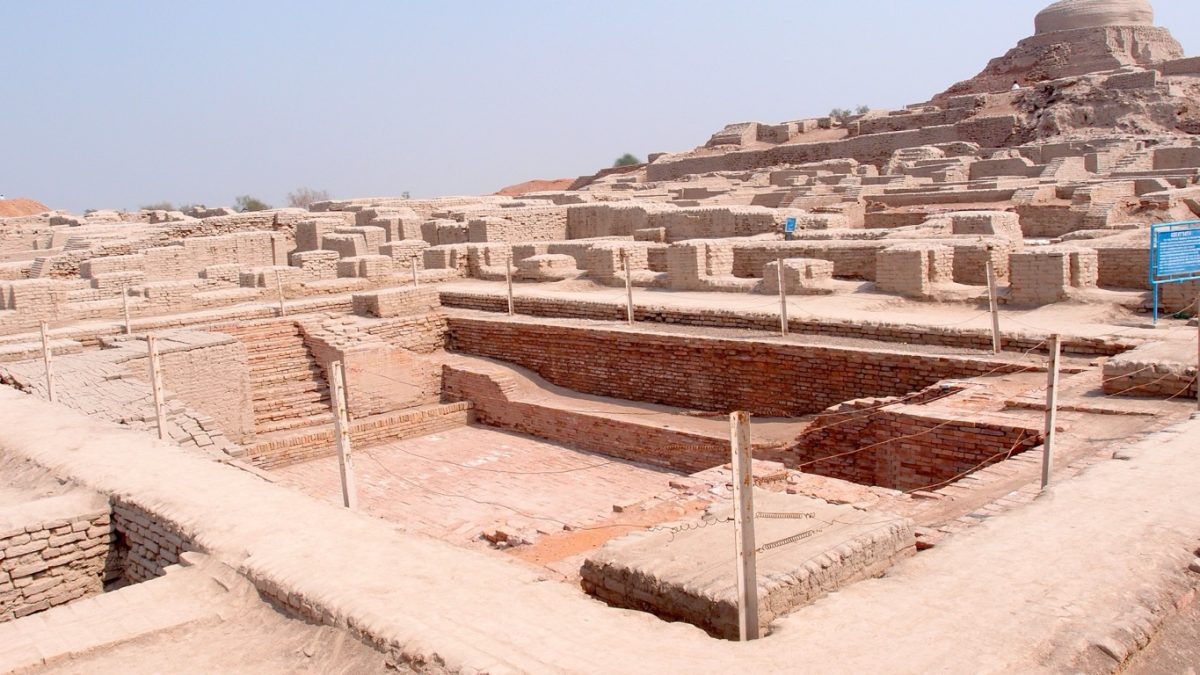
At the center of Mohenjo-daro’s citadel sat the Great Bath: a magnificent heated swimming pool measuring 12 by 7 meters and sunk 2.4 meters into a brick courtyard. Its floor and walls were sealed against leakage with a layer of natural bitumen (asphalt) sandwiched between layers of brick. Far from a private royal indulgence, the Great Bath served as a monumental public sanctuary for ritual bathing and communal purification, prefiguring the sacred water tanks of later Indian spirituality.
The Paradox of Power: A Civilization Without Palaces or Kings?
Perhaps the most profound mystery of the Harappan world is its utter lack of conventional authoritarian imagery. In Egypt and Mesopotamia, the archaeological record is dominated by colossal monuments to royal vanity: pharaonic colossi, victory stelae depicting decapitated enemies, fortified imperial palaces, and royal tombs overflowing with sacrificed retainers.
In the Indus Valley, five decades of scientific excavation have revealed:
- No royal palaces or ostentatious private mansions.
- No monumental temples housing giant cult statues.
- No depictions of standing armies, military conquest, or royal triumphs. Weaponry found is sparse, utilitarian, and designed for hunting or personal defense rather than systematic warfare.
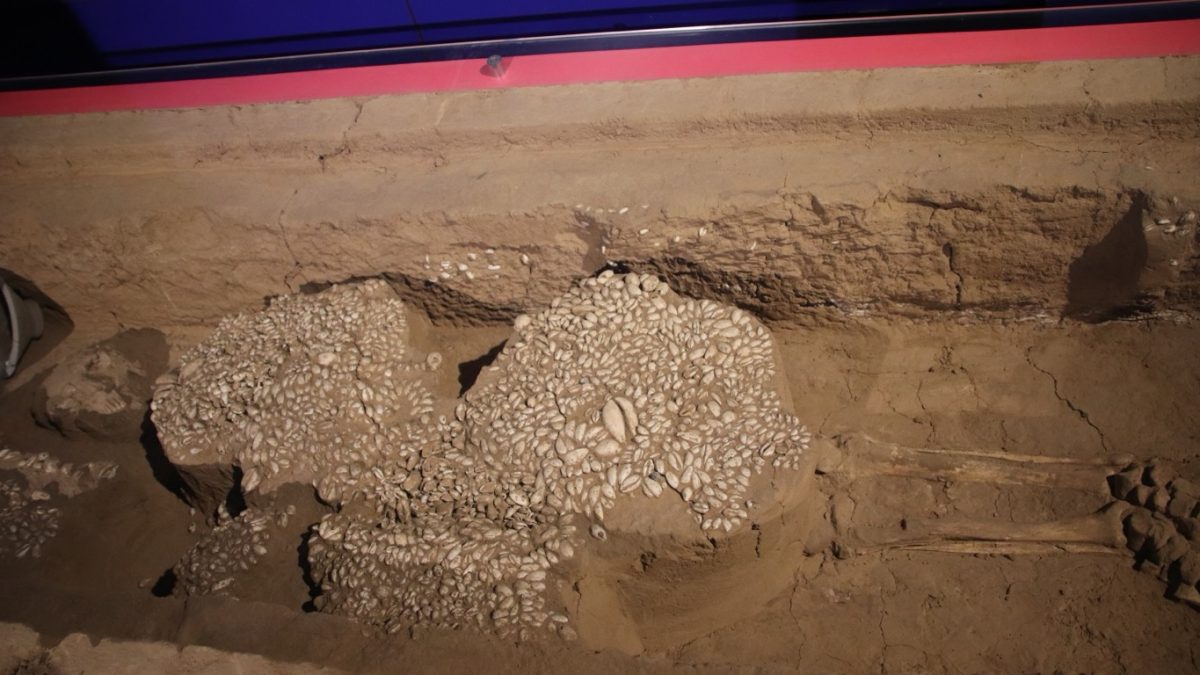
- Modest, democratic burials: Harappans were interred with plain pottery vessels and personal amulets rather than hoards of gold bullion.
The famous statuette known as the “Priest-King” from Mohenjo-daro—a miniature steatite sculpture depicting a bearded man wearing a trefoil-patterned shawl and a headband fillet—is one of the few pieces of elite iconography. Anthropologists speculate that the Indus Civilization was governed not by autocratic dynastic despots, but by a civic merchant oligarchy, guild councils, or municipal assemblies that prioritized public welfare, standardization, and commercial logistics over militaristic glory.
Maritime Trade and the Undeciphered Script
Harappan society was a trading powerhouse. At Lothal on the Gulf of Khambhat in Gujarat, engineers constructed the world’s first tidal dockyard, equipped with sluice gates and quays to handle ocean-going vessels. Cuneiform records from Sargon of Akkad and the Third Dynasty of Ur explicitly record trade with a wealthy eastern land named Meluhha—the Mesopotamian name for the Indus civilization.
Harappan merchants exported carnelian beads, lapis lazuli, ivory comb carvings, timber, and copper ingots, securing transactions with small square soapstone (steatite) cylinder and stamp seals. These seals, featuring exquisite miniature engravings of unicorns, humped bulls (zebu), elephants, and tigers, carry brief inscriptions in the Indus Script.
Comprising over four hundred distinct signs written generally from right to left, the Indus Script remains one of the greatest unsolved cryptanalytic puzzles in archaeology. Because no bilingual inscription (such as a Harappan-cuneiform Rosetta Stone) has yet been discovered, the underlying language—whether ancestral Dravidian, an early Indo-European dialect, or an extinct language isolate—remains fiercely contested.
The Desiccation of the Rivers and the De-Urbanization
Around 1900 BCE, the great Harappan metropolises entered a period of systemic decline and gradual abandonment. This was not caused by an apocalyptic invasion of nomadic chariot riders, as early colonial historians hypothesized, but by profound ecological and hydro-climatic shifts:
- Weakening of the Indian monsoon system led to prolonged regional droughts and the gradual drying up of the sacred Ghaggar-Hakra river system (frequently identified with the Vedic Sarasvati).
- Tectonic earthquakes altered river courses, causing catastrophic avulsions and silt accumulation that paralyzed maritime docks and municipal drainage networks.
Rather than dying out, Harappan populations decentralized, migrating eastward into the lush, rain-fed agricultural valleys of the Ganges and Yamuna. They carried with them their agricultural traditions, water harvesting technologies, and philosophical motifs, weaving the indelible cultural fabric of classical Indian civilization.