For thousands of years prior to the seventh century BCE, uncoined precious metals circulated throughout the ancient Mediterranean and Near East in the form of crude ingots, coils of wire, scrap silver (known to archaeologists as Hacksilber), and ornamental rings. Every market transaction involving bullion required two cumbersome, error-prone operations: cutting the metal to the required weight and testing its metallurgical purity with a touchstone or scale balance. Commercial exchange was crippled by crushing transaction costs.
Around 610–600 BCE, on the western shores of Asia Minor in the wealthy kingdom of Lydia (modern-day western Turkey), King Alyattes—father of the legendary King Croesus—instituted an invention that revolutionized world commerce: the struck coin. As the Greek historian Herodotus recorded in Book I of his Histories:
“The Lydians were the first people we know of to strike and use coins of gold and silver, and they were the first to become retail merchants.”
— Herodotus, Histories (I.94)
The Geology of Electrum: The Pactolus Gold Rush
The catalytic catalyst for Lydian coinage lay in the unique geology of Mount Tmolus. Mountain streams, most famously the River Pactolus which flowed directly through the capital city of Sardis, carried alluvial dust and nuggets of a naturally occurring alloy of gold and silver known to the Greeks as electrum (leukos chrysos, or “white gold”).
According to classical mythology, the river was turned to gold when the greedy King Midas bathed in its waters to rid himself of his cursed golden touch. In physical reality, Lydian electrum was a natural geochemical composite composed typically of 70% to 80% gold, 20% to 25% silver, and trace quantities of copper and iron.
Yet electrum posed a fundamental economic conundrum: its natural composition was wildly erratic. A single nugget might contain 85% gold, while another from the same stream bed contained only 50% gold. Because gold was valued at roughly ten to thirteen times the price of silver, two nuggets of identical weight could possess drastically divergent intrinsic values. Purity could not be determined by visual inspection alone.
The mathematical physics of calculating the gold fraction in an electrum alloy is governed by the principles of specific gravity. Let the total mass be (m), density of gold be (rho_{text{gold}} approx 19.32 text{ g/cm}^3), and density of silver be (rho_{text{silver}} approx 10.49 text{ g/cm}^3). Neglecting atomic compression, the bulk density (rho_{text{alloy}}) is given by:
$$frac{1}{rho_{text{alloy}}} = frac{f_{text{gold}}}{rho_{text{gold}}} + frac{1 – f_{text{gold}}}{rho_{text{silver}}}$$
Solving for the gold mass fraction (f_{text{gold}}):
$$f_{text{gold}} = frac{rho_{text{gold}} (rho_{text{alloy}} – rho_{text{silver}})}{rho_{text{alloy}} (rho_{text{gold}} – rho_{text{silver}})}$$
Because ordinary merchants in a bustling bazaar could not perform hydrostatic Archimedean density assays for every handful of grain or amphora of wine, uncoined electrum was unusable for daily commerce. It required an institutional guarantee.
The Royal Seal: Institutionalizing Trust
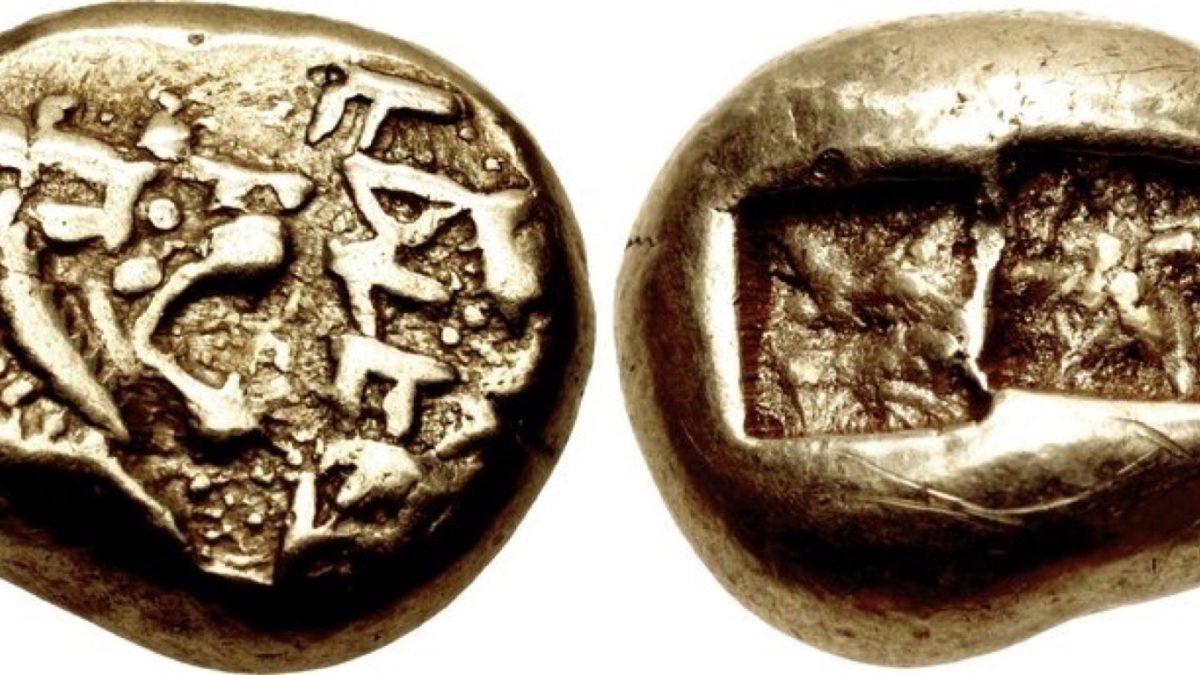
The breakthrough of King Alyattes was to transform a variable natural mineral into a standardized state-backed asset. Royal metallurgists melted the electrum, deliberately added copper to stabilize the mixture, and poured precisely measured globules of molten metal onto an anvil. Scribes then struck the globule with an engraved bronze die and a heavy hammer.
On the obverse (front) of the coin, the die impressed the fierce heraldic emblem of the Mermnad dynasty: the roaring head of a lion, often adorned with a sun-burst or radiant wart on its forehead. On the reverse (back), a handheld punch left two deep incuse geometric impressions, demonstrating that the coin was solid metal through to its core.
| Lydian Denomination | Fraction of Stater | Theoretical Weight (Milesian Standard) | Daily Purchasing Power |
|---|---|---|---|
| Stater | 1 | ~14.10 grams | Monthly subsistence for an elite mercenary captain. |
| Trite (Third) | 1/3 | ~4.70 grams | Value of an ox or major weapon. |
| Hekte (Sixth) | 1/6 | ~2.35 grams | Substantial trade unit across Ionian ports. |
| Hemihekte (Twelfth) | 1/12 | ~1.18 grams | Monthly grain ration for an urban laborer. |
| Fractional (1/96th) | 1/96 | ~0.15 grams (pinhead size) | Daily retail purchases in local Sardis markets. |
The stamp of the lion was not merely decorative art; it was a state seal of quality and weight assurance. By stamping the metal, the King of Lydia declared: “This token contains the exact weight and purity decreed by royal law. Accept it by count, not by the scale. Whoever refuses it or clips its edges challenges the sovereignty of the Crown.” In a single stroke, transaction costs plummeted to near zero.
The Croeseid: Inventing Bimetallism
Alyattes’ son, King Croesus (reigned c. 560–546 BCE), whose immense wealth spawned the enduring Western idiom “rich as Croesus,” realized the fatal limitation of electrum: its inherent gold-silver ambiguity still invited foreign skepticism. Around 550 BCE, Croesus’ metallurgists invented the world’s first industrial cementation process to part electrum into its constituent elements using salt and brick dust.
Croesus discontinued electrum and issued the world’s first bimetallic monetary system: the famous Croeseids. He struck coins of pure gold (98%+ purity) and pure silver, featuring the facing heads of a lion and a bull locked in combat. The golden stater weighed approximately 8.05 grams, while the silver stater weighed 10.7 grams, reflecting an official exchange ratio of:
$$10 text{ Silver Staters} = 1 text{ Gold Stater} quad (text{Ratio } 13.33 : 1)$$
This bimetallic standard spread rapidly across the Aegean. When the Persian Empire under Cyrus the Great conquered Lydia in 546 BCE, the Persians did not destroy the Lydian mint; instead, Darius I adopted the system directly, striking the famous gold Daric and silver Siglos, which circulated from the Indus Valley to the Danube.
Conclusion: The Dawn of Commercial Monetization
The Lydian invention of coinage fundamentally severed money from its ancient temple and palace ledgers. While Mesopotamian credit had been institutional, bureaucratic, and stationary, the stamped coin was portable, anonymous, and universally negotiable. A mercenary soldier could carry his wages in a leather pouch, march hundreds of miles across borders, and buy wine, armor, and lodging from strangers who did not know his name or share his language, but recognized and trusted the stamped lion of Lydia.