In the early eleventh century, in the bustling commercial metropolis of Chengdu in the landlocked Sichuan basin of southwestern China, everyday commerce was paralyzed by an absurd physical burden: the crushing weight of money. Under the monetary regulations of the newly founded Song Dynasty (960–1279 CE), Sichuan was restricted to the circulation of cast-iron coins rather than bronze. Because iron was vastly less valuable than copper, purchasing a single bolt of silk required paying roughly twenty thousand iron coins, weighing upwards of one hundred and thirty pounds. To purchase expensive commodities or transport capital across mountain passes, merchants were forced to load creaking wooden wheelbarrows and ox-carts with literal tons of base metal.
Out of this acute logistical crisis emerged one of the most audacious financial inventions in human civilization: paper money. Seven hundred years before the Bank of England issued printed banknotes, and five centuries before the goldsmith-bankers of London transformed receipts into circulating currency, medieval China dematerialized money from heavy metal into printed paper sheets of mulberry bark.
The Precursor: Tang Dynasty “Flying Money” (Feiqian)
The institutional foundation of Chinese paper currency was established during the late Tang Dynasty (618–907 CE) in the early ninth century with a credit instrument known as Feiqian (飛錢, literally “Flying Money”). As trans-provincial trade boomed in tea, salt, and silk, wealthy provincial merchants traveling to the imperial capital of Chang’an faced constant peril from bandit gangs along mountain highways.
To eliminate the hazard of carting heavy strings of bronze cash (guan) over hundreds of miles, the imperial Treasury and regional administrative offices devised a remittance clearing mechanism:
- The provincial merchant paid cash into the capital memorial office (Jinzu) in Chang’an.
- The treasury issued a bipartite paper certificate consisting of two halves: one retained in the central capital ledger, and one given to the merchant.
- Upon returning to his home province, the merchant presented his paper certificate to the local government warehouse, matched the torn edge with the provincial counterpart, and redeemed the full amount in local bronze coin or salt vouchers.
Feiqian was not yet legal tender paper currency—it did not circulate from hand to hand in the marketplace as a medium of exchange. It was an advanced proto-banking draft or traveler’s bill of exchange. Yet it crossed the psychological Rubicon: it demonstrated that a stamped paper document could represent massive sums of metallic wealth across vast geographical distances.
The Birth of Jiaozi in Chengdu (1024 CE)
In Sichuan, the iron coin dilemma catalyzed the transition from remittance draft to circulating paper currency. Around the year 1000 CE, sixteen prominent merchant houses in Chengdu formed a cooperative financial syndicate. They established specialized deposit shops (Jiaozi hu) that accepted bulky iron coins and issued standardized deposit receipts printed on colored paper, known as Jiaozi (交子, “exchange certificates”).
Initially, Jiaozi were simple receipts stating: “The bearer has deposited X strings of iron coins.” But merchants quickly recognized that rather than redeeming the heavy iron metal to settle debts, it was infinitely simpler to endorse and transfer the lightweight paper certificate directly to other merchants. Jiaozi had transformed into circulating fiat money.
| Phase of Chinese Paper Money | Historical Era | Institutional Nature & Reserve Model |
|---|---|---|
| Feiqian (Flying Money) | Tang Dynasty (c. 810 CE) | Private/state remittance draft; non-circulating credit transfer. |
| Private Jiaozi Syndicate | Early Northern Song (c. 1000 CE) | 16 merchant houses in Chengdu; fractional reserve backing. |
| Official State Jiaozi | Song Dynasty (1024 CE) | First government monopoly paper currency; fixed issuance terms (jie). |
| Huizi (Southern Song) | Southern Song (1160 CE) | Empire-wide paper currency; funding military defense against Jurchen Jin. |
| Jiaochao (Yuan Dynasty) | Mongol Yuan (1260 CE) | Pure unbacked fiat paper money; gold and silver strictly banned. |
By 1023 CE, several of the private merchant houses over-issued receipts beyond their iron reserves and defaulted, triggering runs on the deposit houses and widespread commercial riots. The Song imperial government intervened decisively. In 1024 CE, Emperor Renzong nationalized the system, establishing the Office of Jiaozi (Jiaozi Wu) in Chengdu. Paper money became a sovereign state monopoly.
The Mechanics of Song Paper Currency: The Reserve Ratio and Term Cycles
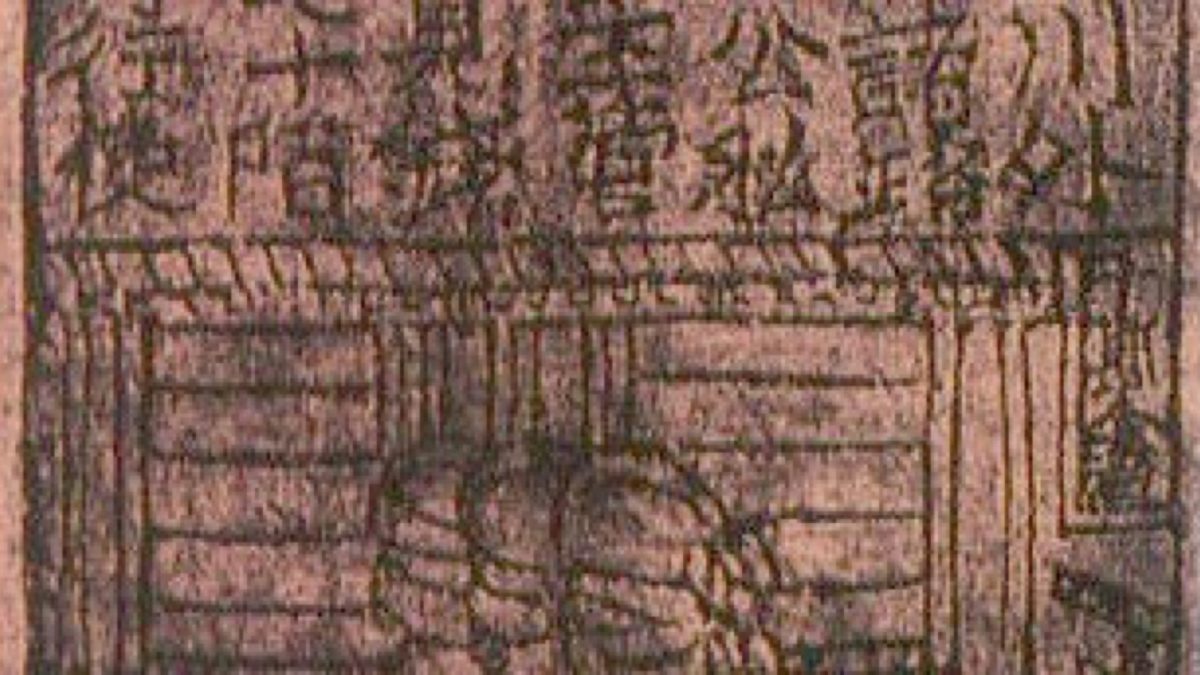
The state-issued Jiaozi was a marvel of medieval administrative technology. To prevent counterfeiting—which was punishable by death—the banknotes were manufactured from high-grade mulberry bark paper using intricate multi-colored woodblock printing techniques. The notes featured detailed landscapes, moral homilies, official red and black seals, imperial warnings, and hand-written signatures of mint magistrates.
Crucially, the early Song state understood the necessity of fractional reserve banking and liquidity management. For the first official issue of 1024 CE:
- Total Authorized Paper Issuance: 1,256,340 strings (guan).
- State Cash Reserve (Iron & Bronze): 360,000 strings.
- Statutory Reserve Backing Ratio ((R)):
$$text{Reserve Ratio } R = frac{360,000}{1,256,340} approx 28.65%$$
To prevent notes from wearing out and to periodically clear the state’s outstanding balance sheets, Song bureaucrats instituted fixed three-year cycles known as jie (界, “terms”). At the end of every three-year term, old notes had to be brought to the state office to be redeemed in coin or exchanged for newly printed notes of the next term upon payment of a small administrative fee (usually 3%).
The Southern Song, Huizi, and the Temptation of the Printing Press
In 1127 CE, the Jurchen Jin dynasty conquered northern China, capturing the Song capital of Kaifeng and taking Emperor Qinzong prisoner. The court fled south to Hangzhou, inaugurating the Southern Song Dynasty (1127–1279 CE). Cut off from the northern silver and copper mines, and facing astronomical military defense budgets to hold the Yangtze River line with gunpowder bombs and paddle-wheel warships, the Southern Song leaned ever harder on paper currency.
In 1160 CE, the government issued a new national paper currency: the Huizi (會子). Initially, the Huizi was strictly managed; but as military emergencies mounted, the government succumbed to the universal temptation of fiat money: printing unbacked paper to fund war deficits.
Between 1168 and 1260 CE, the active circulation of Huizi exploded from 20 million strings to hundreds of millions of strings. The statutory reserve ratio collapsed toward zero. Predictably, the purchasing power of the paper collapsed. By the 1270s, as Mongol armies under Kublai Khan encircled the southern cities, a Huizi note with a nominal face value of 1,000 cash was trading in Hangzhou markets for barely 10 or 20 bronze coins. Paper money had degenerated into hyperinflationary waste paper.
The Mongol Experiment: Kublai Khan and Pure Fiat (Chao)
When the Mongol Yuan Dynasty (1271–1368 CE) conquered China, Kublai Khan executed an even more radical monetary experiment: he abolished all metallic coinage entirely and decreed the Chao (鈔)—the first completely fiat, unconvertible paper currency in world history.
Private ownership of gold and silver was outlawed under penalty of death; all merchants arriving in China were forced to surrender their foreign bullion to the imperial treasury in exchange for printed paper notes. The Venetian traveler Marco Polo was utterly mesmerized by this spectacle, devoting an entire chapter of his Travels to describing how the Great Khan had discovered the secret of turning tree bark into gold:
“With these pieces of paper, made as I have described, he causes all payments on his own account to be made; and he makes them to pass current everywhere in all his kingdoms… Furthermore, all merchants from what country soever, bringing gold, or silver, or gems, or pearls, may not sell to any one except to the Emperor… He pays them with this paper money, and they take it gladly because they can spend it in all his domains.”
— Marco Polo, The Travels of Marco Polo (c. 1300)
When Marco Polo returned to Venice and recounted that the Great Khan ruled the richest empire on Earth through paper sheets made of tree bark, his European contemporaries dismissed his accounts as the wild hallucinations of a mad fabulist. To medieval Europe, money was gold and silver by physical definition; the concept of pure fiat purchasing power was an incomprehensible abstraction.
Conclusion: The Double-Edged Sword of Fiat
The Chinese invention of paper money was an intellectual triumph that anticipated modern central banking by nearly a millennium. It proved that money does not require intrinsic commodity value; its value derives from social consensus, state authority, and legal acceptability. Yet the tragic collapse of the Song Huizi and Yuan Chao also sounded an enduring historical warning: when a state decouples money from physical limits, only rigid institutional discipline can prevent the printing press from devouring the economy it was designed to serve.