In the spring of 483 BCE, miners toiling in the arid hills of southern Attica struck a spectacularly rich strike of argentiferous galena (lead-silver ore) at Maroneia in the district of Laurion. Under normal Athenian constitutional practice, the windfall profit of one hundred talents of pure silver would have been distributed evenly among the citizen body—roughly ten drachmas per man. However, the visionary statesman and naval strategist Themistocles intervened with an audacious proposal: convince the democratic Assembly (Ekklesia) to forego the personal cash handout and invest the entire silver hoard in constructing a fleet of two hundred state-of-the-art triremes.
Three years later, in 480 BCE, that fleet crushed the invading armada of Persian King Xerxes at the Battle of Salamis. The silver veins of Laurion did not merely save Greek democracy; they established the economic bedrock upon which the Athenian Empire, the Golden Age of Pericles, and the first integrated market economy of the Mediterranean world were constructed.
The Global Reserve Currency: The Athenian “Owl”
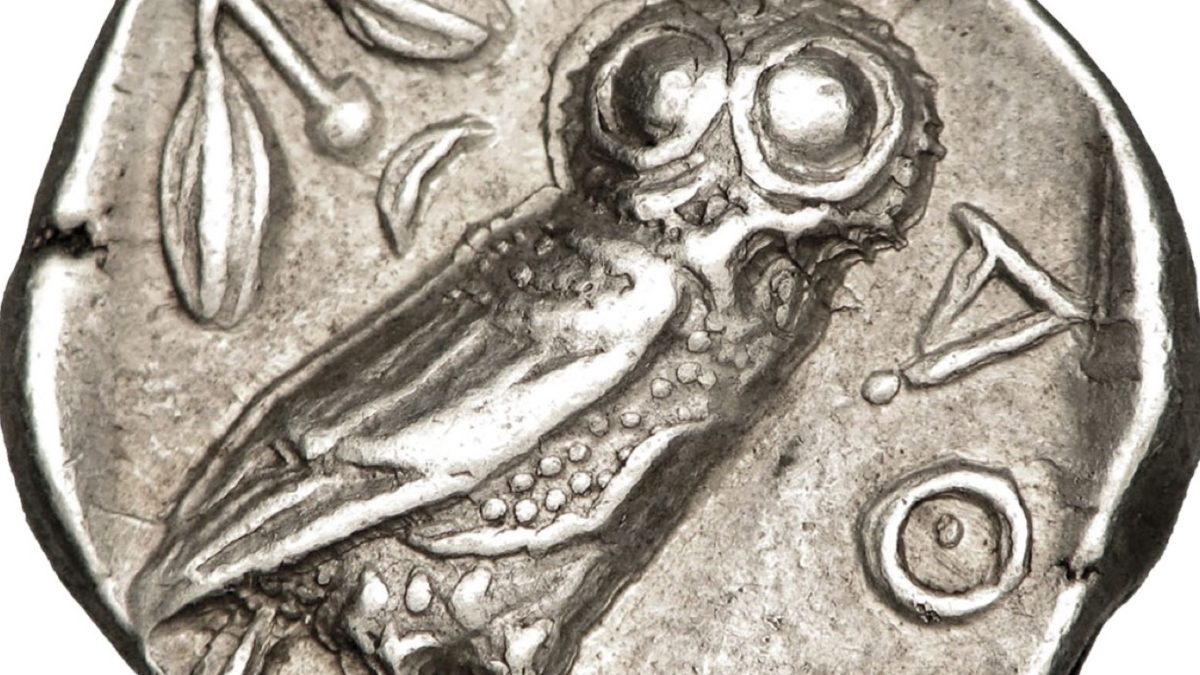
To finance its naval empire, public architecture (including the Parthenon), and burgeoning maritime trade, the mint of Athens struck the most famous, trusted, and ubiquitous coin of antiquity: the Athenian Tetradrachm (literally “four-drachma piece”), universally known across the ancient world simply as the “Owl” (Greek: (gammalambdaalphatilde{upsilon}xi), glaux).
On its obverse, the coin portrayed the helmeted profile of Athena, protector goddess of the polis, adorned with olive leaves. On its reverse stood Athena’s sacred owl standing in a characteristic upright posture, flanked by a sprig of olive, a waning crescent moon, and the ethnic inscription (ΑΘΕ) (ATHE, “of the Athenians”).
The Athenian Owl achieved unmatched monetary supremacy because of two unbending metallurgical and administrative commitments:
- Unwavering Weight Standardization: The tetradrachm weighed exactly 17.2 grams of silver on the Attic standard (4.3 grams per single drachma).
- Extreme Metallurgical Purity: Cupellation techniques at Laurion produced refined silver that was consistently 98% to 99% pure—a standard unmatched by any rival Aegean city-state.
Because merchants from the Black Sea grain ports to the Phoenician harbors of the Levant could accept Owls without discounting them for debasement, the Athenian tetradrachm became the classical world’s first true international reserve currency. Foreign kings and Persian satraps stockpiled Athenian Owls in their royal treasuries; nomadic Scythians north of the Danube hoarded them; and Egyptian traders along the Nile valued them so highly that when local supplies ran short, Egyptian mints struck exact local replicas.
Monetizing the Agora: Democracy and Wage Labor
Before the mid-fifth century BCE, daily life in the Greek world was overwhelmingly agrarian and based on self-sufficient household production (oikos). Under Pericles, the flood of Laurion silver thoroughly monetized the civic and economic life of Athens. For the first time in European history, the state used money to systematically compensate citizens for democratic participation:
| Athenian Public Office / Civic Duty | Daily State Stipend (Periclean Era) | Socio-Economic Impact |
|---|---|---|
| Juror (Dikastes): dikastikos misthos | 2 obols (raised to 3 obols by Cleon in 425 BCE) | Enabled poor citizens and retirees to serve on democratic jury panels of 501+ citizens. |
| Council Member: bouleutikos misthos | 5 obols per day | Compensated 500 citizens serving on the executive Council of 500 (Boule). |
| Trireme Oarsman (Thetes): | 3 obols to 1 drachma (6 obols) per day | Provided living wages for 20,000+ landless urban citizens rowing in the imperial fleet. |
| Assembly Attendance: misthos ekklesiastikos | 1 to 3 obols (introduced 390s BCE) | Guaranteed broad democratic attendance at the Pnyx assembly hill. |
With thousands of citizens receiving daily wages in silver coin, the central marketplace—the Agora—transformed into a permanent, bustling commercial hub. Farmers brought figs, garlic, and olives from the countryside; potters, cobblers, and metalsmiths sold manufactured goods; and specialized retail food stalls emerged. Money had evolved from an elite instrument of foreign trade into the indispensable lubricant of daily urban survival.
Maritime Loans and the Piraeus Money Market: The Birth of Bottomry
At the center of Athenian commercial dominance lay the port of Piraeus, the greatest commercial emporium of the Mediterranean. Athens was structurally dependent on maritime commerce: the rocky soil of Attica could feed barely a quarter of its 250,000 inhabitants. To prevent mass starvation, Athens was forced to import between 1.2 and 1.5 million bushels of wheat every year from the Crimea and Egypt.
To finance these high-risk maritime voyages, Athenian financiers—many of them resident aliens (metics) or emancipated slaves, most famously the billionaire banker Pasion—invented the world’s first sophisticated commercial credit instruments: the bottomry loan (Greek: nautikon daneion).
A bottomry contract was a hybrid credit and marine insurance vehicle. A financier advanced capital to a merchant captain to charter a ship and purchase grain. If pirate fleets or Mediterranean squalls sank the vessel, the debt was entirely liquidated: the borrower owed nothing, and the lender absorbed the total loss. However, if the ship returned safely to Piraeus, the captain was obligated to repay the principal plus an exorbitant interest rate—typically 20% to 30% for a single round-trip summer voyage of several months.
The mathematical pricing of Athenian bottomry loans reflected a modern understanding of risk premium and conditional probability. Let (P) be the principal loaned, (R_f) the risk-free rate of return, (p_{text{loss}}) the probability of shipwreck or piracy, and (R_{text{maritime}}) the contractual interest rate. Setting the expected return equal to the risk-free rate:
$$E[text{Return}] = (1 – p_{text{loss}}) cdot P(1 + R_{text{maritime}}) + p_{text{loss}} cdot 0 = P(1 + R_f)$$
Solving for the equilibrium maritime loan interest rate (R_{text{maritime}}):
$$R_{text{maritime}} = frac{1 + R_f}{1 – p_{text{loss}}} – 1 = frac{R_f + p_{text{loss}}}{1 – p_{text{loss}}}$$
If the baseline annual interest rate was (R_f = 0.10) and the estimated probability of total maritime loss on the stormy Black Sea route was (p_{text{loss}} = 0.15), the required contractual rate was:
$$R_{text{maritime}} = frac{0.10 + 0.15}{1 – 0.15} = frac{0.25}{0.85} approx 29.4%$$
In the bank stalls (trapezai) lining the wharves of Piraeus, bankers accepted interest-bearing deposits, issued letters of credit, settled accounts by book transfer without moving bags of physical silver, and monitored maritime cargo manifests. Banking had evolved from passive temple vaults into an active mechanism for allocating capital and underwriting global risk.
Imperial Monopoly: The Standards Decree
As the Delian League transformed into an outright Athenian maritime empire, Athens sought to institutionalize its monetary monopoly across the Aegean. In the 420s or 440s BCE, the Athenian Assembly passed the controversial Coinage Decree (also known as the Standards Decree, proposed by Klearchos). The law mandated that:
- All allied cities across the Aegean must close their local mints and cease striking silver coins.
- All foreign silver currencies must be surrendered to the Athenian mint to be melted down and re-struck as Athenian Owls, subject to a minting fee (seigniorage).
- All market transactions, port duties, and imperial tribute payments across the empire must be conducted exclusively in Athenian weights, measures, and coins.
The Standards Decree was the classical world’s first attempt to create a compulsory, single-currency monetary union. It demonstrated the eternal nexus between political hegemony and monetary privilege: the power to define the currency of an empire is the power to levy an invisible tax on every trade executed within its borders.
Conclusion: The Golden Age of Sound Money
The Athenian silver owl demonstrated what a sound, standardized, and uncorrupted currency could achieve when paired with naval security, legal protection of property rights, and an open market economy. For over a century, the owl presided over the greatest burst of philosophical, scientific, dramatic, and democratic creativity in the ancient world. Yet when the Peloponnesian War drained the Laurion mines and Sparta besieged the city, even Athens would succumb to the ultimate temptation of fiscally exhausted states: the debasement of its beloved currency.