Between the eighth and twelfth centuries CE, while Western Europe remained fragmented in the wake of the Roman collapse, the Islamic world forged the most expansive, integrated, and sophisticated commercial civilization the world had ever witnessed. Stretching from the Atlantic shores of Morocco and Muslim Spain (al-Andalus) across North Africa, the Levant, Mesopotamia, and Persia to the borders of China and India, the Dar al-Islam formed a unified economic continuum. Within this vast trade zone, a merchant could draw a financial draft in Baghdad, cash it in Cairo, purchase textiles in Damascus, and settle accounts in Samarkand—protected by a common commercial legal code, a universally trusted currency standard, and revolutionary financial credit instruments.
The economic engine of the Islamic Golden Age rested upon two foundational pillars: the imperial monetary reform of the Umayyad Caliphate that created the gold Dinar and silver Dirham, and the development of contract jurisprudence that gave birth to the Suftaja (bill of exchange), the Hawala (debt transfer system), and the Qirad (limited liability equity partnership)—institutions that directly laid the groundwork for Italian Renaissance capitalism.
The Monetary Revolution of Abd al-Malik (696–697 CE)
During the first six decades following the Islamic conquests, the emergent Caliphate operated without a native currency, relying on captured Byzantine gold solidi and Sasanian Persian silver drachms. In 696–697 CE (77 AH), the fifth Umayyad Caliph, Abd al-Malik ibn Marwan, enacted an epochal monetary reform that permanently defined Islamic civilization.
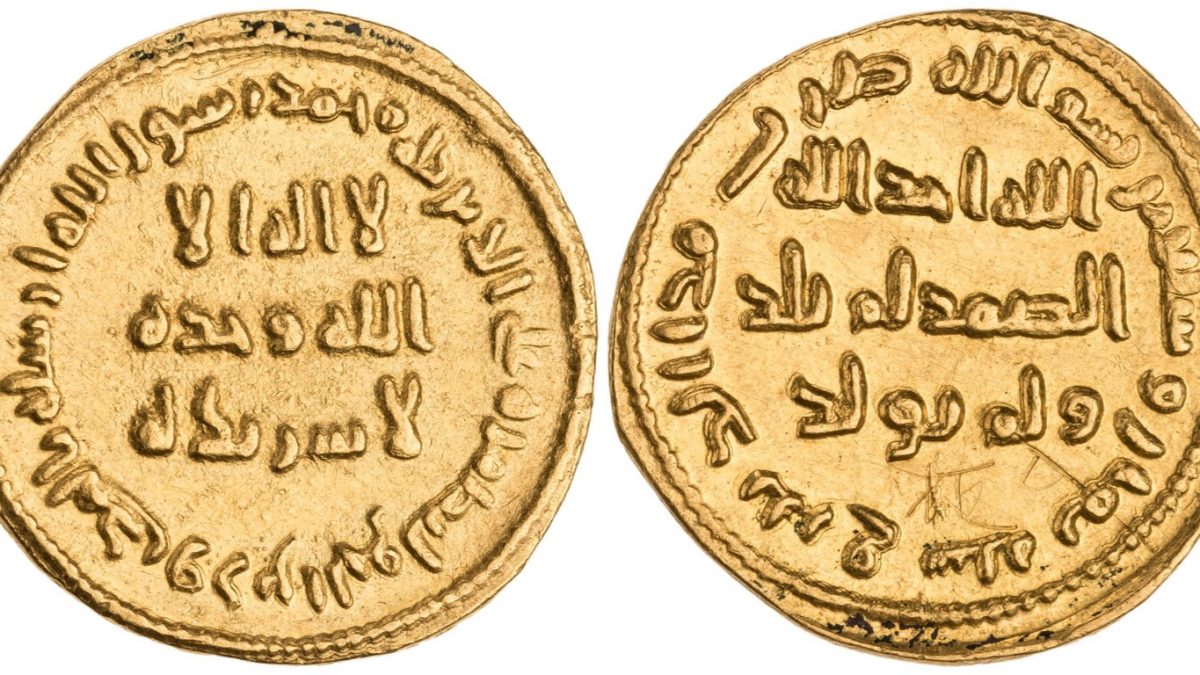
Abd al-Malik swept away all foreign coinage and banned figurative iconography—the portraits of Byzantine emperors, Christian crosses, and Zoroastrian fire altars. In their place, he struck the world’s first purely epigraphic, aniconic currency. The new gold Dinar and silver Dirham featured solely elegant Arabic Kufic calligraphy declaring the central tenets of Islamic monotheism (the Shahada), the mint location, and the Hijri year:
“There is no god but Allah alone, He has no partner. Muhammad is the Messenger of Allah, whom He sent with guidance and the religion of truth to make it prevail over all religions.”
— Kufic Inscription on the Umayyad Reform Dinar (77 AH / 697 CE)
| Islamic Currency Standard | Canonical Arabic Name | Statutory Weight (Mithqal / Shar’i) | Metallurgical Standard & Fineness |
|---|---|---|---|
| Gold Dinar | دينار (Dīnār) | 1 Mithqāl = 4.25 grams | High-purity gold (96% to 98% fine); stable across Abbasid & Fatimid eras. |
| Silver Dirham | درهم (Dirham) | 7/10ths of a Mithqal = 2.975 grams | High-grade silver (90%+ fine); minted in millions across eastern mints. |
| Copper Fals | فلس (Fals, pl. Fulūs) | Variable weight (~2 to 3 grams) | Base-metal token currency for local urban markets and small change. |
The canonical ratio between gold and silver was established in Islamic jurisprudence (*Sharia*) as: 7 Dinars were equivalent in weight to 10 Dirhams ((10 times 2.975text{g} = 7 times 4.25text{g} = 29.75text{g})). Because the Fatimids in Egypt and the Abbasids in Baghdad maintained immaculate metallurgical honesty for centuries, the gold Dinar became the undisputed “dollar of the Mediterranean,” accepted unconditionally in Constantinople, Venice, Genoa, and the courts of Christian Europe.
The Invention of Commercial Paper: The Suftaja and Ruq’a
Carrying bags of gold dinars across thousands of miles of arid desert or pirate-infested waters incurred prohibitive physical risks and transportation costs. To circumvent this friction, medieval Muslim merchant-bankers (known as ṣayārifah, singular ṣayrafī, or currency changers/bankers) developed the world’s first inter-regional paper credit instrument: the Suftaja (سفتجة, pl. safātij).
The Suftaja was an unconditional bill of exchange or traveler’s draft. A merchant in Baghdad wishing to travel to Cairo deposited gold dinars with a reputable Baghdad banker. The banker issued a Suftaja drawn on his correspondent banking partner or business agent in Cairo. The document instructed the Cairo agent to pay a specified sum to the named bearer on a fixed future date upon presentation.
To ensure security against theft, the Suftaja was drawn in duplicate or triplicate, signed by authorized witnesses, and carried personal secret identification codes. The Jewish merchants of Cairo—whose voluminous ninth-to-eleventh-century business letters were miraculously preserved in the Cairo Geniza—routinely remitted hundreds of thousands of dinars across the Mediterranean using safātij without moving a single ounce of gold.
Complementing the Suftaja was the Ruq’a (رقعة) and Ṣakk (صك)—the direct etymological ancestor of the modern English word “Check”. A merchant wrote a order on a slip of paper instructing his banker to disburse funds directly from his deposit account to a third party. Tenth-century Arab chroniclers record merchants in the Persian Gulf port of Siraf settling maritime cargo bills involving millions of dirhams exclusively through written ṣakk drafts.
The Hawala: Trust-Based Value Transfer Networks
Where formal documentation was impractical, Islamic commercial law formalized an informal, network-based value clearing mechanism that operates to this day: the Hawala (حوالة, literally “transfer” or “trust”).
The mechanics of Hawala functioned through bilateral debt clearance within closed networks of trusted brokers (hawaladars):
$$text{Clearing Balance} = sum_{k=1}^n text{Transfers}(A rightarrow B) – sum_{j=1}^m text{Transfers}(B rightarrow A)$$
If merchant (A) in Córdoba wished to remit funds to family member (B) in Damascus, he handed gold to Córdoba broker (H_1). Broker (H_1) contacted Damascus broker (H_2) via caravan letter or cipher. Broker (H_2) disbursed local currency to recipient (B). The two brokers maintained open ledger accounts, settling their net clearing balance periodically through inverse shipments of luxury merchandise (Andalusian silk, Damascene steel) or trade goods, entirely without cross-border bullion transfer.
The Hawala operated without courts, sovereign borders, or physical police. It was enforced through strict communal social collateral: a broker who defaulted on a Hawala draft was instantly expelled from the merchant guild, losing his livelihood, social standing, and creditworthiness across the entire Islamic world.
The Qirad: The Medieval Ancestor of the Joint-Stock Venture
To assemble the massive capital required for trans-oceanic Indian Ocean voyages to Malacca and China, Muslim jurists developed the Qirad (قراض) or Mudarabah (مضاربة)—the limited liability partnership.
In a Qirad contract, one party (the rabb al-mal, or investor) provided the financial capital, while the other party (the mudarib, or active managing merchant) provided the commercial expertise, labor, and travel. The allocation of financial risk and return was codified with pristine clarity:
- Profit Sharing: Profits were distributed according to an agreed-upon contractual ratio (e.g., 50/50 or 60/40), not as a fixed rate of interest, which would violate the Islamic prohibition against usury (*riba*).
- Asymmetric Loss Distribution: If the venture failed due to legitimate market misfortune (shipwreck, banditry, collapse of commodity prices), the entire financial loss fell exclusively upon the capital investor. The active merchant lost solely his time, sweat, and uncompensated labor. The merchant’s personal assets could not be seized by the investor.
When Italian merchants from Venice, Pisa, and Amalfi established commercial colonies in Alexandria, Acre, and Constantinople during the twelfth century, they studied and directly copied the Qirad partnership structure, translating it into Latin law as the commenda. The commenda contract, born in the bazaars of Cairo and Baghdad, became the institutional vehicle through which Renaissance Italy financed its voyages of global trade.
Conclusion: The Architecture of Islamic Commerce
The Islamic Golden Age proved that global trade flourishes when sound money is paired with sophisticated credit and contract law. By standardizing the Dinar, pioneering the check (*ṣakk*), engineering the bill of exchange (*suftaja*), and inventing limited liability equity partnerships (*qirad*), Muslim civilization created the financial nervous system that bridged Asia, Africa, and Europe. It was this Islamic commercial synthesis that awakened Western Europe from its feudal slumber and ignited the commercial revolution of the Mediterranean.