Throughout the euphoric decade of the Roaring Twenties, the American public believed they had entered an era of permanent, uninterrupted prosperity. Mass production of automobiles by Henry Ford, electrification of homes, the spread of household appliances, and the jazz-fueled optimism of the post-WWI boom created an intoxicating economic cocktail. Between 1921 and 1929, industrial production rose by 75%, corporate profits soared, and the New York Stock Exchange became the national altar of retail speculation. Ordinary barbers, shoe-shine boys, and schoolteachers poured life savings into the market, egged on by financial luminaries like Yale economist Irving Fisher, who famously declared in autumn 1929 that stock prices had reached “what looks like a permanently high plateau.”
Six weeks later, that plateau collapsed into the abyss. The Wall Street Crash of October 1929, followed by the catastrophic wave of over nine thousand American commercial bank failures between 1930 and 1933, precipitated the Great Depression—the most devastating economic cataclysm in modern history. The crisis shattered global capitalism, fueled the rise of totalitarian fascism across Europe, and permanently revolutionized monetary theory, giving birth to Keynesian economics and the modern welfare state.
The Mechanics of Speculative Leverage: Margin Debt in 1929
The explosive engine of the 1920s bull market was an unprecedented expansion of margin debt. A retail investor wishing to buy $1,000 worth of stock was not required to put up $1,000 in cash. Instead, under lax exchange rules, they deposited a mere 10% margin ($100 in cash), borrowing the remaining $900 from their broker.
The broker, in turn, borrowed the $900 from commercial banks and corporations through the overnight call money market, pledging the purchased stock as collateral. By late 1929, broker loans on Wall Street exceeded $8.5 billion—more money than the entire circulating currency of the United States. This created an inverted pyramid of terrifying financial fragility:
$$text{Return on Equity (ROE)} = frac{Delta P}{E_0} = frac{Delta P}{P_0 cdot m}$$
Where (m = 0.10) was the margin requirement. If a stock rose by 10%, the investor doubled their money ((text{ROE} = +100%)). But the mathematics of leverage is brutally symmetric: if the stock declined by just 10%, the investor’s entire equity was wiped out. When prices fell, brokers issued immediate margin calls demanding additional cash within twenty-four hours. If the client failed to pay, the broker automatically liquidated the shares on the open market, triggering a cascading, self-feeding chain reaction of forced selling.
Black Thursday and Black Tuesday: The Days of Reckoning
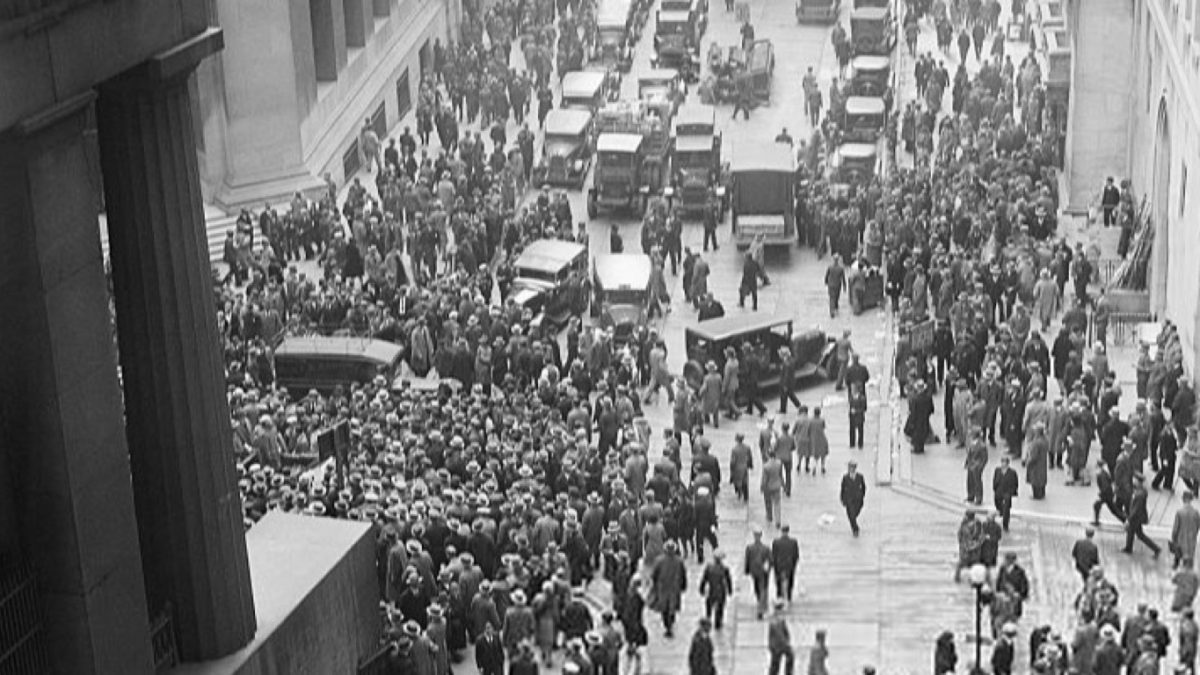
The cracks in the edifice widened throughout September 1929 as industrial production slowed and the Bank of England raised its discount rate to stem gold outflows, sucking British capital out of Wall Street. On Thursday, October 24, 1929—Black Thursday—the market opened in sheer panic. Terrified investors dumped shares at any price; trading volume broke all records, overwhelming the ticker tape by several hours; and billions in paper wealth vanished before noon.
At midday, a consortium of Wall Street bankers led by Thomas Lamont of J.P. Morgan & Co. met secretly and pooled hundreds of millions of dollars to prop up the market. Richard Whitney, vice president of the exchange, strode onto the trading floor and dramatically placed massive bids above market prices for blue-chip stocks like US Steel. The intervention temporarily halted the rout, but it was a finger in the dike.
The definitive slaughter occurred five days later on Black Tuesday, October 29, 1929. Over sixteen million shares were dumped in an avalanche of blind panic. Giant investment trusts collapsed; margin clerks threw portfolios onto the market for pennies; and by the end of the day, an estimated $14 billion in equity values had evaporated. Between September 1929 and the market trough in July 1932, the Dow Jones Industrial Average plunged from an all-time high of 381 to a rock-bottom of 41—a catastrophic collapse of 89.2%.
The Banking Panics of 1930–1933: Milton Friedman’s Indictment
The stock market crash did not directly cause the Great Depression; the crash was a financial shock that the economy might have weathered had the banking system remained sound. The true engine of the Depression was the systemic collapse of the American banking sector.
Between 1930 and 1933, the United States suffered three separate, devastating waves of banking panics:
| Wave of Banking Panic | Catalyst & Epicenter | Systemic Impact & Closures |
|---|---|---|
| First Wave (Late 1930): | Collapse of Caldwell & Co. (Tennessee) and the Bank of United States (New York). | Over 600 banks failed in two months; credit contraction spread to rural Midwest. |
| Second Wave (Spring 1931): | European financial collapse (Creditanstalt in Austria; German banking crisis). | Over 1,000 banks failed; Britain abandoned the gold standard, causing gold runs on the Fed. |
| Third Wave (Early 1933): | Complete breakdown of confidence preceding FDR’s inauguration; state banking holidays. | Over 4,000 banks closed permanently; national banking system paralyzed. |
In their monumental 1963 masterwork, A Monetary History of the United States, economists Milton Friedman and Anna Schwartz presented the definitive monetary explanation of the Great Depression: the crisis became “Great” because the Federal Reserve failed catastrophically to perform its fundamental duty as a lender of last resort.
Under the sway of the flawed “Real Bills Doctrine” and liquidationist ideology championed by Treasury Secretary Andrew Mellon (who urged: “Liquidate labor, liquidate stocks, liquidate farmers, liquidate real estate… it will purge the rottenness out of the system”), the Federal Reserve passively stood by as nine thousand commercial banks collapsed. The Fed permitted the US money stock ((M_2)) to contract by an unimaginable one-third (33%) between 1929 and 1933.
The resulting monetary asphyxiation triggered deep, debt-deflationary spiral (analyzed by Irving Fisher). As prices dropped by 25%, the real purchasing power burden of fixed debts increased exponentially: (text{Real Debt} = frac{text{Nominal Debt}}{P downarrow} uparrow). Bankrupt farmers dumped milk; one in four American workers (25%) was thrown into unemployment; and national GDP was cut in half.
FDR’s Revolution: The Bank Holiday, Gold Confiscation, and Glass-Steagall
On March 4, 1933, with the banking system in cardiac arrest, Franklin Delano Roosevelt was inaugurated as President of the United States. Within thirty-six hours, FDR declared a nationwide four-day National Bank Holiday, shutting every bank in the country. Federal examiners audited balance sheets, and only solvent banks were permitted to reopen, backed by emergency Fed liquidity. In his first legendary “Fireside Chat” on March 12, FDR explained the mechanics of banking to sixty million radio listeners, famously concluding: “I can assure you that it is safer to keep your money in a reopened bank than under the mattress.” Deposits flooded back; the panic ended.
Over the subsequent hundred days, FDR enacted the most radical structural overhaul of financial capitalism in American history:
- Executive Order 6102 (April 1933): Criminalized the private ownership and hoarding of gold coins, bullion, and certificates, forcing citizens to surrender gold to the Federal Reserve at $20.67 per ounce. In 1934, FDR devalued the dollar by 41%, re-pegging gold at $35.00 per ounce.
- The Glass-Steagall Banking Act of 1933: Erected an impenetrable wall separating commercial deposit-taking banks from speculative investment banks, strictly outlawing commercial banks from underwriting stocks.
- Creation of the FDIC: Established the Federal Deposit Insurance Corporation, guaranteeing bank deposits with the full faith and credit of the federal government. The FDIC permanently eliminated the scourge of retail bank runs from American life.
- Creation of the SEC (1934): Founded the Securities and Exchange Commission, mandating strict public disclosure, outlawing insider trading, and regulating margin leverage.
Conclusion: The Re-Engineering of Capitalism
The Great Depression buried the classical laissez-faire dogma that financial markets are naturally self-stabilizing. It demonstrated that uncontrolled speculative leverage and bank runs can drag an entire civilization into economic ruin. Out of the ashes of 1929 emerged the regulated, insured, and safety-netted architecture of modern financial capitalism—a framework of state deposit insurance, central bank liquidity guarantees, and regulatory firewalls that stabilized Western economies for the next three generations.