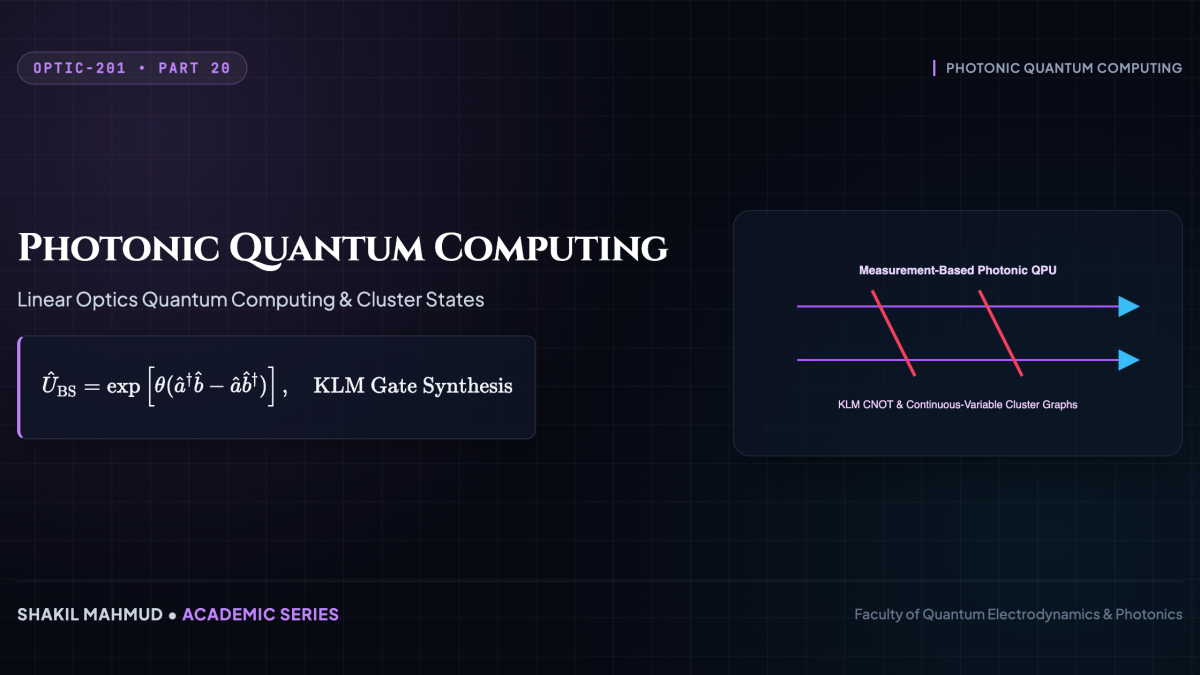
Among all candidate physical platforms for quantum computing—including superconducting transmon circuits, trapped atomic ions, and neutral Rydberg atoms—photons possess a supreme physical virtue: they are completely immune to environmental thermal decoherence at ambient temperatures. Photons travel at the ultimate speed limit (c) without charge or mass, interacting with environmental thermal phonons almost negligibly. The capstone of quantum optics is Photonic Quantum Computing: synthesizing scalable, fault-tolerant universal quantum computers through linear optics, quantum measurements, and continuous-variable cluster states.
1. The Non-Interaction Paradox and The KLM Theorem
The greatest strength of photons is also their greatest engineering challenge: because photons do not possess electrical charge, they do not interact directly with one another in free space ((chi^{(3)}) non-linearities in bulk media are far too weak to realize a two-qubit quantum gate at the single-photon level). For decades, universal optical quantum computing was considered physically impossible.
In 2001, Emanuel Knill, Raymond Laflamme, and Gerard Milburn (the KLM Theorem) shattered this impossibility conjecture with a historic proof: effective non-linear two-qubit quantum logic gates can be realized using exclusively linear optical elements (beam splitters and phase shifters), ancillary single photons, and single-photon threshold detectors.
In a KLM non-linear sign gate, two single photons interfere constructively/destructively at a network of beam splitters. Projective measurement of the ancillary modes collapses the output quantum wavefunction conditionally, enacting an entangling Controlled-NOT (CNOT) or Controlled-Z (CZ) gate with non-zero probability. While probabilistic, teleportation tricks allow gates to scale efficiently with polynomial resources.
2. Measurement-Based Quantum Computing (MBQC) and Cluster States
To eliminate the complex adaptive feedforward loops mandated by gate-based linear optics, modern photonic quantum architectures adopt the Measurement-Based (One-Way) Quantum Computing paradigm (Raussendorf & Briegel):
- Offline Cluster State Generation: Before execution, a massive, highly entangled multi-photon graph state (a Cluster State) is synthesized. The nodes represent photonic qubits, and the edges represent entangling operations:
[
|G
angle = prod_{(i, j) in E} widehat{CZ}_{ij} |+
angle^{otimes N}
] - Computation via Measurement: Universal quantum computation proceeds strictly by performing sequential single-qubit projective measurements in rotated bases:
[
hat{M}( heta) = cos heta hat{sigma}_x + sin heta hat{sigma}_y
]
Measurement of one node teleports the transformed quantum information forward through the cluster lattice, executing quantum algorithms purely through destructive measurement.
3. Continuous-Variable (CV) Photonics and Squeezed Light
Rather than encoding qubits into discrete single-photon Fock states ((|0
angle, |1
angle)), which suffer from optical photon loss, Continuous-Variable (CV) Photonic Quantum Computing encodes quantum information into the continuous quadratures (hat{x}) and (hat{p}) of squeezed light modes generated by optical parametric oscillators.
In the CV framework, an infinite-dimensional Hilbert space is harnessed. By multiplexing thousands of squeezed optical temporal pulses through fiber loops and beam splitters, teams (such as Xanadu’s Borealis and USTC’s Jiuzhang) synthesize colossal two-dimensional and three-dimensional cluster states containing millions of entangled modes, demonstrating decisive Quantum Computational Advantage via Gaussian Boson Sampling (GBS).
4. Fault-Tolerant Photonic Architectures: The GKP Code
To correct photon loss and phase jitter in continuous variables, the system implements the Gottesman-Kitaev-Preskill (GKP) code, which embeds a discrete finite-dimensional qubit inside a continuous harmonic oscillator grid:
[
|0_{ ext{GKP}}
angle propto sum_{s=-infty}^infty |x = 2ssqrt{pi}
angle, quad |1_{ ext{GKP}}
angle propto sum_{s=-infty}^infty |x = (2s+1)sqrt{pi}
angle
]
Interleaving GKP grid states with topological surface codes provides a complete mathematical architecture for fault-tolerant, room-temperature universal quantum computation. Integrated silicon photonic foundries now manufacture these quantum processors using commercial CMOS fabrication lines, heralding an era where light itself computes the deepest mysteries of the universe.