For six decades, Moore’s Law rode the relentless geometric scaling of electronic silicon transistors. Today, modern microprocessors and Artificial Intelligence supercomputers face an insurmountable physical bottleneck: electrical copper interconnects suffer from catastrophic RC latency, excessive ohmic heat dissipation, and bandwidth saturation. Silicon Photonics provides the ultimate paradigm shift: replacing metallic copper wires with micro-fabricated optical waveguides on standard CMOS Silicon-on-Insulator (SOI) wafers, routing petabytes of data via photons with speed-of-light propagation and near-zero thermal loss.
1. The Silicon-on-Insulator (SOI) Platform
Silicon is an ideal optical medium for telecommunications wavelengths ((lambda = 1310 ext{ nm}) and (1550 ext{ nm})), where its bandgap energy ((E_g = 1.12 ext{ eV})) renders it completely transparent ((alpha < 0.1 ext{ dB/cm})). The Silicon-on-Insulator (SOI) architecture consists of a thin silicon device core layer ((n_{ ext{Si}} approx 3.48)) situated atop a buried silicon dioxide cladding layer ((n_{ ext{SiO}_2} approx 1.44)).
The colossal refractive index contrast ((Delta n = n_{ ext{Si}} – n_{ ext{SiO}_2} approx 2.04)) provides unprecedented optical confinement. Waveguide cross-sections shrink to (450 ext{ nm} imes 220 ext{ nm}), permitting sub-micrometer bend radii ((R < 5 mu ext{m})) without radiative leakage and allowing millions of photonic components to integrate onto a single microprocessor die.
2. The Plasma Dispersion Effect (Soref-Bennett Relations)
Because crystalline silicon has a centrosymmetric diamond cubic lattice, it lacks linear electro-optic Pockels susceptibility ((chi^{(2)} quiv 0)). Fast optical phase modulation must therefore exploit the Plasma Dispersion Effect: the alteration of refractive index and optical absorption via free-carrier concentration variations ((Delta N_e, Delta N_h)).
At (lambda = 1550 ext{ nm}), the empirical Soref-Bennett equations govern the modulation:
[
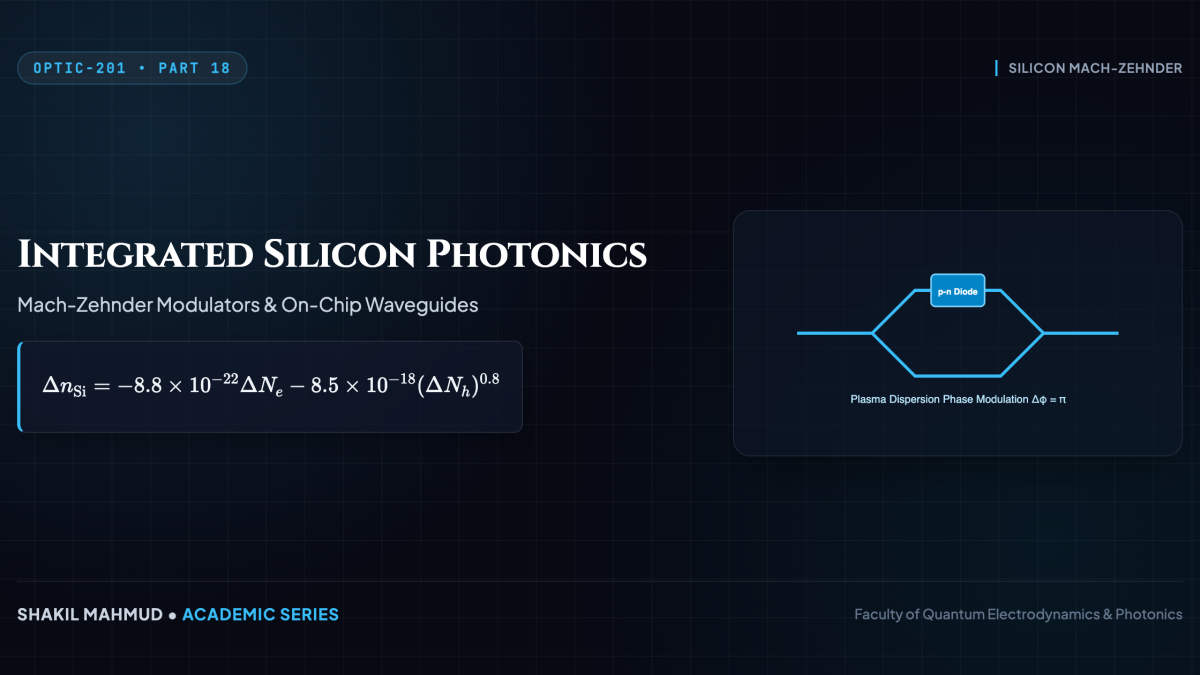
Delta n = -8.8 imes 10^{-22} Delta N_e – 8.5 imes 10^{-18} (Delta N_h)^{0.8}
]
[
Delta alpha = 8.5 imes 10^{-18} Delta N_e + 6.0 imes 10^{-18} Delta N_h
]
To modulate carriers at gigahertz frequencies, waveguides incorporate reverse-biased p-n junction diodes. Modulating the reverse bias sweeps the carrier depletion width across the optical mode volume in picoseconds, producing ultra-fast refractive index shifts with zero static DC power consumption.
3. Mach-Zehnder Optical Modulators (MZM)
To translate carrier-induced phase shifts into high-contrast optical intensity modulation, waveguides are arranged in a balanced Mach-Zehnder Interferometer (MZI). An input 50:50 directional coupler splits laser light into two parallel waveguide arms of length (L):
[
E_{ ext{out}} = rac{1}{2} E_{ ext{in}} left( e^{i phi_1} + e^{i phi_2}
ight) = E_{ ext{in}} e^{i bar{phi}} cosleft( rac{Delta phi}{2}
ight)
]
where (Delta phi = phi_1 – phi_2 = rac{2pi}{lambda} Delta n_{ ext{eff}} L). The transmitted optical power varies sinusoidally with phase differential:
[
P_{ ext{out}} = P_{ ext{in}} cos^2left(rac{Delta phi}{2}
ight)
]
When (Delta phi = pi), destructive interference completely extinguishes the output. The performance figure of merit is the voltage-length product (V_pi L), typically (V_pi L sim 1 ext{–}2 ext{ V} cdot ext{cm}). Traveling-wave electrode designs synchronize the RF electrical signal velocity with the optical group velocity, achieving electro-optic modulation bandwidths exceeding (100 ext{ GHz}) and supporting (400 ext{G}) and (800 ext{G}) optical transceiver modules.
4. Co-Packaged Optics (CPO) and AI Data Centers
Modern Large Language Model (LLM) training clusters demand massive inter-GPU interconnect bandwidth. Traditional pluggable optical transceivers suffer from excessive parasitic capacitance across printed circuit boards. The state of the art deploys Co-Packaged Optics (CPO): integrating silicon photonic dies directly onto the same multi-chip substrate package as GPU compute engines.
Optical fibers plug directly into the GPU package, cutting interconnect energy consumption from (20 ext{ pJ/bit}) to sub-(2 ext{ pJ/bit}), unlocking the exascale bandwidth demanded by frontier generative artificial intelligence.