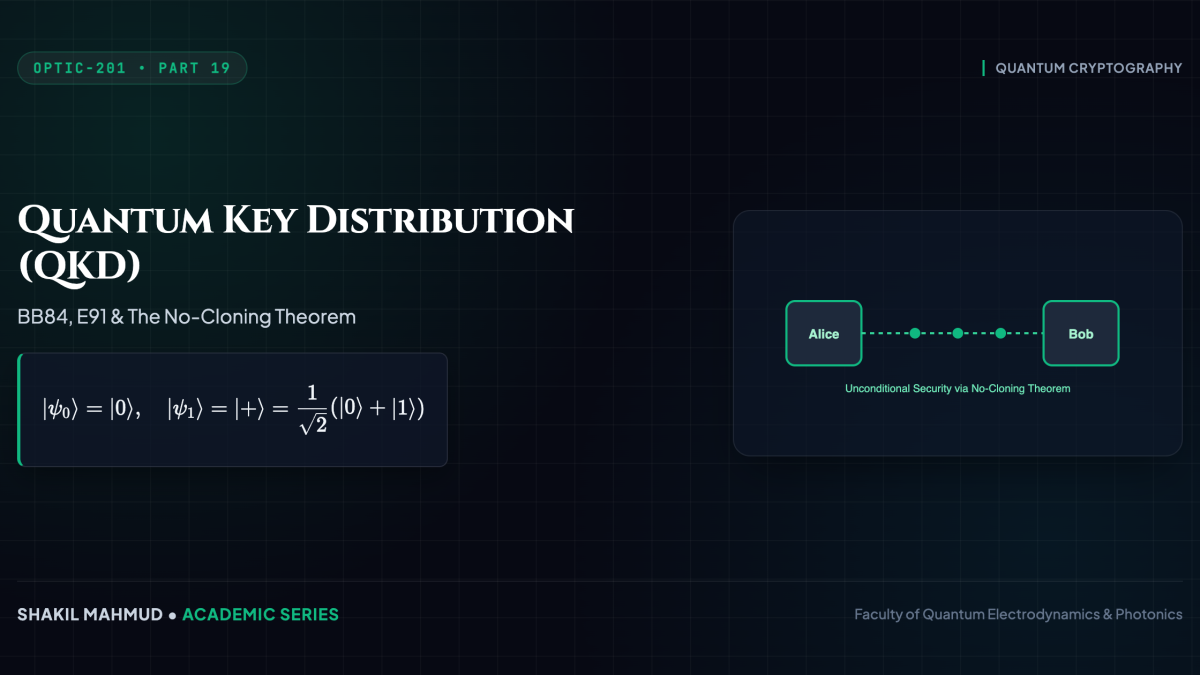
Classical cryptographic security—including RSA and elliptic-curve cryptography—relies on unproven computational complexity assumptions, such as the difficulty of prime factorization. Peter Shor’s 1994 quantum algorithm proved that a fault-tolerant quantum computer will obliterate classical public-key cryptography. In response, quantum optics developed an uncrackable shield: Quantum Key Distribution (QKD). Protected by the immutable laws of quantum mechanics—the Heisenberg uncertainty principle and the No-Cloning Theorem—QKD enables two parties to synthesize secret cryptographic keys with absolute information-theoretic security.
1. Fundamental Physical Principles of Quantum Cryptography
Quantum cryptographic security is rooted in two foundational theorems of quantum electrodynamics:
- The No-Cloning Theorem (Wootters & Zurek, 1982): An arbitrary unknown quantum state (|psi
angle) cannot be cloned identically by any unitary quantum operation (hat{U}). If an eavesdropper (“Eve”) attempts to clone the state onto an ancilla (|e
angle), linearity requires:
[
hat{U}(|psi
angle |e
angle) = |psi
angle |psi
angle quad ext{and} quad hat{U}(|phi
angle |e
angle) = |phi
angle |phi
angle
]
Taking the inner product yields (langle psi | phi
angle = (langle psi | phi
angle)^2), which is satisfied strictly if and only if (langle psi | phi
angle = 0) or (1). Thus, non-orthogonal quantum states cannot be duplicated without perturbing the original state. - Measurement Collapse: Projective measurement of a quantum superposition unavoidably disturbs the state, leaving an indelible physical footprint that legitimate communicators (“Alice” and “Bob”) detect immediately.
2. The Bennett-Brassard 1984 (BB84) Protocol
The BB84 protocol executes secret key distribution using single photons prepared in four polarization states spanning two mutually unbiased bases (MUB):
- Rectilinear Basis ((oplus)): (|H
angle quiv |0
angle), (|V
angle quiv |1
angle) - Diagonal Basis ((otimes)): (|D
angle = rac{1}{sqrt{2}}(|H
angle + |V
angle) quiv |0
angle), (|A
angle = rac{1}{sqrt{2}}(|H
angle – |V
angle) quiv |1
angle)
The transmission occurs in sequential phases:
- Transmission: Alice generates a random bit sequence, randomly selects basis (oplus) or (otimes) for each bit, and transmits a polarized single photon to Bob across an optical fiber.
- Measurement: Bob randomly and independently chooses basis (oplus) or (otimes) for each arriving photon and records his detection outcomes.
- Sifting: Over an authenticated public classical channel, Alice and Bob announce the bases they used for each photon (without disclosing the bit values). They discard all instances where their bases mismatched ((50%) sifted key retention).
- Eavesdropping Detection and QBER: Alice and Bob publicly compare a subset of their sifted bits to calculate the Quantum Bit Error Rate (QBER):
[
ext{QBER} = rac{N_{ ext{error}}}{N_{ ext{total}}}
]
If Eve intercepted photons using an intercept-resend attack, she chose the wrong basis with probability (1/2), producing an unavoidable minimum QBER of (25%). If the measured QBER is below the Shor-Preskill security threshold (( ext{QBER} < 11.0%)), Alice and Bob execute error correction (Cascade protocol) and privacy amplification (universal hashing), extracting a shorter, absolutely secret key.
3. Entanglement-Based QKD: The Ekert91 (E91) Protocol
In Artur Ekert’s 1991 protocol, Alice and Bob do not transmit prepared single photons. Instead, an entangled source distributes polarization-entangled Bell pairs (|Phi^+
angle = rac{1}{sqrt{2}}(|H
angle_A |H
angle_B + |V
angle_A |V
angle_B)). Alice and Bob measure their respective photons along three different analyzer angles.
To detect eavesdropping, they calculate the Clauser-Horne-Shimony-Holt (CHSH) Bell parameter (S):
[
S = |E(a_1, b_1) – E(a_1, b_2) + E(a_2, b_1) + E(a_2, b_2)| le 2sqrt{2} approx 2.828
]
If Eve attempts any measurement, the quantum entanglement is destroyed; the system collapses into a classical mixture, reducing (S le 2). A violation of Bell’s inequality ((S > 2)) provides device-independent mathematical proof that the channel is uncompromised and the generated key is pure.
4. Quantum Repeaters and Satellite-to-Ground Links
Because the No-Cloning Theorem forbids conventional optical amplifiers (EDFA), fiber attenuation restricts terrestrial QKD to (sim 500 ext{–}800 ext{ km}). To bridge continental distances, quantum engineers deploy Quantum Repeaters (combining quantum memory and entanglement swapping) and free-space Satellite-to-Ground Quantum Links (e.g., the Micius satellite), establishing a global quantum internet.