On the night of March 25, 1971, the Pakistan military unleashed a campaign of industrial-scale slaughter against the unarmed civilian population of East Bengal under the codename Operation Searchlight. Before his arrest in the early hours of March 26, Bangabandhu Sheikh Mujibur Rahman formally proclaimed the independence of Bangladesh. Over nine harrowing months, the people of Bengal endured one of the worst genocides of the 20th century: three million slaughtered, hundreds of thousands of women violated, and ten million driven into refugee exile. Guided by the Mujibnagar Government, the gallant freedom fighters of the Mukti Bahini waged an epic guerrilla war that culminated on December 16, 1971, with the unconditional surrender of 93,000 Pakistani troops in Dhaka, birthing the sovereign People’s Republic of Bangladesh.
1. Operation Searchlight and the Declaration of Independence
At 11:30 PM on Thursday, March 25, 1971, heavily armed mechanized columns of the Pakistan Army—commanded by Lieutenant General Tikka Khan—rolled out of Dhaka Cantonment into the sleeping streets of the city. Tanks, armored personnel carriers, and heavy artillery pulverized the dormitories of Dhaka University (specifically Jagannath Hall, Iqbal Hall, and Rokeya Hall), slaughtering hundreds of sleeping students and eminent professors including Dr. G.C. Dev, Dr. A.N.M. Maniruzzaman, and Jyotirmoy Guhathakurta.
Concurrently, Pakistani commandos attacked the Rajarbagh Police Lines, where patriotic Bengali policemen offered fierce resistance with antiquated .303 rifles until overwhelmed by artillery, while the East Pakistan Rifles (EPR) headquarters at Peelkhana and the Hindu neighbourhoods of Old Dhaka were firebombed into ash. British journalist Simon Dring of The Daily Telegraph, who evaded military censors by hiding in the lobby of the Hotel InterContinental, slipped out into the smoking ruins at dawn, sending the first eyewitness dispatch to the horrified world: “In the name of ‘God and a united Pakistan’, Dacca is today a crushed and frightened city… at least 7,000 people have been murdered.”
The Midnight Proclamation of March 26
Moments before Pakistani commandos stormed his Dhanmondi 32 residence at approximately 1:00 AM on March 26, Bangabandhu sent his historic, formal Declaration of Independence via special wireless transmitter to Chittagong:
“This may be my last message: from today Bangladesh is independent. I call upon the people of Bangladesh, wherever you might be and with whatever you have, to resist the army of occupation to the last. Your fight must go on until the last soldier of the Pakistan occupation army is expelled from the soil of Bangladesh and final victory is achieved. Joy Bangla.”
— Bangabandhu Sheikh Mujibur Rahman (March 26, 1971)
The declaration was broadcast over Swadhin Bangla Betar Kendra from Kalurghat in Chittagong by Awami League leader M. A. Hannan on the afternoon of March 26, and repeated on March 27 on Bangabandhu’s behalf by Major Ziaur Rahman, galvanizing nationwide armed resistance.
2. The 1971 Genocide and the Mujibnagar Government
Over the subsequent nine months, the Pakistani military—aided by local fanatic auxiliary death squads (Razakars, Al-Badr, and Al-Shams)—conducted a systematic campaign of extermination targeting Bengali intellectuals, youth, and the Hindu minority. Over three million Bengalis were murdered, an estimated 200,000 to 400,000 women were subjected to horrific wartime sexual violence, and ten million refugees crossed the borders into makeshift relief camps in India, while thirty million were internally displaced. Journalist Anthony Mascarenhas stunned global conscience with his explosive exposé in London’s The Sunday Times on June 13, 1971, titled simply: “Genocide”.
To provide constitutional legitimacy, strategic command, and diplomatic leadership, the elected representatives of Bangladesh assembled in a mango grove at Baidyanathtala (Meherpur) on April 17, 1971, formally establishing the Mujibnagar Government. The historic Proclamation of Independence was adopted, naming Bangabandhu Sheikh Mujibur Rahman as President, Syed Nazrul Islam as Acting President, and Tajuddin Ahmad as Prime Minister. With visionary statesmanship, Tajuddin Ahmad organized civil administration, relief coordination, and international diplomacy.
3. The Mukti Bahini and Operation Jackpot
Under Commander-in-Chief General M. A. G. Osmani, the military theater of Bangladesh was partitioned into eleven operational sectors, alongside specialized brigade groups (Z-Force, K-Force, S-Force). Over 100,000 young freedom fighters—comprising university students, peasants, workers, and defecting Bengali soldiers of the East Bengal Regiment—trained in camps along the Indian border to form the heroic Mukti Bahini.
Waging unconventional guerrilla warfare in the monsoon-swollen rivers and paddy fields, the Mukti Bahini bled the Pakistani occupation forces white:
- Operation Jackpot (August 15, 1971): In a daring, synchronized amphibious commando raid, 148 naval commando freedom fighters—swimming underwater at midnight armed with limpet mines—infiltrated Chittagong, Mongla, Chandpur, and Narayanganj ports. They simultaneously blew up and sank twenty-six Pakistani gunboats, supply ships, and ocean freighters, disabling the occupation army’s naval logistical supply lines and stunning international observers.
- The Dhaka Crack Platoon: A legendary urban guerrilla unit operating deep inside the occupied capital, carrying out audacious daylight grenade attacks on Pakistani military checkpoints, hotels, and power transformers (immortalized by the martyrdom of Shafi Imam Rumi, son of Shahid Janani Jahanara Imam).
4. The Killing of the Intellectuals and Final Victory (December 16, 1971)
On December 3, 1971, Pakistan launched preemptive airstrikes on northwestern Indian airfields, transforming the conflict into the Indo-Pakistani War of 1971. India and the Mujibnagar Government formed the Joint Allied Command (Mitro Bahini) under Lieutenant General Jagjit Singh Aurora. Cracking Pakistani fortified defensive lines with lightning speed, Allied tanks and airborne brigades advanced relentlessly toward Dhaka from east, north, and west.
Sensing impending military annihilation, the Pakistani military command—guided by Major General Rao Farman Ali and executed by Al-Badr death squads—orchestrated a barbaric final crime: The Martyred Intellectuals Massacre. Between December 10 and 14, masked death squads abducted hundreds of Bengal’s foremost professors, physicians, journalists, and philosophers—including Munier Choudhury, Dr. G.C. Dev, Dr. Alim Chowdhury, Shahidullah Kaiser, and Selina Parvin—blindfolded them, brutally tortured them, and bayoneted them to death in the muddy brick kilns of Rayerbazar and Mirpur, aiming to intellectually paralyze the newborn nation.
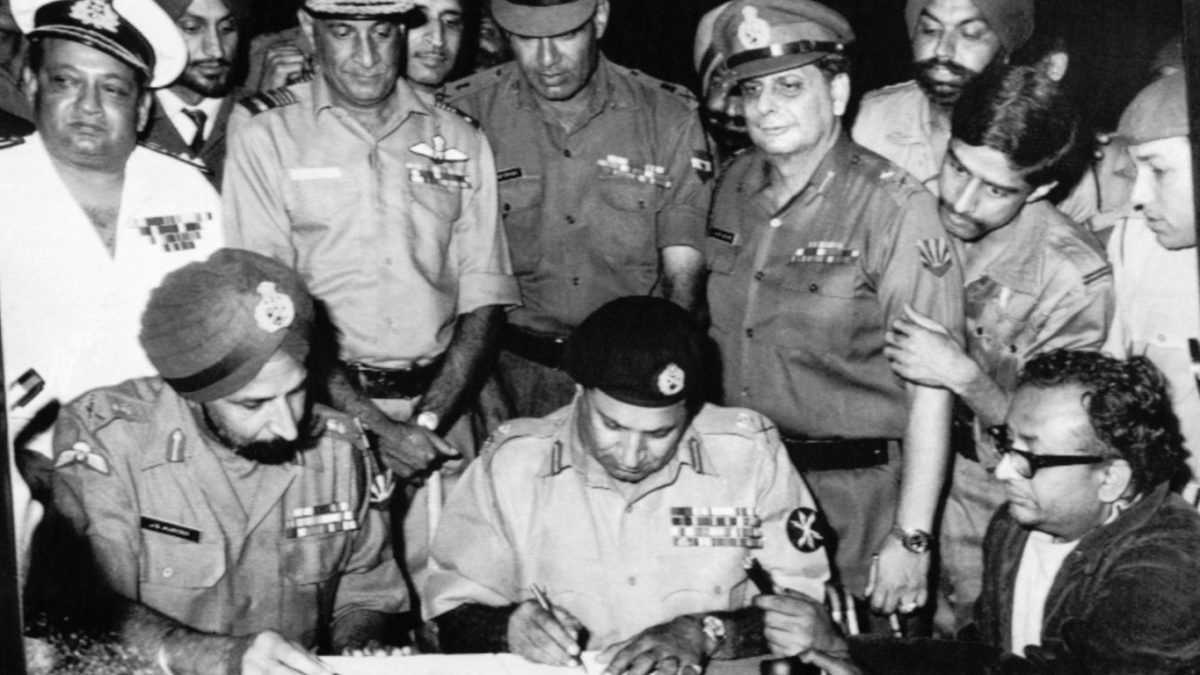
On the afternoon of December 16, 1971, surrounded on all sides and under constant aerial bombardment, Lieutenant General A. A. K. Niazi, commander of the Pakistan Eastern Command, surrendered unconditionally. At 4:31 PM at the Dhaka Racecourse Ground, Niazi signed the historic Instrument of Surrender before Lieutenant General Jagjit Singh Aurora, while Air Vice Marshal A. K. Khandker represented the Mukti Bahini.
93,000 Pakistani soldiers and officers laid down their arms—the largest military capitulation in the world since the Fall of Berlin in World War II. As millions of weeping, jubilant citizens flooded the streets chanting “Joy Bangla!”, the sovereign, democratic People’s Republic of Bangladesh took its rightful place among the nations of the earth.
Primary Academic References
- Bass, G. J. (2013). The Blood Telegram: Nixon, Kissinger, and a Forgotten Genocide. Alfred A. Knopf.
- Raghavan, S. (2013). 1971: A Global History of the Creation of Bangladesh. Harvard University Press.
- Mascarenhas, A. (1971). The Rape of Bangla Desh. Vikas Publications, Delhi.
- Islam, Rafiqul. (1974). A Tale of Millions: Bangladesh Liberation War 1971. Adeylebros & Co., Dacca.
- Khandker, A. K. (2014). 1971: Bhetore Baire. Prothoma Prokashon, Dhaka.