The aftermath of the Battle of Plassey inaugurated a century of predatory economic extraction, institutionalized de-industrialization, and human catastrophe under the British East India Company. Following the Battle of Buxar in 1764, the Mughal Emperor granted the Company the Diwani (revenue collecting rights) over Bengal in 1765, establishing Robert Clive’s ruthless “Dual Government.” Within five years, this unbridled extortion produced the apocalyptic Great Bengal Famine of 1770, which slaughtered ten million souls. Yet the people of Bengal did not suffer in silence; from the Sannyasi-Fakir rebellion to Titumir’s heroic Bamboo Fortress, the Santhal Hool, and the Sepoy Mutiny of 1857, the soil of Bengal ran red with revolutionary resistance.
1. The Diwani of 1765 and the “Plunder of Bengal”
Following the defeat of the allied armies of Mir Qasim (Nawab of Bengal), Shuja-ud-Daula (Nawab of Awadh), and the Mughal Emperor Shah Alam II at the Battle of Buxar in October 1764, the British East India Company ceased to be a mere commercial merchant. On August 12, 1765, in a ceremonial tent at Allahabad, Emperor Shah Alam II signed over the Diwani—the perpetual right to collect the entire civil land revenue of Bengal, Bihar, and Orissa—to Robert Clive.
Clive instituted the notorious Dual System of Governance (দ্বৈত শাসন): the British collected the entire revenues of the state without assuming any administrative responsibility for public welfare, while the puppet Nawab retained nominal criminal administration without a single rupee of independent revenue. British revenue extraction skyrocketed: land taxes were ruthlessly doubled and trebled, while company servants monopolized essential commodities like salt, grain, and betel nut, sending hundreds of millions of silver pounds back to London—an economic haemorrhage famously termed the “Drain of Wealth”.
2. The Great Bengal Famine of 1770 (Chhiyattorer Monnontor)
When the monsoon rains failed in 1769, the predatory nature of Company rule resulted in the worst demographic catastrophe in Asian history: the Great Bengal Famine of 1770 (বাংলা ১১৭৬ সনের ছিয়াত্তরের মন্বন্তর). Rather than remitting land taxes or releasing grain reserves, the Company’s revenue supervisors violently forced starving peasants to pay their full assessments at bayonet point, while hoarding rice in river warehouses to sell at astronomical wartime black-market profits.
The result was apocalyptic. Over ten million people—fully one-third of Bengal’s entire population—perished from agonizing starvation and pestilence. Entire villages were depopulated, fertile rice fields reverted to wild jungle roamed by tigers, and corpses choked the Hooghly, Padma, and Buriganga rivers. Yet in its official dispatches to London, the Court of Directors cold-bloodedly boasted that despite the death of a third of the inhabitants, revenue collection in 1771 exceeded that of the previous year!
3. Cornwallis and the Permanent Settlement of 1793
To secure a loyal political aristocracy and guarantee an unalterable annual revenue, Governor-General Lord Cornwallis enacted the Permanent Settlement (চিরস্থায়ী বন্দোবস্ত) in 1793. This revolutionary legislation fundamentally restructured rural property relations:
- Traditional tax collectors and court favourites were arbitrarily declared the permanent, hereditary absolute proprietors (Zamindars) of the land.
- The indigenous peasantry (*Ryots*), who had enjoyed customary hereditary usufruct rights over the soil for millennia, were overnight reduced to vulnerable, landless tenant farmers subject to arbitrary eviction, illegal cesses (*Abwabs*), and usurious rural moneylenders (*Mahajans*).
- If a Zamindar failed to pay his fixed revenue to the British collector by sunset on the designated day (the *Sunset Law*), his estate was auctioned off, leading to the rise of an absentee, urban landlord class based in Calcutta with zero organic connection to the agrarian delta.
4. Grassroots Rebellions: Sannyasi-Fakir to Titumir
Confronted with intolerable oppression, peasant communities across Bengal took up arms in repeated insurrections:
- The Sannyasi-Fakir Rebellion (1763–1800): Led by ascetics and dispossessed peasants under leaders like Majnu Shah, Bhavani Pathak, and Devi Chaudhurani. Operating from northern Bengal’s dense river forests, these guerrilla bands attacked Company treasuries, ambushed British patrols, and distributed grain to starving villagers.
- Titumir and the Bamboo Fortress (Bansher Kella, 1831): In 24 Parganas, Syed Mir Nisar Ali (Titumir) organized oppressed Muslim and Hindu peasants against British indigo planters (*Neelkor*) and tyrannical zamindars like Krishna Dev Roy, who levied humiliating punitive taxes on Muslim beards. At Narkelbaria, Titumir erected a formidable Bamboo Fortress (Bansher Kella) and declared an independent peasant republic. On November 19, 1831, a heavily armed British military regiment commanded by Major Scott stormed the fort with artillery. Titumir died heroically in battle, cementing his status as an immortal martyr of anti-colonial resistance.
- The Faraizi Movement: Founded by Haji Shariatullah and led by his charismatic son Dudu Miyan (Muhsinuddin Ahmad) in Faridpur and Madaripur. Dudu Miyan organized peasant panchayats and boldly proclaimed: “The earth is the creation of Almighty God; no zamindar has a moral right to impose taxes upon it.”
- The Santhal Hool (1855): Led by the four heroic brothers Sidhu, Kanhu, Chand, and Bhairav, tens of thousands of Santhal indigenous peasants in the Rajmahal hills rose up with bows and arrows against British tax officials and rapacious moneylenders, fighting with desperate courage before being brutally crushed by British muskets.
5. The 1857 Sepoy Mutiny in Bengal
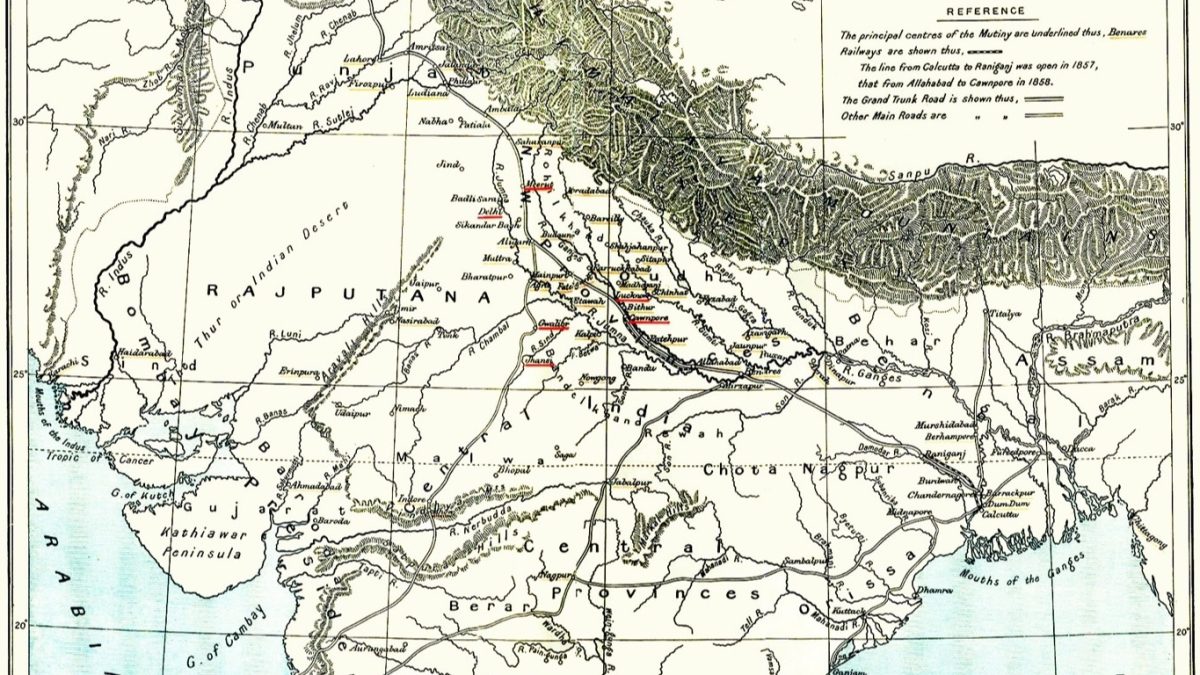
A century after Plassey, the simmering rage of the Indian soldier erupted into the First War of Independence / Sepoy Mutiny of 1857. The first spark was struck on Bengal’s soil: on March 29, 1857, at the military cantonment of Barrackpore, Sepoy Mangal Pandey of the 34th Bengal Native Infantry openly fired upon his British officers, calling upon his comrades to rise up against foreign tyranny.
The rebellion spread rapidly across eastern Bengal. In Dhaka, on November 22, 1857, sepoys of the 73rd Native Infantry stationed at Lalbagh Fort refused to surrender their weapons to British naval detachments. A fierce, bloody battle raged across the ramparts of Lalbagh Fort; dozens of sepoys were killed, and forty-one captured freedom fighters were brutally executed by hanging in public from trees at Antaghar Maidan (modern Victoria Park / Bahadur Shah Park) to terrorize the local citizenry. Though crushed by imperial might, the 1857 uprising ended East India Company rule forever, forcing the British Crown to assume direct imperial control over the subcontinent.
Primary Academic References
- Hunter, W. W. (1868). The Annals of Rural Bengal. Smith, Elder & Co., London.
- Chandra, B. (1966). The Rise and Growth of Economic Nationalism in India. People’s Publishing House.
- Guha, R. (1983). Elementary Aspects of Peasant Insurgency in Colonial India. Oxford University Press.
- Sen, S. N. (1957). Eighteen Fifty-Seven. Ministry of Information & Broadcasting, Government of India.
- Bhadra, G. (1985). Four Rebels of Eighteen-Fifty-Seven. Subaltern Studies IV, Oxford University Press.