In the middle of the 8th century CE, exhausted by a hundred years of lawless chaos during Matsyanyayam, the people and chieftains of Bengal achieved an extraordinary constitutional act: they united to elect an able warrior named Gopala as their king. This election birthed the glorious Pala Empire, a four-hundred-year Buddhist dynasty (c. 750–1161 CE) that transformed Bengal into an imperial superpower spanning northern India, patronized the grandest monastic universities in the Buddhist world, fostered the philosophical mission of Atisa Dipankara to Tibet, and nurtured the linguistic birth of the Bengali vernacular in the mystic songs of the Charyapada.
1. The Election of Gopala and the Khalimpur Charter
The accession of Gopala I around 750 CE is documented in the famous Khalimpur Copperplate Inscription issued during the 32nd regnal year of his son, Emperor Dharmapala. It contains one of the most famous political passages in ancient epigraphy:
“Matsyanyayam apohitum prakritibhir lakshmya karam grahitah sri gopala iti kshitisa-siromanir ajani tasmadanurupa-guna-ganah…”
(“To put an end to the state of Matsyanyayam [the law of the fish], the general populace [prakritayah] made him take the hand of royal fortune—Gopala, the crest-jewel of rulers, endowed with all matching virtues.”)
— Khalimpur Copperplate Inscription (c. 785 CE)
This remarkable passage indicates that Gopala was neither an invasive conqueror nor a hereditary despot; his legitimacy rested upon a consensus of regional nobles and representatives of the people (*Prakriti*), seeking salvation from anarchy. Gopala unified Varendra, Gauda, and Vanga, establishing institutional order and military cohesion.
2. The Imperial Zenith: Dharmapala and Devapala
Under Gopala’s illustrious son, Dharmapala (r. c. 770–810 CE), the Pala state transformed from a regional kingdom into the dominant imperial power of northern India. Dharmapala marched up the Gangetic plains, capturing Kannauj and deposing its ruler Indrayudha. At Kannauj, Dharmapala held a magnificent imperial durbar attended by the kings of Bhoja, Matsya, Madra, Kuru, Yadu, Avanti, and Gandhara, assuming the paramount imperial title Paramabhattaraka Maharajadhiraja Paramesvara.
This expansion pulled Bengal into the epic Tripartite Struggle for imperial mastery over northern India against the Gurjara-Pratiharas of Rajasthan and the Rashtrakutas of the Deccan. Under Dharmapala’s son, Devapala (r. c. 810–850 CE), the Pala Empire reached its maximum territorial expanse. His Badal pillar inscription records victorious campaigns extending to the foot of the Himalayas, the shores of the southern ocean, the Kamarupa borders in the east, and the Kambojas in the northwest.
3. Somapura Mahavihara and the Buddhist Renaissance
Devout patrons of Mahayana and Vajrayana Buddhism, the Pala emperors poured vast imperial resources into monastic universities that attracted scholars from all over Asia:
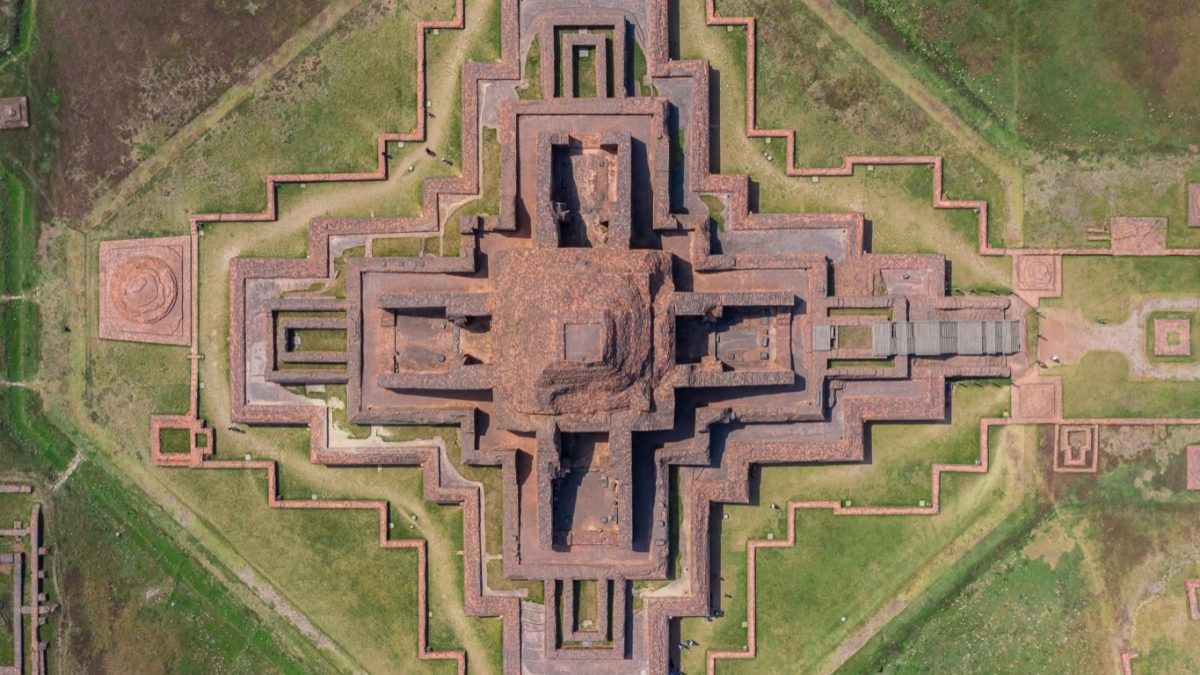
- Somapura Mahavihara (Paharpur, Naogaon): Founded by Dharmapala (*Sri-Dharmapaladeva-mahavihare* stamped on terracotta sealings), this colossal monastery covers 27 acres. Its monumental cross-shaped central temple rises through terraced brick levels adorned with over 2,800 terracotta plaques depicting dancers, ascetics, archers, and animals. It served as the architectural prototype for the great temples of Pagan in Myanmar and Prambanan in Java.
- Vikramasila and Odantapuri: Renowned centers of esoteric Buddhist philosophy and translation in Bihar, heavily patronized by the Bengal throne.
- International Diplomacy: The Nalanda Copperplate of Devapala records that King Balaputradeva of the maritime Sailendra Empire of Sumatra/Java built a monastery at Nalanda and requested Devapala to grant five villages for its perpetual maintenance, illustrating Bengal’s maritime stature.
Atisa Dipankara Srijnana (982–1054 CE)
From Vajrayogini in Vikrampur, Bengal, emerged one of the most revered philosopher-monks in world history: Atisa Dipankara Srijnana. Having mastered Buddhist dialectics at Nalanda and Odantapuri and studied in Sumatra, Atisa served as the chancellor of Vikramasila. In 1040 CE, responding to urgent invitations from the King of Western Tibet (Guge), the elderly master crossed the frozen Himalayan passes. He cleansed and reformed Tibetan Buddhism, authoring the foundational text Bodhipathapradipa (Lamp for the Path to Enlightenment). His memory is venerated across the Himalayas and East Asia to this day.
4. The Charyapada: The Genesis of Bengali
The Pala period witnessed not only imperial and religious splendor, but the revolutionary birth of the Bengali language. Around the 10th to 12th century, Buddhist Mahasiddhas—tantric poet-yogis including Luipa, Kanhapa, Bhusukupa, and Sarahapa—composed mystic songs known as the Charyapada (চর্যাপদ).
Discovered in 1907 by Mahamahopadhyaya Haraprasad Shastri in the Royal Court Library of Nepal, these 46 surviving palm-leaf hymns represent the earliest documented specimen of Old Bengali. Written in a twilight symbolic language (Sandhya Bhasha), the poems use the everyday metaphors of Bengal’s riverine life—ferry boats, bamboo bridges, cotton carding, fishing nets, and hunter tribes—to convey profound non-dual esoteric meditation:
“কাআ তরুবর পঞ্চ বি ডাল। চঞ্চল চীএ পইঠো কাল॥”
(“The body is a noble tree with five branches [senses]; into the restless mind enters death/time.”)
— Luipa, Charyapada (Song 1)
In the Charyapada, the Bengali tongue took its first sovereign breath, speaking directly of the lives, tools, rivers, and spiritual yearnings of ordinary Bengalis. Through four glorious centuries, the Pala Empire laid the indelible cultural, spiritual, and linguistic foundation upon which modern Bengal stands.
Primary Academic References
- Majumdar, R. C. (1943). History of Bengal: Volume I — Hindu Period. University of Dacca.
- Kielhorn, F. (1896). The Khalimpur Plate of Dharmapaladeva. Epigraphia Indica, IV, 243–254.
- Shastri, H. (1916). Hajar Bachharer Purana Bangala Bhasay Rachita Bauddhagan O Doha. Bangiya Sahitya Parishat.
- Chatterji, S. K. (1926). The Origin and Development of the Bengali Language. Calcutta University Press.
- Altekar, A. S. (1934). The Rashtrakutas and Their Times. Oriental Book Agency.