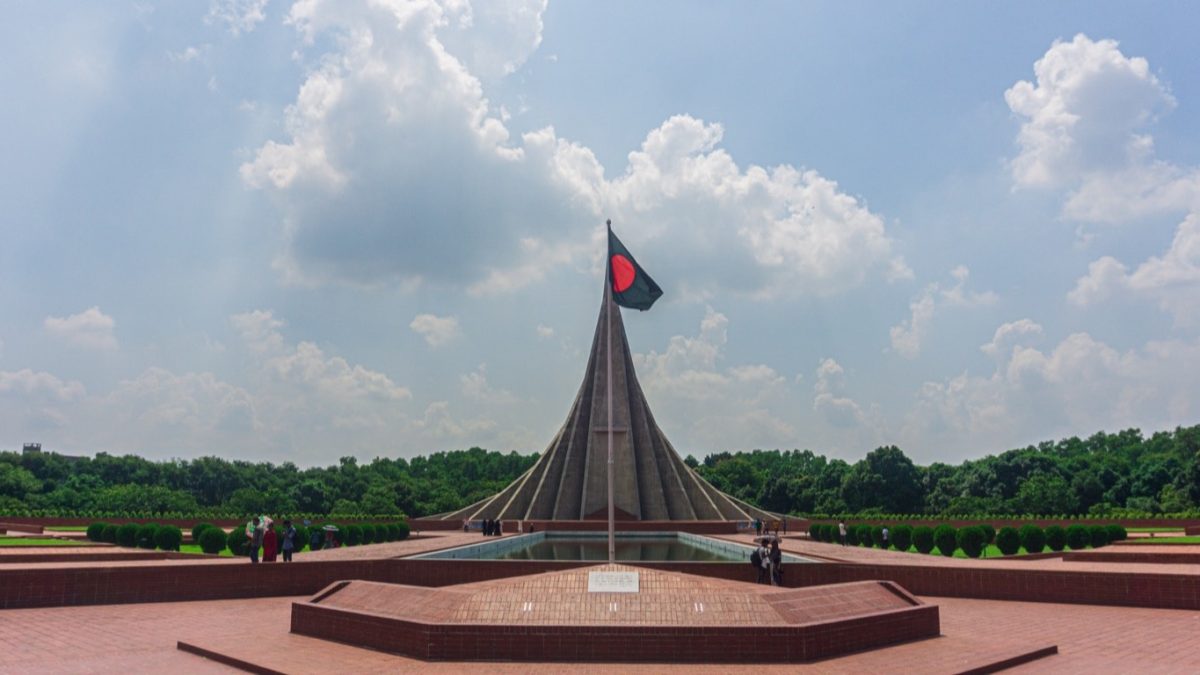
The dawn of sovereign Bangladesh on December 16, 1971, brought both supreme national pride and immense existential challenges. Emerging from the ashes of genocidal devastation, the new republic possessed empty state coffers, destroyed infrastructure, mined ports, and ten million traumatized returnees. On January 10, 1972, Bangabandhu Sheikh Mujibur Rahman returned from Pakistani captivity to lead the monumental task of nation-building. Yet the subsequent three decades were marked by turbulent political storms: the catastrophic assassination of Bangabandhu on August 15, 1975, protracted military rule under Ziaur Rahman and H. M. Ershad, the triumphant 1990 Mass Uprising that restored parliamentary democracy, and an extraordinary grassroots economic resilience led by the readymade garment sector and pioneering microfinance institutions.
1. Bangabandhu’s Homecoming and the 1972 Constitution
Released unconditionally from Mianwali prison in Pakistan under intense international pressure, Bangabandhu Sheikh Mujibur Rahman returned to sovereign Dhaka on January 10, 1972, via London and New Delhi. Weeping before millions of ecstatic citizens at the Racecourse Ground, Bangabandhu took charge of a nation that international skeptics (notably US Secretary of State Henry Kissinger’s aides) infamously dismissed as a “bottomless basket”.
Within an astonishingly brief period of ten months, Bangladesh drafted and enacted one of the most progressive constitutional frameworks in the post-colonial world: the 1972 Constitution of Bangladesh. Crafted by a committee chaired by Dr. Kamal Hossain, the constitution enshrined four core Fundamental Principles of State Policy:
- Nationalism: Rooted in Bengali linguistic, cultural, and historic identity.
- Socialism: Emphasizing social justice, equitable distribution of wealth, and an exploitation-free society.
- Democracy: Universal adult franchise, human rights, and rule of law.
- Secularism: Eliminating communal discrimination and guaranteeing equal freedom for all religions.
Concurrently, Bangabandhu achieved the withdrawal of all Indian military troops by March 1972, secured recognition from over 130 nations, and brought Bangladesh into the United Nations in September 1974.
2. Post-War Crises and the Tragedy of August 15, 1975
Reconstruction, however, was buffeted by colossal headwinds: global oil shocks, consecutive catastrophic floods in 1974, smuggling, administrative corruption, and a devastating post-war famine. Faced with severe economic distress and armed underground insurgency, Bangabandhu amended the constitution in early 1975, establishing a presidential system and the one-party national platform known as BAKSAL (Bangladesh Krishak Sramik Awami League), aiming to execute his “Second Revolution” for compulsory agricultural cooperatives, administrative decentralization, and corruption eradication.
Before these socio-economic reforms could take root, tragedy struck. In the pre-dawn darkness of August 15, 1975, a cabal of reactionary military officers and conspirators stormed Bangabandhu’s residence at Dhanmondi 32. In an act of savage brutality, they assassinated the Father of the Nation, his wife Bangamata Begum Fazilatunnesa Mujib, his three sons (Sheikh Kamal, Sheikh Jamal, and ten-year-old Sheikh Russell), his daughters-in-law, and close family members. Only his two daughters, Sheikh Hasina and Sheikh Rehana, survived because they were traveling in West Germany.
On November 3, 1975, the conspirators committed another monstrous crime inside Dhaka Central Jail: the execution of the Four National Leaders who had steered the 1971 Liberation War—Syed Nazrul Islam, Tajuddin Ahmad, Captain M. Mansur Ali, and A. H. M. Qamaruzzaman.
3. Military Regimes: Ziaur Rahman and H. M. Ershad
Following chaotic counter-coups, Major General Ziaur Rahman emerged as the strongman of the state following the November 7, 1975 soldier-citizen uprising. Zia introduced the concept of “Bangladeshi Nationalism” to replace secular Bengali nationalism, amended the constitution through the Fifth Amendment, founded the Bangladesh Nationalist Party (BNP), promoted free-market capitalism, and pioneered the founding of the South Asian Association for Regional Cooperation (SAARC). Zia survived multiple military coup attempts before being assassinated in an abortive military rebellion in Chittagong on May 30, 1981.
In March 1982, Army Chief Lieutenant General Hussain Muhammad Ershad seized power in a bloodless coup, instituting eight years of autocratic military rule. Ershad introduced the decentralized Upazila local governance system and amended the constitution (Eighth Amendment, 1988) to declare Islam the State Religion, while suppressing democratic opposition through electoral manipulation.
4. The 1990 Mass Uprising and Democratic Restoration
Throughout the late 1980s, democratic resistance against Ershad’s military regime escalated under two prominent female leaders: Begum Khaleda Zia (leading the 7-Party Alliance) and Sheikh Hasina (leading the 8-Party Alliance). In late 1990, the movement erupted into the historic 1990 Mass Uprising (Noroboi-er Gano Obhyutthan), spearheaded by the All-Party Student Alliance (Shorbodoliyo Chhatro Oikyo).
Following the martyrdom of student activist Naziruddin Jehad and medical leader Dr. Shamsul Alam Khan Milon, millions of citizens paralyzed the country with continuous general strikes. Ershad was forced to resign on December 6, 1990, handing power to an interim government headed by Chief Justice Shahabuddin Ahmed. In February 1991, Bangladesh held free, fair parliamentary elections, restoring the parliamentary system of governance through the landmark Twelfth Amendment.
5. Grassroots Miracles: RMG, Microfinance, and Social Development
Amid political polarization during the 1990s and alternating administrations of Khaleda Zia (1991–1996, 2001–2006) and Sheikh Hasina (1996–2001), Bangladesh quietly executed an economic and social transformation that astonished international developmental economists:
- The Ready-Made Garment (RMG) Revolution: Beginning with modest pioneers like Desh Garments, Bangladesh became the second-largest apparel exporter on Earth. Employing over four million workers—the vast majority rural young women—the RMG sector triggered a profound demographic and socio-cultural empowerment of women across traditional village societies.
- Microfinance and Grassroots Empowerment: Pioneered by Professor Muhammad Yunus and the Grameen Bank, microcredit revolutionized the global understanding of poverty alleviation by demonstrating that poor women are bankable and entrepreneurial, culminating in the award of the Nobel Peace Prize in 2006 to Yunus and Grameen Bank. Simultaneously, Sir Fazle Hasan Abed built BRAC into the largest non-governmental development organization in the world, pioneering community-based oral rehydration therapy, non-formal primary schools, and ultra-poor graduation programs.
- The Bangladesh Paradox: Despite governance challenges and natural hazards, Bangladesh steadily outperformed its regional peers—including India and Pakistan—in critical Human Development Indicators (HDI), achieving dramatic declines in infant and maternal mortality, achieving gender parity in secondary schooling, and drastically increasing average life expectancy.
Primary Academic References
- Lifschultz, L. (1979). Bangladesh: The Unfinished Revolution. Zed Press, London.
- Maniruzzaman, T. (1982). The Bangladesh Revolution and Its Aftermath. University Press Limited (UPL).
- Yunus, M. (1999). Banker to the Poor: Micro-Lending and the Battle Against World Poverty. PublicAffairs.
- Sen, A., & Drèze, J. (2013). An Uncertain Glory: India and its Contradictions. Princeton University Press (Chapter on Bangladesh).
- Ahmed, Moudud. (1984). Bangladesh: Era of Sheikh Mujibur Rahman. University Press Limited.