The disintegration of the imperial Gupta state in the 6th century CE triggered a profound geopolitical transformation across eastern India. For the first time in recorded history, Bengal cast off imperial suzerainty from northern India and coalesced into an independent, sovereign kingdom under a native monarch: King Sasanka of Gauda. Ruling from his magnificent capital at Karnasuvarna, Sasanka challenged the combined might of northern and northeastern empires, establishing a fiercely independent regional identity that endured even through the catastrophic century of anarchy that followed his death—the dark age of Matsyanyayam.
1. The Collapse of Empire and the Rise of Gauda
By the mid-6th century CE, internal dynastic fractures and devastating invasions by the Hunas (Huns) shattered the Gupta imperium. In the ensuing power vacuum, two independent realms emerged within Bengal: the kingdom of Vanga in the south and east (ruled by Gopachandra, Dharmaditya, and Samacharadeva), and the kingdom of Gauda in the west and north. Gauda soon swallowed surrounding territories under a bold, charismatic military leader: Sasanka (r. c. 590–625 CE).
Sasanka, who initially governed as a feudatory (*Mahasamanta*) under the Later Guptas, swiftly declared full sovereign independence, assuming the imperial title of Mahadhiraja. He established his fortified capital at Karnasuvarna (modern Rajbari Danga near Murshidabad), situated along the strategic Bhagirathi River. Excavations at Rajbari Danga have revealed expansive royal palace complexes, grand monasteries, and clay sealings confirming Karnasuvarna as an opulent imperial metropolis.
2. Geopolitical Triad: Sasanka, Harsha, and Bhaskaravarman
Sasanka’s reign was marked by one of the most celebrated geopolitical confrontations in early medieval South Asian history. To counter the hegemonic expansion of the Maukhari dynasty of Kannauj and the Pushyabhuti dynasty of Thanesar, Sasanka forged a strategic military alliance with King Devagupta of Malwa.
When the Pushyabhuti king Rajyavardhana marched to avenge the murder of his brother-in-law (Grahavarman of Kannauj), Sasanka engaged him in a decisive military campaign in 606 CE, in which Rajyavardhana was slain. In retaliation, Rajyavardhana’s younger brother—the legendary Harshavardhana of Kannauj—ascended the throne and formed an encirclement alliance with King Bhaskaravarman of Kamarupa (modern Assam), catching Gauda in a perilous vice between west and east.
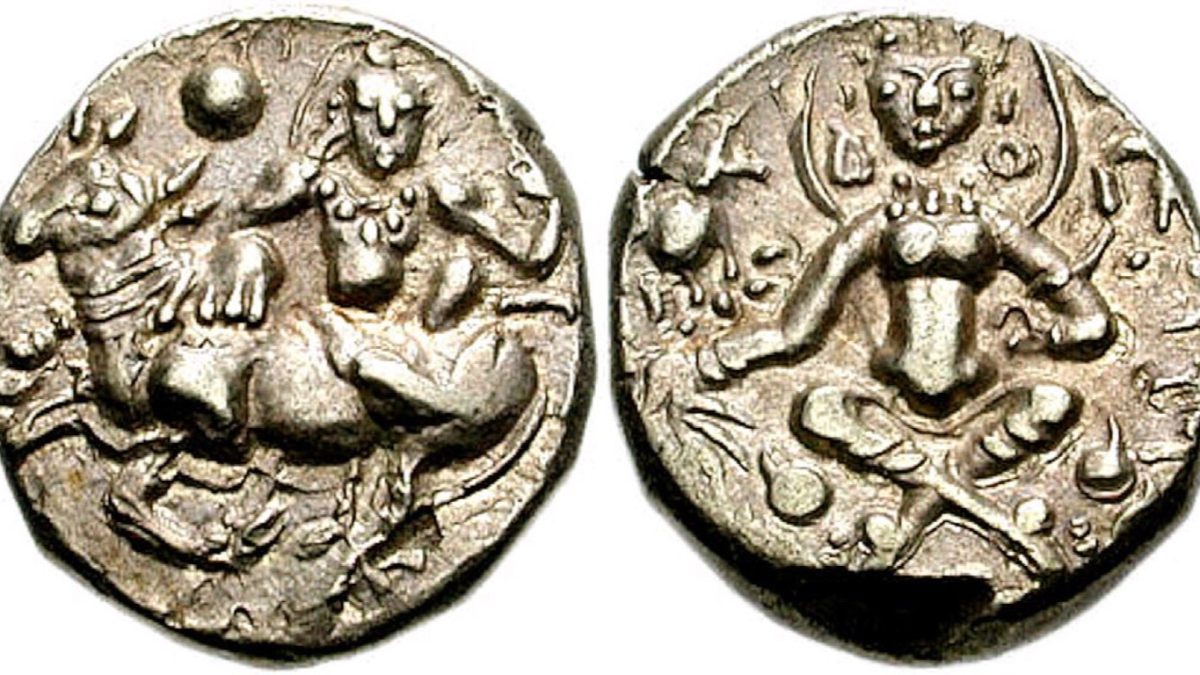
Hostile courtly accounts, notably Banabhatta’s celebrated Sanskrit biography Harshacharita, portrayed Sasanka as a cunning adversary. Yet despite the united forces of Harsha and Bhaskaravarman, Sasanka maintained sovereign control over his realm throughout his life, expanding Gauda’s borders westward to Varanasi, southward across coastal Orissa (Kongoda), and holding the northern river passes. Sasanka minted elegant gold dinars bearing the Shaivite emblem of Shiva seated upon the sacred bull Nandi, asserting cultural and theological autonomy against the Buddhist patronage of Kannauj.
3. Xuanzang’s Eyewitness Account of Karnasuvarna
Around 638 CE, a decade after Sasanka’s death, the renowned Chinese Buddhist pilgrim Xuanzang (Hiuen Tsang) traversed Bengal and documented the legacy of Gauda:
“The country of Karnasuvarna is about 1,400 or 1,500 li in circuit; the capital is about 20 li round. The country is well cultivated and produces abundant crops. The climate is soft, and the manners of the people are polite and esteemed for learning. There are fifty Buddhist monasteries with about 2,000 monks, who study the teachings of the Sammitiya school. There are also fifty Deva temples of various sects.”
— Xuanzang, Si-Yu-Ki: Buddhist Records of the Western World
Xuanzang’s testimony refutes sectarian claims that Sasanka completely eradicated Buddhism, revealing that decades after his passing, vast Buddhist monastic institutions—such as the magnificent Raktamrittika Mahavihara (Lo-to-mo-chi)—flourished side by side with Hindu shrines in the capital of Gauda.
4. The Anarchy of Matsyanyayam (c. 650 – 750 CE)
Sasanka’s death around 625 CE plunged Bengal into catastrophic instability. Without a strong institutional succession, Gauda was invaded and partitioned between Harsha of Kannauj and Bhaskaravarman of Kamarupa (the Nidhanpur copperplate charter marks Bhaskaravarman issuing land grants directly from Sasanka’s captured camp at Karnasuvarna). Over the subsequent century, Bengal fell victim to successive predatory raids from Yashovarman of Kannauj, Lalitaditya of Kashmir, and Tibetan warlords.
The total collapse of central authority gave rise to a protracted dark age remembered in historical memory as Matsyanyayam (সংস্কৃত: মাৎস্যায়ম)—literally, “the law of the fish”:
“Where there is no ruler, the strong devour the weak, exactly as in water the larger fish ruthlessly swallow up the smaller fish. A country afflicted by Matsyanyayam knows neither law, nor property, nor life; neighbor plunders neighbor, and terror reigns supreme.”
— Kautilya, Arthashastra (Definition of Anarchy)
For nearly a hundred years, regional warlords, bandit chieftains (*Samantas*), and rival mercenary bands ravaged the delta. Trade routes decayed, granaries were pillaged, and agrarian peasantry faced unrelenting extortion. Yet out of this agonizing century of despair arose a political miracle unique in ancient Asian history: the voluntary, collective election of a common leader to restore peace and law to Bengal.
Primary Academic References
- Majumdar, R. C. (1943). History of Bengal: Volume I — Hindu Period. University of Dacca.
- Beal, S. (1884). Si-Yu-Ki: Buddhist Records of the Western World by Hiuen Tsiang. Trübner & Co., London.
- Cowell, E. B., & Thomas, F. W. (1897). The Harsa-carita of Bana. Royal Asiatic Society, London.
- Basak, R. G. (1919). The Tipperah Copperplate Grant of Lokanatha. Epigraphia Indica, XV.