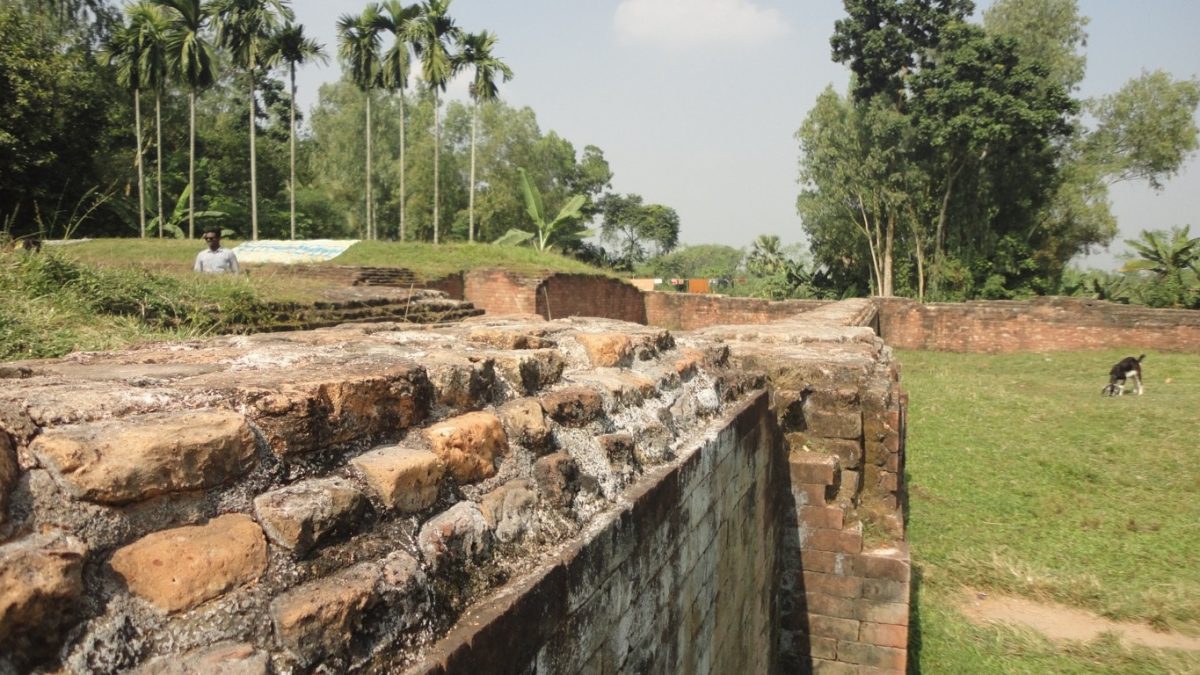
Between the 3rd century BCE and the 6th century CE, the scattered agrarian janapadas of Bengal were integrated into the vast political architectures of South Asia’s classical empires. Anchored by the mighty fortified city of Pundranagara (Mahasthangarh) on the banks of the Karatoya River, Bengal functioned not as a remote borderland, but as a crucial imperial revenue province, intellectual powerhouse, and international maritime gateway connecting northern India with the Indian Ocean trade network.
1. Pundranagara and the Mahasthan Brahmi Inscription
The earliest written epigraphic record discovered on the soil of Bengal is the legendary Mahasthan Brahmi Inscription, found in 1931 at Mahasthangarh in Bogra district. Carved upon a small, rectangular limestone slab in six lines of early Ashokan Brahmi script and Prakrit language, the inscription dates conclusively to the 3rd century BCE, during the height of the Mauryan Empire.
The epigraph reveals a remarkably sophisticated, state-managed emergency relief infrastructure overseen by a royal governor (Mahamatra) stationed at Pundranagara:
“To the Mahamatra stationed at Pundranagara: In times of emergency, famine, or water distress (caused by locusts or drought), grain stored in the state granary (Kothagala) and cash funds (Gandaka and Kakani coins) shall be disbursed to the distressed people (the Samvamgiyas). When prosperity returns, these shall be replenished to the state treasury.”
— Mahasthan Limestone Inscription (c. 3rd Century BCE)
This single artifact proves that more than 2,200 years ago, Pundranagara was a fortified imperial metropolis equipped with municipal grain reserves, monetized public assistance, and direct bureaucratic communication with the Mauryan imperial capital at Pataliputra.
2. Mauryan Integration and the Diffusion of Buddhism
Under Emperor Ashoka the Great (r. 268–232 BCE), Mauryan sovereignty over northern and western Bengal expanded dramatically. Chinese Buddhist pilgrims who visited Bengal centuries later—specifically Faxian (Fa-Hien, early 5th century CE) and Xuanzang (Hiuen Tsang, 7th century CE)—documented numerous Ashokan stupas erected throughout Pundravardhana, Tamralipti, and Samatata.
Ashoka’s rock and pillar edicts, combined with the propagation of Dhamma, catalyzed the spread of early Buddhism into Bengal. Monasteries and stupas emerged along river trade routes, acting as hubs not merely of religious contemplation, but of literacy, manuscript preservation, and medical care for travelers and merchants.
3. The Gupta Imperial Golden Age (4th – 6th Century CE)
With the rise of the Imperial Gupta dynasty under Samudragupta and Chandragupta II, Bengal experienced profound administrative restructuring and economic prosperity. The famous Allahabad Pillar Inscription of Samudragupta mentions Samatata (southeastern Bengal) as an autonomous tributary frontier kingdom (Pratyanta-rajya) acknowledging Gupta imperial supremacy, while northern and western Bengal were directly annexed into the empire as an imperial province: Pundravardhana-bhukti.
The Damodarpur and Paharpur Copperplate Charters
Our detailed knowledge of Gupta administration in Bengal stems from remarkable copperplate land-grant charters (Kraya-shasana) discovered at Damodarpur, Baigram, Paharpur, and Gunaighar. These inscriptions reveal a highly decentralized, participatory district governance system:
- The Administrative Bureaucracy: The province (Bhukti) was governed by an imperial viceroy (Uparika) appointed directly by the Gupta emperor. Sub-districts (Vishayas, such as Kotivarsha Vishaya) were administered by district magistrates (Ayuktakas or Vishayapatis).
- Municipal District Councils: The district magistrate governed alongside an advisory board representing the principal economic guilds of civil society:
- Nagara-sreshthin: President of the city’s merchant guilds and banking elite.
- Sarthavaha: Chief of the caravan traders and transport merchants.
- Prathama-kulika: Representative of the artisan and craftsman guilds.
- Prathama-kayastha: Chief imperial scribe and keeper of administrative archives.
- Land Sale Procedures: Inviolable public land surveys (*Pustapala* record-keepers) determined titles before wasteland or forest was transferred to Brahman scholars, Buddhist viharas, or Vedic temples, ensuring sustainable agrarian expansion into the forested river deltas.
4. Tamralipti: Bengal’s Window to the World
While Pundranagara anchored inland politics, the great coastal port of Tamralipti (modern Tamluk on the Rupnarayan River) served as one of the most illustrious maritime trading emporiums of the ancient world. Connecting the fertile hinterlands of the Ganges basin to the Bay of Bengal, Tamralipti was the primary port of departure for voyages to Sri Lanka, Myanmar (Suvarnabhumi), the Indonesian archipelago, and southern China.
When the Chinese pilgrim-monk Faxian arrived at Tamralipti in 410 CE, he was astounded by its maritime grandeur and Buddhist scholarship:
“Here there are twenty-four sangharamas (monasteries), in all of which there are priests; the Law of Buddha is also flourishing. Faxian remained here for two years, writing out copies of the Vinaya and drawing pictures of images. He then embarked in a large merchant vessel and sailed towards the southwest, reaching the country of Sinhala (Sri Lanka) in fourteen days.”
— Faxian, A Record of Buddhist Kingdoms
Through Tamralipti flowed Bengali fine cotton muslins, silk, terracotta vessels, iron weaponry, and aromatic resins in exchange for Roman glass, Mediterranean gold coins, and Southeast Asian spices. By the dawn of the 6th century CE, Bengal stood as a sophisticated nexus of commerce, culture, and high administrative governance.
Primary Academic References
- Bhandarkar, D. R. (1932). Important Epigraphical Discoveries in Eastern India: The Mahasthan Inscription. Epigraphia Indica, XXI, 83–91.
- Majumdar, R. C. (1943). History of Bengal: Volume I — Hindu Period. University of Dacca.
- Chakravarti, R. (2002). Trade and Traders in Early Indian Society. Manohar Publishers.
- Legge, J. (1886). A Record of Buddhistic Kingdoms: Being an Account by the Chinese Monk Fa-Hien. Clarendon Press, Oxford.