The sixteen months between November 1970 and March 1971 marked the decisive historical threshold of Bengali statehood. Propelled by the catastrophic tragedy of the Bhola Cyclone and the criminal neglect of the central Pakistani government, the people of East Bengal delivered an overwhelming, unprecedented democratic verdict in the December 1970 General Elections, granting Bangabandhu Sheikh Mujibur Rahman an outright majority to govern the entire country. When the military junta conspiratorially aborted the constitutional handover of power, Bengal erupted in non-violent non-cooperation, culminating in Bangabandhu’s thunderous March 7, 1971 speech that de facto severed the bonds of Pakistan and declared the struggle for sovereign independence.
1. The 1970 Bhola Cyclone and the Fractured Nation
On the night of November 12, 1970, the deadliest tropical cyclone in human history made landfall on the coastal islands of East Pakistan. Driven by a twenty-foot storm surge, the Bhola Cyclone wiped out entire populations across Hatia, Sandwip, Bhola, and Patuakhali, slaughtering an estimated 500,000 human beings.
The tragedy exposed the terminal moral bankruptcy of the Pakistani state. While foreign nations scrambled to airlift disaster relief, military dictator General Agha Muhammad Yahya Khan spent days casually vacationing in Beijing before stopping briefly in Dhaka. Three full weeks elapsed before the Pakistan Army mobilized military helicopters stationed in West Pakistan to drop life-saving supplies to drowning citizens. Enraged by this callous racism, veteran political leader Maulana Abdul Hamid Khan Bhashani addressed a massive rally in Dhaka on November 23, declaring with bitter prophetic clarity: “Assalam-o-Alaikum, Pakistan!” (Farewell, Pakistan!).
2. The December 1970 Elections: The Sovereign Mandate
On December 7, 1970, Pakistan held its first-ever general elections based on universal adult franchise. The Awami League, campaigning relentlessly on the Six-Point Programme under the leadership of Bangabandhu Sheikh Mujibur Rahman, achieved an electoral sweep unprecedented in democratic history:
- National Assembly: The Awami League won 167 out of 169 seats allocated to East Pakistan, securing an outright parliamentary majority in the 313-seat National Assembly of Pakistan.
- Provincial Assembly: In East Pakistan, the Awami League captured 288 out of 300 general seats.
- West Pakistan Split: In the western wing, Zulfikar Ali Bhutto’s Pakistan People’s Party (PPP) secured 81 seats (predominantly in Punjab and Sindh), while regional parties won in the North-West Frontier Province and Balochistan.
By all constitutional and parliamentary laws, Sheikh Mujibur Rahman was the legitimate, democratically elected Prime Minister of Pakistan. However, the ruling troika of the West Pakistani Punjabi military high command, feudal industrialists, and Bhutto refused to accept a Bengali-led government that would decentralize financial and political power away from Islamabad.
3. The Conspiracy and the March 1 Explosion
General Yahya Khan convened the National Assembly to meet in Dhaka on March 3, 1971. In response, Zulfikar Ali Bhutto issued a reckless ultimatum, threatening to break the legs of any West Pakistani lawmaker who traveled to Dhaka and declaring that Pakistan possessed two centers: “Udhar hum, idhar tum” (“We rule there, you rule here”).
On March 1, 1971, at 1:05 PM, Yahya Khan broadcast an abrupt, indefinite postponement of the National Assembly. Instantly, Dhaka exploded. Tens of thousands of workers, students, lawyers, and civil servants streamed into the streets, chanting revolutionary slogans: “Bir Bangali astro dhoro, Bangladesh shadhin koro!” (Brave Bengalis take up arms, liberate Bangladesh!). Bangabandhu immediately launched the historic Non-Cooperation Movement (Oshohyog Andolon).
For twenty-five days, the authority of the Pakistani state completely ceased to exist in East Bengal. From March 2 onward, the civil administration, high court judges, police force, port workers, and central bank answered solely to directives issued from Bangabandhu’s residence at Dhanmondi Road 32. On March 2, the student leadership hoisted the new national flag of Bangladesh at Dhaka University; on March 3, the Manifesto of Independence was proclaimed at Paltan Maidan.
4. The Thunderous March 7 Speech: The Magna Carta of Liberty
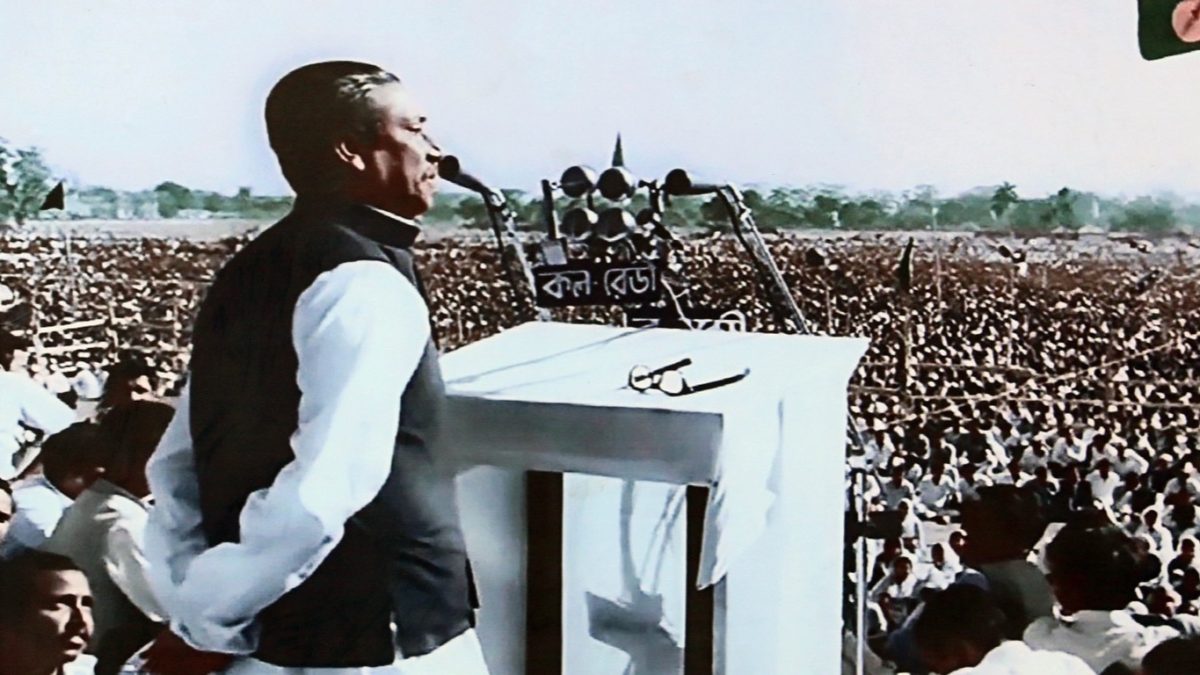
The crescendo of the movement was reached on Sunday afternoon, March 7, 1971. Over one million Bengalis—armed with bamboo sticks, iron rods, and an unshakeable will for liberty—converged on the Racecourse Ground (now Suhrawardy Udyan) in Dhaka. Pakistani army gunships circled menacingly overhead.
Dressed in his signature white kurta and black Mujib coat, Bangabandhu stepped up to the microphone. Speaking without written notes for eighteen electrifying minutes, he outlined the twenty-three years of colonial exploitation, laid down four stringent conditions for attending any assembly, issued administrative directives for nationwide civil resistance, and delivered the immortal battle cry of a nation being born:
“রক্ত যখন দিয়েছি, রক্ত আরও দেব—এ দেশের মানুষকে মুক্ত করে ছাড়বো ইনশাআল্লাহ! এবারের সংগ্রাম আমাদের মুক্তির সংগ্রাম, এবারের সংগ্রাম স্বাধীনতার সংগ্রাম! জয় বাংলা!”
(“Since we have given blood, we will give more blood! By the grace of God, we will liberate the people of this land! The struggle this time is the struggle for our emancipation; the struggle this time is the struggle for our independence! Joy Bangla!”)
— Bangabandhu Sheikh Mujibur Rahman (March 7, 1971)
The March 7 speech was an unparalleled masterwork of political strategy and oratory. Without technically declaring unilateral secession—which would have given the Pakistani military legal pretext to carpet-bomb the crowd—Bangabandhu gave his people complete, definitive instructions for revolutionary guerrilla warfare: “Build fortresses in every home; confront the enemy with whatever weapons you possess.” In 2017, UNESCO officially recognized this speech as an international documentary heritage by inscribing it on the Memory of the World Register.
5. The Deceptive Negotiations and Military Buildup
Terrified by the total collapse of their civil authority, Yahya Khan flew to Dhaka on March 15 for ostensible negotiations with Bangabandhu, soon joined by Bhutto. In reality, these talks were a sinister tactical smokescreen. Behind the scenes, the military junta was executing Operation Blitz: commercial airliners of Pakistan International Airlines (PIA) were stripped of seats to secretly airlift thousands of armed troops around the southern tip of India via Sri Lanka, while transport ships unloaded tanks, heavy artillery, and munitions at Chittagong port.
The blueprint for mass murder had been finalized on March 18 by Major General Khadim Hussain Raja and Major General Rao Farman Ali under the code name Operation Searchlight. On the evening of March 25, 1971, Yahya Khan secretly boarded a flight back to Karachi. The countdown to genocide had reached zero.
Primary Academic References
- Mujibur Rahman, Sheikh. (2012). The Unfinished Memoirs. The University Press Limited (UPL).
- Raghavan, S. (2013). 1971: A Global History of the Creation of Bangladesh. Harvard University Press.
- Sisson, R., & Rose, L. E. (1990). War and Secession: Pakistan, India, and the Creation of Bangladesh. University of California Press.
- Choudhury, G. W. (1974). The Last Days of United Pakistan. C. Hurst & Co., London.
- Raja, K. H. (2012). A Stranger in My Own Country: East Pakistan, 1969–1971. Oxford University Press.