In the year 1342 CE, a visionary statesman of extraordinary political and military acumen, Haji Shamsuddin Ilyas Shah, seized the throne of Lakhnauti, conquered the rival principalities of Satgaon and Sonargaon, and accomplished what no ruler had ever previously achieved: the unification of the entire linguistic, geographic, and deltaic basin under a single sovereign realm. Assuming the historic titles Shah-i-Bangalah (“King of Bengal”) and Sultan-i-Bangalah, Ilyas Shah formally inaugurated the Independent Bengal Sultanate—a two-century golden era of sovereign statehood, international maritime trade with Ming China, and monumental brick and stone architecture that placed Bengal on the map of world powers.
1. Shamsuddin Ilyas Shah and the Birth of “Bangalah”
Prior to 1342, the term “Bangalah” or “Vanga” referred exclusively to the eastern deltaic regions, while northern Bengal was known as Gauda or Varendra, and western Bengal as Radha or Satgaon. By bringing Lakhnauti, Satgaon (Hooghly), and Sonargaon under a singular centralized crown, Ilyas Shah forged a unified geopolitical entity and declared himself the sovereign of all its people: Shah-i-Bangalah.
This political consolidation aroused the fury of Sultan Firuz Shah Tughluq of Delhi, who marched an enormous imperial army of 100,000 cavalry, infantry, and war elephants into Bengal in 1353 to crush the rebellion. Instead of confronting the Delhi host in open plains, Ilyas Shah executed a masterclass in deltaic defensive warfare: he withdrew into the impenetrable mud-and-water fortifications of Ekdala Fort (in Dinajpur):
“The Sultan of Delhi besieged Ekdala with all his might, but the fort was encircled by deep waters and mud. The Bengali archers, firing from the battlements, inflicted severe casualties. When the monsoon approached and pestilence broke out in the imperial camp, Firuz Shah was compelled to lift the siege and negotiate peace, recognizing Ilyas Shah’s sovereign independence over Bengal.”
— Ziauddin Barani, Tarikh-i-Firuz Shahi
By repelling the Delhi invasion, Ilyas Shah secured Bengal’s complete de jure and de facto independence, inaugurating an unbroken tradition of regional sovereignty that endured for over two centuries.
2. Sikandar Shah and the Colossal Adina Mosque (1375 CE)
Ilyas Shah’s son and successor, Sultan Sikandar Shah (r. 1358–1390 CE), cemented this imperial majesty by founding a new royal capital at Pandua (Firozabad, near Malda). When Firuz Shah Tughluq invaded Bengal a second time in 1359, Sikandar Shah once again held Ekdala Fort against the Delhi army, forcing the Delhi Sultan to sign a formal peace treaty and present gifts of jeweled crowns and horses.
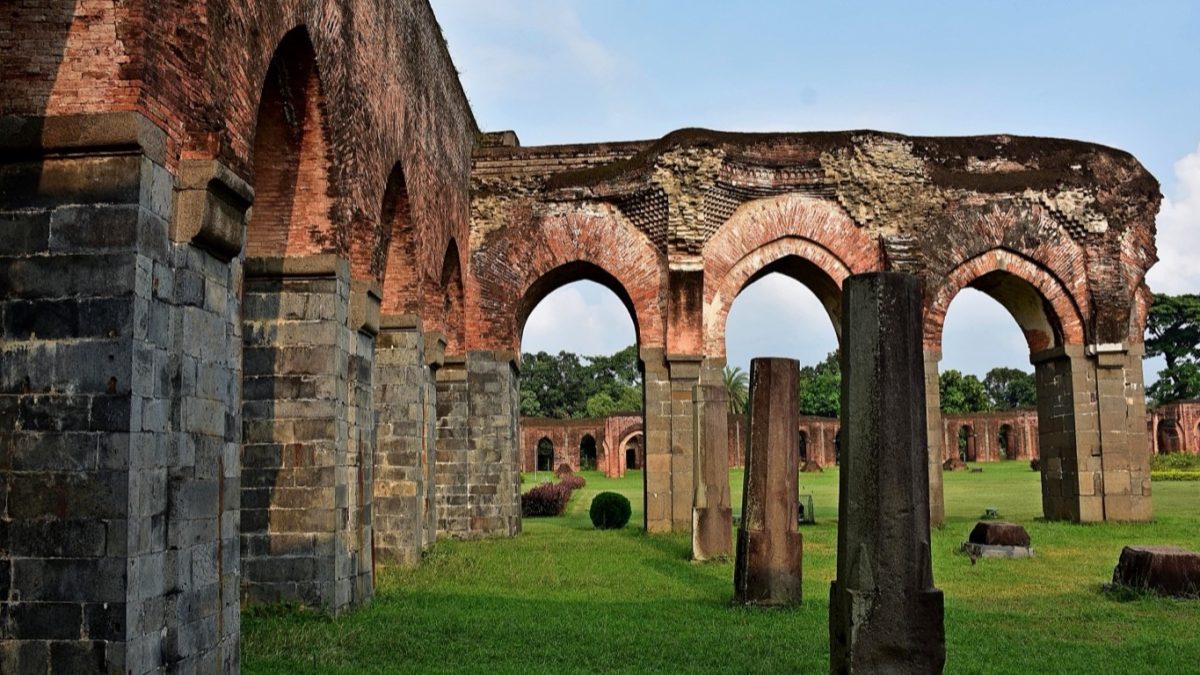
To celebrate Bengal’s sovereign triumph over Delhi, Sikandar Shah constructed the gargantuan Adina Mosque at Pandua between 1369 and 1375 CE. Covering an astonishing 516 by 300 feet, the Adina Mosque was:
- The Largest Mosque in South Asia: Vastly outstripping the contemporary Quwwat-ul-Islam Mosque of Delhi in scale and courtyard dimensions.
- Architectural Grandeur: Featuring an expansive central barrel-vaulted nave rising over sixty feet high, supported by 260 monolithic stone pillars quarried from ancient ruins and 370 brick domes.
- Royal Elevation: Incorporating the Badshah-ka-Takht (Emperor’s Throne)—an elevated royal stone mezzanine gallery where the Sultan prayed, guarded by elite soldiers.
3. The House of Raja Ganesha and Jalaluddin Muhammad Shah
In the early 15th century, the Sultanate underwent a remarkable internal dynastic transformation. Raja Ganesha, a powerful Hindu landlord and minister from Dinajpur/Bhaturia, took control of the government amid factional conflict. To resolve tensions with orthodox Islamic religious authorities (notably Saint Nur Qutb Alam), Ganesha agreed that his twelve-year-old son, Jadu, would convert to Islam.
Taking the throne as Sultan Jalaluddin Muhammad Shah (r. 1415–1432 CE), this native Bengali monarch presided over a brilliant era of cultural indigenization. Jalaluddin minted coins featuring the Bengali lion emblem (*Simha-vahini*) alongside Arabic calligraphy, patronized Sanskrit scholars like Brihaspati Rayamukuta, appointed Hindu ministers to high military and civil offices, and rebuilt the capital at Gaur. Under his rule, the Sultanate shed its foreign Turkish-Persian veneer and became a genuinely indigenous Bengali empire.
4. Ming Diplomacy and the Maritime Silk Road
The Bengal Sultanate engaged in high-level diplomatic and economic relations with the global superpowers of the 15th century, foremost among them the Ming Dynasty of China under Emperor Yongle. Between 1405 and 1433, the legendary Chinese treasure fleets commanded by Admiral Zheng He docked multiple times at the port of Chittagong (*Cha-di-gang*).
Chinese envoy and chronicler Mahuan, who accompanied the imperial fleet, recorded a mesmerizing description of Bengal in his travelogue Yingya Shenglan (“The Overall Survey of the Ocean’s Shores”, 1433):
“The kingdom of Bangalah is vast and populous. The people are wealthy, well-mannered, and clothed in fine garments. They manufacture several kinds of exquisite cotton cloth, each as thin and light as the cicada’s wing. The currency is silver coins, called Tanka. In the capital, the palace of the king is magnificent, built of brick and stone with broad watercourses. The Sultan sent envoys to our court carrying tribute of pearls, precious stones, fine muslins, and a live giraffe (Qi-lin), which astonished our Emperor.”
— Mahuan, Yingya Shenglan
By the mid-15th century, Bengal was internationally recognized as an autonomous, fabulously wealthy mercantile empire whose maritime reach spanned from the Persian Gulf to the shores of the Yellow Sea.
Primary Academic References
- Dani, A. H. (1961). Muslim Architecture in Bengal. Asiatic Society of Pakistan.
- Eaton, R. M. (1993). The Rise of Islam and the Bengal Frontier, 1204–1760. University of California Press.
- Mills, J. V. G. (1970). Ma Huan: Ying-yai Sheng-lan — The Overall Survey of the Ocean’s Shores (1433). Cambridge University Press.
- Sarkar, J. N. (1948). The History of Bengal: Volume II — Muslim Period. University of Dacca.