At the close of the 15th century, Bengal attained the supreme pinnacle of its medieval cultural and economic flourishing under the legendary monarch Sultan Alauddin Husain Shah (r. 1494–1519 CE), founder of the celebrated Husain Shahi Dynasty. Remembered by contemporary chroniclers and poets as Nripati-tilaka (“The Crown-Jewel of Kings”) and Jagat-bhushana (“Adornment of the Universe”), Husain Shah ushered in an era of profound religious harmony, institutionalized royal patronage for Bengali vernacular literature, provided an open environment for Sri Chaitanya Mahaprabhu’s Vaishnava renaissance, and erected architectural masterpieces in brick and stone that defined the golden age of the Bengal Sultanate.
1. The Ascent of Alauddin Husain Shah (1494 CE)
The late 15th century witnessed dangerous internal instability in Gaur caused by the palace intrigues of the Habshi (Abyssinian) palace guards who had assassinated the last Ilyas Shahi sultans. In 1494, Sayyid Alauddin Husain, an Arab nobleman who had served with distinction as wazir (prime minister), overthrew the rogue Habshi usurper Muzaffar Shah with the overwhelming backing of both Muslim and Hindu grandees.
Upon ascending the throne, Husain Shah immediately disbanded the corrupt palace guard, re-established disciplined civic governance, restored peace across the borders by checking the expansion of the Kamata kingdom in Assam and the Gajapatis of Orissa, and granted universal amnesty. His court became a beacon of enlightened governance where high state offices were awarded strictly on merit, irrespective of creed.
2. Royal Patronage of the Bengali Vernacular
Perhaps the most transformative historical legacy of the Husain Shahi dynasty was the institutional elevation of the Bengali vernacular language to the status of high court literature. For centuries, orthodox Brahmanical elites had stigmatized the vernacular, insisting that sacred epics be preserved exclusively in Sanskrit (an orthodox proverb warned: “He who hears the eighteen Puranas or the Rama-story in the vernacular shall be cast into the Raurava hell”). Husain Shah and his generals shattered this linguistic taboo by commissioning master translations into Bengali:
- The Bengali Mahabharata: General Paragal Khan, Husain Shah’s military governor of Chittagong, commissioned the poet Kavindra Parameshwar to translate the entire *Mahabharata* into popular Bengali verse (known as the *Pandava-vijaya*). Paragal Khan’s son, Chhuti Khan, later commissioned Srikar Nandi to translate the *Ashvamedha Parva*.
- Sri Krishna Vijaya: Earlier patronized by the court, the poet Maladhar Basu was granted the grand imperial titles Gunaraja Khan by the Sultan, while his son was honored as Satyaraja Khan.
- Vipradasa Pipilai and Bijay Gupta: Master poets who composed classical Manasamangal kavya celebrated the Sultan in their verses:
“The sovereign king Sultan Husain Shah is the crest-jewel of rulers; he rules his realm with justice like the legendary Vikramaditya, and in his kingdom, all subjects enjoy peace and prosperity.”
— Bijay Gupta, Manasamangal (c. 1495 CE)
3. Sri Chaitanya and the Gaudiya Vaishnavism Revolution
During Husain Shah’s reign, Navadvipa in Nadia blossomed into the epicentre of a spiritual and social awakening led by Sri Chaitanya Mahaprabhu (1486–1534 CE). Preaching the doctrine of universal love, devotion (*Bhakti*), and the congregational chanting of the holy names (*Nama-sankirtana*), Chaitanya boldly dismantled rigid caste divisions, embracing Brahmans, outcastes, and Muslims alike into spiritual brotherhood.
When conservative elements complained to the local administration about public kirtans, Husain Shah issued a celebrated royal decree forbidding any interference with Chaitanya’s movement, declaring that the master should be granted unhindered freedom to preach wherever he traveled. Two of Husain Shah’s highest cabinet ministers—the court private secretary Sakara Mallik and the finance minister Dabir Khas—were so deeply inspired by Chaitanya’s teachings that they renounced their worldly fortunes and became his foremost theological disciples, immortalized in Vaishnava history as Sanatana Goswami and Rupa Goswami.
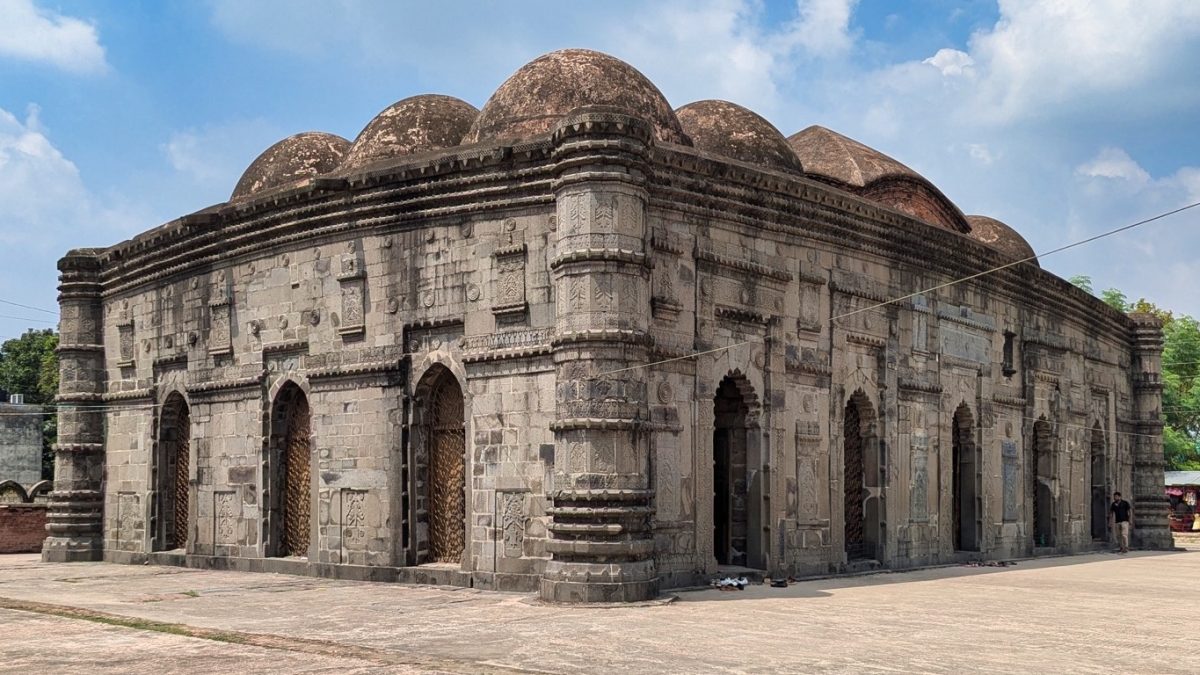
4. Architectural Gems: Choto Sona and Bagha Mosques
The prosperity of the Husain Shahi era found enduring expression in a distinct regional architecture that married indigenous Bengali bamboo-thatched hut curves (*Chala* rooflines) with refined Islamic stone masonry and intricate terracotta tilework:
- Choto Sona Mosque (Small Golden Mosque, Gaur): Erected by an imperial officer named Wali Muhammad during Husain Shah’s reign. Clad in finely polished black basalt stone imported from the Rajmahal hills and carved with delicate arabesques, its fifteen gilded domes sparkled under the tropical sun, earning its name as the “gem of Gaur.”
- Bagha Mosque (Rajshahi): Built in 1523 by Husain Shah’s son, Sultan Nusrat Shah. Renowned for its exquisite, deeply undercut terracotta plaques depicting floral vines, lotus blossoms, pomegranate trees, and water birds—an authentic celebration of Bengal’s natural deltaic ecology.
5. Arrival of the Portuguese: First European Footprints
The twilight of Husain Shah’s reign coincided with the arrival of the first European mariners in the Bay of Bengal. In 1518, an official Portuguese commercial embassy led by João de Silveira arrived at Chittagong. Impressed by the colossal volume of trade, Portuguese merchants christened Chittagong Porto Grande (“The Grand Port”) and the western port of Satgaon Porto Pequeno (“The Little Port”). Portuguese trading settlements flourished, introducing firearms, New World crops (tobacco, chilies, pineapples), and Christian friars to the delta, foreshadowing the dramatic European mercantile rivalries that would engulf Bengal two centuries later.
Primary Academic References
- Tarafdar, M. R. (1965). Husain Shahi Bengal (1494–1538 A.D.): A Socio-Political Study. Asiatic Society of Pakistan.
- Eaton, R. M. (1993). The Rise of Islam and the Bengal Frontier, 1204–1760. University of California Press.
- Sen, D. C. (1911). History of Bengali Language and Literature. University of Calcutta.
- Campos, J. J. A. (1919). History of the Portuguese in Bengal. Butterworth & Co., Calcutta.