The creation of Pakistan in August 1947 swiftly revealed itself to the people of East Bengal not as liberation, but as the substitution of British colonial hegemony with West Pakistani internal colonialism. Though constituting fifty-six percent of Pakistan’s total population, Bengalis were systematically excluded from civil-military power, while foreign exchange earned from Bengali jute was siphoned off to finance factories and canals in West Pakistan. When the ruling oligarchy insolently attempted to eradicate the Bengali mother tongue, the youth of Dhaka mounted the historic Language Movement of February 21, 1952. That sacrifice catalyzed an unstoppable cascade of democratic assertion: the 1954 United Front landslide, Bangabandhu Sheikh Mujibur Rahman’s Six-Point Programme, and the volcanic 1969 Mass Uprising that forever shattered Pakistan’s military dictatorship.
1. The Language Movement (Bhasha Andolon): February 21, 1952
The cultural subjugation of East Bengal began almost immediately after partition. In December 1947, an educational summit in Karachi proposed that Urdu be declared the sole state language of Pakistan. On March 21, 1948, at the Racecourse Ground in Dhaka, and again on March 24 at the historic Curzon Hall of Dhaka University, Pakistan’s founding governor-general, Muhammad Ali Jinnah, declared with authoritarian finality:
“Let me make it very clear to you that the State Language of Pakistan is going to be Urdu and no other language. Anyone who tries to mislead you is really the enemy of Pakistan.”
— Muhammad Ali Jinnah, Dhaka Speech (March 21, 1948)
Instantly, courageous Dhaka University students, led by student leaders including young Sheikh Mujibur Rahman, shouted in protest: “No! No!” Bengali, spoken by 56% of the country, was to be reduced to a second-class vernacular while Urdu, spoken by less than 4%, was imposed as the imperial tongue.
The crisis reached its boiling point in early 1952 when Prime Minister Khawaja Nazimuddin reiterated Jinnah’s diktat. The Shorbodorliyo Kendrio Rashtrobhasha Kormoporisad (All-Party Central Language Action Council) called for a general strike across East Bengal on February 21, 1952 (8 Falgun 1358). The government responded by imposing Section 144, banning all public meetings and processions in Dhaka.
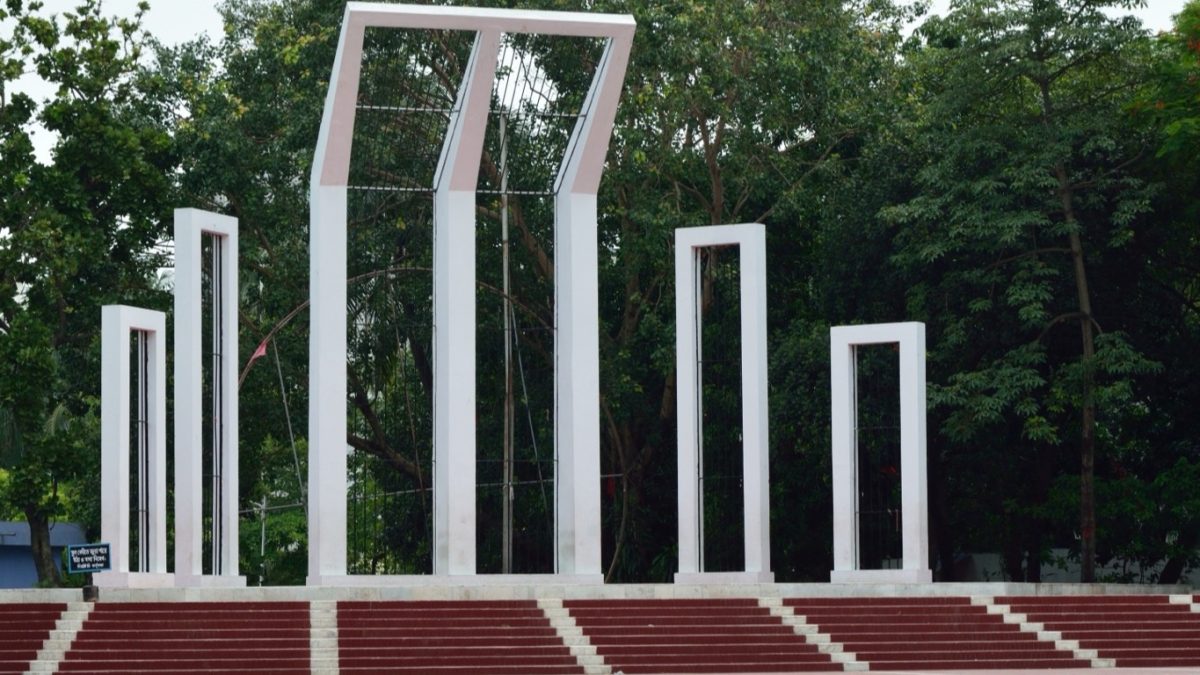
Defying the ban, brave students assembled at the Dhaka University Amtala, organized into small groups of ten, and marched forward toward the East Bengal Legislative Assembly. Beside the Dhaka Medical College hostel, the armed police opened fire with live ammunition into the unarmed procession. Abul Barkat, Abdul Jabbar, Rafiq Uddin Ahmed, Abdus Salam, and nine-year-old schoolboy Shafiur Rahman fell in pools of blood. Overnight, students and citizens erected the first makeshift brick Shaheed Minar, which was promptly demolished by the Pakistani military. The immortal words of Abdul Gaffar Choudhury, set to music by Altaf Mahmud, echoed across the nation:
“আমার ভাইয়ের রক্তে রাঙানো একুশে ফেব্রুয়ারি / আমি কি ভুলিতে পারি…”
(“Can I ever forget the Twenty-First of February, / Crimson with the blood of my brothers…”)
The blood shed on February 21 transformed a linguistic grievance into an existential national consciousness. In 1956, the Pakistani state was forced to recognize Bengali as an official state language. Decades later, in November 1999, UNESCO formally designated February 21 as International Mother Language Day, immortalizing the sacrifice of Dhaka’s martyrs in world history.
2. The 1954 United Front Landslide and Military Coup
In March 1954, East Bengal held its first democratic provincial elections. The three towering leaders of Bengal—Sher-e-Bangla A. K. Fazlul Huq, Huseyn Shaheed Suhrawardy, and Maulana Abdul Hamid Khan Bhashani—united to form the United Front (Jukta Front) on the basis of a historic 21-Point Charter demanding complete provincial autonomy.
The election resulted in a seismic political annihilation of the ruling establishment: the United Front swept 223 out of 237 Muslim seats, completely obliterating the Muslim League, which secured a humiliating nine seats. Yet the West Pakistani military-bureaucratic clique refused to surrender power: within fifty-six days, Governor-General Ghulam Muhammad dismissed the ministry under fabricated charges, imposing direct governor’s rule.
In October 1958, General Ayub Khan staged a military coup, abrogating the constitution, banning political parties, and instituting an autocratic “Basic Democracy” system designed to disenfranchise the Bengali majority.
3. Bangabandhu and the Historic Six-Point Programme (1966)
The 1965 India-Pakistan War laid East Pakistan’s absolute vulnerability bare: the province was left completely undefended by the central military, with only a single division stationed in the east while the entire armed forces fought in Kashmir and the Punjab. Sensing that the moment had arrived for decisive action, the dynamic general secretary of the Awami League, Sheikh Mujibur Rahman, unveiled the Six-Point Programme at a national conference in Lahore on February 5, 1966:
- Point 1: Pakistan shall be a federation based on the Lahore Resolution, with parliamentary democracy and a legislature elected by direct adult franchise.
- Point 2: The federal government shall be responsible only for Defence and Foreign Affairs; all other residual subjects shall vest in the federating states.
- Point 3: Two separate, freely convertible currencies for the two wings, or a single currency with constitutional safeguards against capital flight from East to West Pakistan.
- Point 4: The power of taxation and revenue collection shall vest exclusively in the federating units; the federal government shall receive an agreed share.
- Point 5: Two separate accounts for foreign exchange earnings; federating units shall have the authority to establish international trade agreements.
- Point 6: The federating states shall have the constitutional authority to maintain their own paramilitary or territorial armed forces (Militia).
The Six-Point charter was the Magna Carta of Bengali Self-Determination. Ayub Khan threatened to answer the Six Points with “the language of weapons”, throwing Sheikh Mujib and hundreds of Awami League leaders into prison. Yet across every village and town in Bengal, the Six Points became the sacred political scripture of emancipation.
4. The Agartala Conspiracy Case and the 1969 Mass Uprising
Desperate to eliminate Sheikh Mujib permanently, the Ayub regime fabricated the infamous Agartala Conspiracy Case in January 1968, officially titled State vs. Sheikh Mujibur Rahman and Others. Mujib, alongside thirty-four Bengali civil servants, naval officers, and soldiers, was charged with high treason for allegedly conspiring with Indian intelligence at Agartala to achieve the armed secession of East Pakistan.
Rather than crushing the movement, the trial produced a volcano of revolutionary fury. In early 1969, the student community formed the All-Party Student Action Committee, launching the historic 1969 Mass Uprising (Gano Obhyutthan). When student leader Amanullah Asaduzzaman (Asad) was shot dead by police on January 20, and Sergeant Zahurul Haq was murdered in military custody in Kurmitola on February 15, millions of furious citizens took to the streets, defying curfews and burning government secretariats.
Fearing total revolution, the military regime collapsed. On February 21, 1969, Ayub Khan unconditionally withdrew the Agartala Conspiracy Case, freeing Sheikh Mujibur Rahman. Two days later, on February 23, 1969, before a triumphant rally of one million people at the Dhaka Racecourse Ground, student leader Tofail Ahmed bestowed upon Sheikh Mujibur Rahman the immortal, sacred title: “Bangabandhu”—The Friend of Bengal. Ayub Khan resigned in disgrace, handing power to General Yahya Khan, who had no choice but to promise general elections based on adult franchise.
Primary Academic References
- Umar, B. (1970). Purba Banglar Bhasha Andolon O Tatkalin Rajniti (Volumes 1–3). Mowla Brothers, Dhaka.
- Jahan, R. (1972). Pakistan: Failure in National Integration. Columbia University Press.
- Mujibur Rahman, Sheikh. (2012). The Unfinished Memoirs. The University Press Limited (UPL).
- Sobhan, R. (1968). Basic Democracies, Works Programme and Rural Development in East Pakistan. Bureau of Economic Research, Dacca University.
- Zaheer, H. (1994). The Separation of East Pakistan: The Rise and Realization of Bengali Muslim Nationalism. Oxford University Press.