Throughout the 17th century, Bengal was transformed into the economic jewel of the Mughal Empire. Designated in imperial Persian decrees as Jannat al-Bilad (“The Paradise of Nations”), Subah Bangla emerged as the single wealthiest and most industrialized province in the non-Western world. Generating nearly fifty percent of the Mughal crown’s total revenue and producing an estimated twelve percent of global manufacturing output, Bengal became the textile workshop of the world. Centered around the glittering metropolis of Dhaka, Subahdars like Mir Jumla and Shaista Khan presided over an era of unprecedented urban opulence, military pacification of maritime piracy, and commercial attraction that drew merchant fleets from every corner of the globe.
1. The Economic Engine of the Mughal Empire
Under the Pax Mughalica, Bengal experienced an explosion of agricultural productivity, commercial monetization, and industrial manufacturing. The French physician and traveler François Bernier, who visited Bengal during the reign of Emperor Aurangzeb, wrote with astonishment in his 1668 memoirs:
“The kingdom of Bengal has a hundred gates open for entering, but not one for departure. In no part of the world have I seen such boundless abundance of rice, sugar, vegetables, fowl, and cattle. The immense treasures of gold and silver which the Europeans bring from America to purchase the silks, cottons, and cloths of Bengal remain locked here forever, enriching the land beyond all calculation.”
— François Bernier, Travels in the Mogul Empire (1668)
Bengal functioned as a global sink for precious metals. Ships from the English East India Company, the Dutch VOC, the French Compagnie des Indes, the Portuguese, and Armenian merchant guilds brought galleons filled with American silver bullion to exchange for Bengal’s manufactured treasures:
- The Dhaka Muslin: The supreme glory of Bengali textile artisans. Spun from rare long-staple cotton (*Phuti Karpas*) grown along the Meghna river, Dhaka weavers created legendary varieties such as Mulmul Khas (King’s Muslin), Ab-i-Rawan (Running Water), and Shabnam (Morning Dew)—fabrics so ethereal that an entire fifty-yard piece could pass effortlessly through a lady’s signet ring.
- Silk and Shipbuilding: Thousands of silk-reeling filatures operated in Kasimbazar and Murshidabad, while Chittagong shipyards constructed massive teak warships and ocean-going merchant vessels for the Ottoman Empire and European navies at half the cost of London docks.
- Saltpetre: Bengal produced over seventy percent of the high-grade potassium nitrate (saltpetre) consumed by European armies for firearms and cannon gunpowder during the Seven Years’ War.
2. Subahdar Mir Jumla and the Assam Expedition (1660–1663)
In 1660, Emperor Aurangzeb appointed his most capable general and statesman, Mir Jumla (Muazzam Khan), as Subahdar of Bengal. Headquartered in Dhaka, Mir Jumla fortified the city against Magh and Portuguese raids by erecting defensive water-forts at Hajiganj (Narayanganj), Idrakpur (Munshiganj), and Sonakanda.
In November 1661, Mir Jumla launched a daring, monumental military expedition into the northeast. Leading an amphibious force of 12,000 cavalry, 30,000 infantry, and a flotilla of 323 war vessels, he conquered the Koch kingdom of Kamata and pressed deep into the rugged Brahmaputra valley to capture Garhgaon, the capital of the Ahom kingdom of Assam. Mir Jumla’s legendary bronze cannon, Bibi Mariam, cast during this era, remains one of Dhaka’s most iconic historical military monuments.
3. The Era of Shaista Khan: Peace and Abundance (1664–1688)
Mir Jumla was succeeded by Nawab Shaista Khan, maternal uncle of Emperor Aurangzeb, who governed Bengal for nearly a quarter of a century (1664–1678 and 1680–1688). Shaista Khan’s tenure represents the zenith of Mughal provincial majesty:
- Conquest of Chittagong (1666): For over a century, the coastlines of southern and eastern Bengal were terrorized by devastating slave raids carried out by the Arakanese Maghs in alliance with rogue Portuguese buccaneers (*Feringhees*). In late 1665, Shaista Khan launched a brilliant joint land-and-sea offensive. His admiral Ibn Husain defeated the Arakanese navy in a fierce three-day battle off Sandwip, storming the fortress of Chittagong in January 1666. Shaista Khan liberated thousands of enslaved Bengali peasants, expelled the pirates, and renamed Chittagong Islamabad.
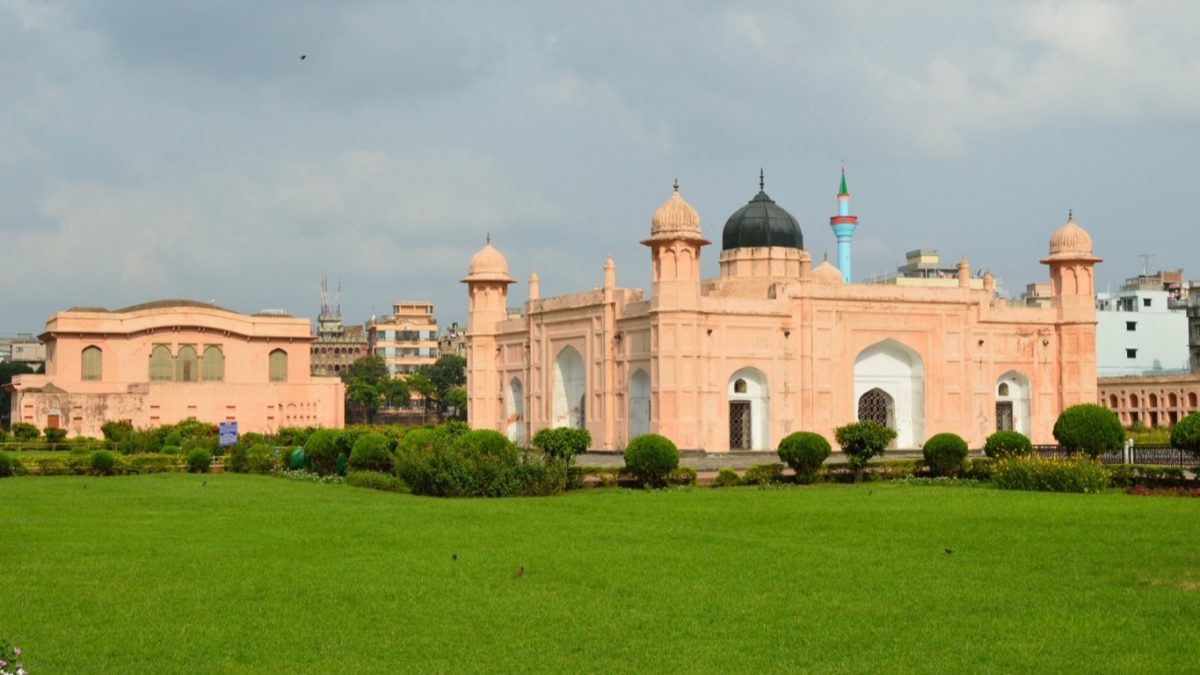
- Architectural Masterpieces in Dhaka: Shaista Khan endowed Dhaka with sublime Mughal brick monuments, notably the world-famous Lalbagh Fort (Fort Aurangabad), the exquisite marble-and-basalt Mausoleum of Bibi Pari (his beloved daughter Iran Dukht), the Choto Katra caravanserai, and the Sat Gambuj Mosque.
- The Golden Price of Rice: Shaista Khan’s administrative efficiency resulted in such agricultural abundance that eight maunds (approximately 300 kilograms) of clean rice sold for a single silver rupee. Upon stepping down from his post, Shaista Khan ordered the western gate of Dhaka sealed, decreeing that it should remain closed until another ruler achieved equal prosperity.
4. The Influx of European Companies and the Founding of Calcutta
Enticed by Bengal’s immense profits, European chartered companies established fortified commercial settlements along the Hooghly river. The Dutch settled at Chinsurah, the French established their headquarters at Chandannagar, and the Danes built their outpost at Serampore.
In August 1690, Job Charnock, an agent of the English East India Company, dropped anchor at the marshy village of Sutanuti on the eastern bank of the Hooghly. Negotiating trading rights with Subahdar Ibrahim Khan, the English acquired the zamindari rights to three villages—Sutanuti, Gobindapur, and Kalikata—and constructed Fort William. What began as a modest British merchant factory grew within a century into Calcutta, the imperial launchpad that would ultimately devour the independence of Bengal.
Primary Academic References
- Bernier, F. (1670). Travels in the Mogul Empire, A.D. 1656–1668 (Trans. A. Constable, 1891). Oxford University Press.
- Karim, A. (1964). Dacca: The Mughal Capital. Asiatic Society of Pakistan.
- Prakash, O. (1985). The Dutch East India Company and the Economy of Bengal, 1630–1720. Princeton University Press.
- Raychaudhuri, T. (1969). Bengal under Akbar and Jahangir: An Approach to Socio-Economic History. Munshiram Manoharlal.