The decade between 1940 and 1950 subjected the people of Bengal to an unrelenting sequence of political earthquakes, artificial famine, communal carnage, and civilizational rupture. In 1940, Bengal’s populist Premier Sher-e-Bangla A. K. Fazlul Huq moved the historic Lahore Resolution demanding sovereign “States” in the east. Three years later, Winston Churchill’s wartime grain-denial policies created the apocalyptic Bengal Famine of 1943, claiming over three million lives. As communal riots swept Calcutta and Noakhali in 1946, a visionary last-ditch effort for a sovereign, undivided Bengal collapsed, culminating in the traumatic Partition of August 1947 that sliced Bengal in two and uprooted millions of refugees in blood and sorrow.
1. The 1940 Lahore Resolution and Sher-e-Bangla
By the late 1930s, the political leadership of Bengal was dominated by the legendary populist peasant champion Sher-e-Bangla A. K. Fazlul Huq, leader of the Krishak Praja Party (Peasant-Tenant Party) and Premier of Bengal. Fazlul Huq fought relentlessly against oppressive moneylenders and landlords, enacting the historic Bengal Tenancy Act and Agricultural Debtors’ Act that saved millions of debt-ridden agrarian families from ruin.
On March 23, 1940, at the historic open session of the All-India Muslim League in Minto Park, Lahore, it was Sher-e-Bangla who rose before a crowd of 100,000 to formally move the historic Lahore Resolution. Drafted with constitutional precision, its core operative clause read:
“Resolved that it is the considered view of this Session of the All-India Muslim League that no constitutional plan would be workable in this country or acceptable to the Muslims unless it is designed on the following basic principle, viz. that geographically contiguous units are demarcated into regions… that the areas in which the Muslims are numerically in a majority as in the North-Western and Eastern zones of India should be grouped to constitute ‘Independent States’ in which the constituent units shall be autonomous and sovereign.”
— The Lahore Resolution (March 23, 1940)
The plural term “Independent States” (স্বতন্ত্র রাষ্ট্রসমূহ) was central to the Bengali vision: it envisioned a fully sovereign, independent eastern state in Bengal and Assam, completely distinct and self-governing from the northwestern territories of Punjab and Sindh. Only in 1946, through a controversial resolution at the Delhi Legislators’ Convention orchestrated by Jinnah, was the word “States” unilaterally altered to the singular “State”—sowing the seeds of the structural contradiction that would explode three decades later.
2. Churchill’s Crime: The Great Bengal Famine of 1943
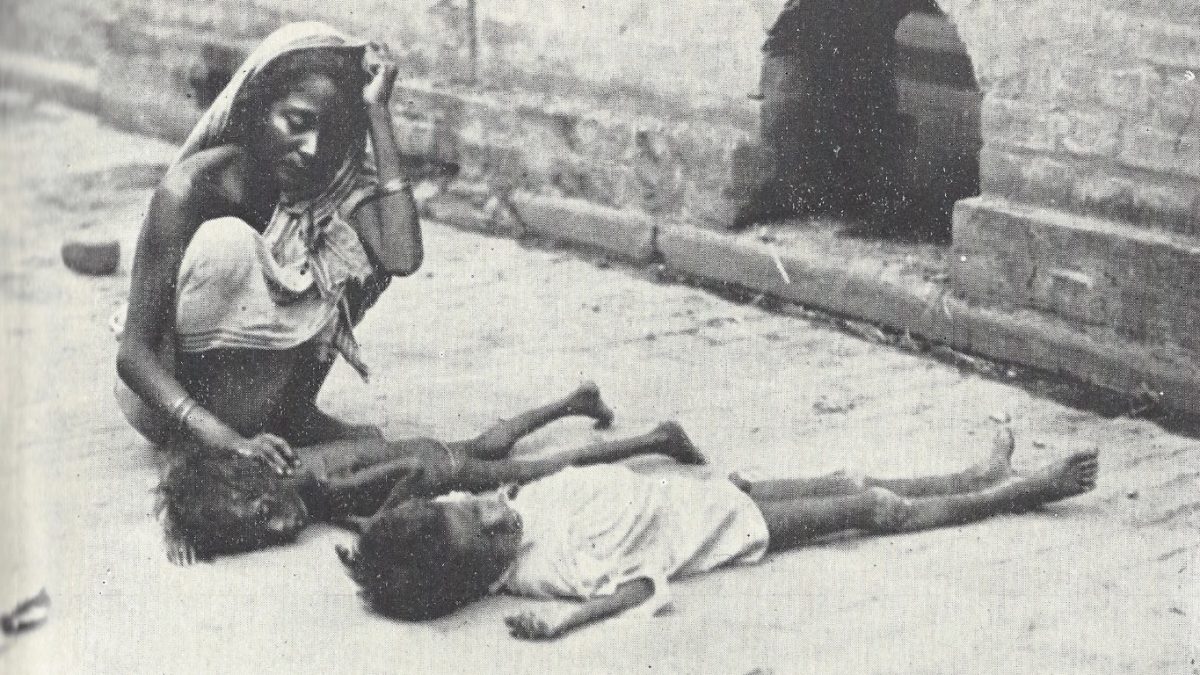
In 1943, while the Second World War raged, Bengal was struck by a man-made horror: the Bengal Famine of 1943 (পঞ্চাশের মন্বন্তর, 1350 BS). Recent declassified war cabinet papers and economic analyses by Nobel Laureate Amartya Sen have conclusively demonstrated that the famine was not caused by an absolute shortage of food, but by callous, deliberate imperial policy orchestrated by British Prime Minister Winston Churchill.
Following the Japanese conquest of Burma in 1942, the British military implemented a scorched-earth “Denial Policy” in coastal Bengal, confiscating and destroying over 25,000 river transport boats and burning rice surpluses to deny them to prospective Japanese invaders. Furthermore, the Churchill War Cabinet systematically diverted grain shipments from Australia and India to build up stockpile reserves for European soldiers in the Mediterranean, while repeatedly refusing urgent pleas from Viceroy Lord Linlithgow and Lord Wavell for famine relief ships.
Over three to four million Bengalis perished from starvation, dysentery, and malaria. Destitute mothers walked hundreds of miles to Calcutta, collapsing dead on the sidewalks with skeletal babies at their dried breasts, while the British colonial elite dined in luxury at the Grand Hotel just blocks away. The horror was immortalized for eternity by Shilpacharya Zainul Abedin, whose searing, minimalist sketches in black Chinese ink and brush on cheap packing paper documented the macabre agony of human desolation, creating an indelible visual indictment of British imperial cruelty.
3. Communal Conflagration and the Abortive “United Bengal” Plan
In August 1946, amid deadlocked negotiations over the transfer of power, the Muslim League called for Direct Action Day on August 16 to press for Pakistan. In Calcutta, the political demonstration degenerated into the horrifying Great Calcutta Killings: seventy-two hours of unmitigated communal savagery that left over 5,000 dead and 15,000 injured, spreading vicious riots to Noakhali, Tipperah, and Bihar. Mahatma Gandhi undertook a heroic, solitary barefoot peace march through the remote villages of Noakhali to quell communal passions.
Horrified by the looming prospect of a communal partition that would tear the economic and cultural heart of Bengal apart, visionary leaders on both sides made a daring final effort for peace. In April and May 1947, Bengal Premier Huseyn Shaheed Suhrawardy, alongside veteran Congress leader Sarat Chandra Bose (elder brother of Netaji) and Muslim League progressive Abul Hashim, formulated the United Bengal Plan (অখণ্ড স্বাধীন বাংলা):
“Bengal shall be a Free State. The Free State of Bengal shall decide its relations with the rest of India. The legislature of the Free State of Bengal shall be elected on the basis of joint electorates and adult franchise… The people of Bengal, bound by language, culture, and thousands of years of shared history, refuse to become the satellite of any distant power.”
— Sarat Bose–Suhrawardy Agreement (May 20, 1947)
Despite receiving cautious conditional interest from Jinnah, the United Bengal initiative was aggressively vetoed by the Congress High Command—specifically Jawaharlal Nehru and Sardar Vallabhbhai Patel—who insisted that if India was to be partitioned, Bengal and Punjab must also be divided to prevent the creation of a massive, third sovereign state in the east.
4. The Traumatic Partition of August 1947
The fate of seventy million Bengalis was sealed by a British barrister, Sir Cyril Radcliffe, who had never previously set foot in India. Working in sweltering heat with outdated census maps, Radcliffe was given just thirty-six days to draw an international border slicing through ancient river systems, villages, and railway lines.
On August 14 and 15, 1947, the partition took effect: Bengal was split in two. West Bengal (Hindu-majority, encompassing Calcutta) was incorporated into the Dominion of India, while East Bengal (Muslim-majority) became the eastern wing of Pakistan, separated from its western wing by over 1,500 kilometers of Indian territory.
The human cost was unfathomable. Millions of Hindu families in East Bengal fled westward, abandoning their ancestral lands and homesteads to crowd into squalid refugee camps in Sealdah and urban slums across West Bengal; simultaneously, hundreds of thousands of Bihari and Indian Muslims migrated eastward into East Pakistan. Families were shattered, cultural continuity was severed, and the riverine delta was carved up by barbed wire. Yet the seeds of future rebellion were planted on the very day of partition: the people of East Bengal had exchanged white British imperial masters for brown Pakistani colonizers.
Primary Academic References
- Sen, A. (1981). Poverty and Famines: An Essay on Entitlement and Deprivation. Oxford University Press.
- Mukerjee, M. (2010). Churchill’s Secret War: The British Empire and the Ravaging of Bengal during World War II. Basic Books.
- Chatterji, J. (1994). Bengal Divided: Hindu Communalism and Partition, 1932–1947. Cambridge University Press.
- Hashim, A. (1974). In Retrospect. Mawla Brothers, Dacca.
- Bose, S. C. (1968). I Warned My Countrymen: Being the Collected Works of Sarat Chandra Bose. Netaji Research Bureau.