On April 19, 1943, Swiss chemist Albert Hofmann cycled home from his Sandoz laboratory in Basel through an altered reality of terrifying kaleidoscope colors and undulating cobblestones. He had accidentally ingested an infinitesimal microgram dose of lysergic acid diethylamide: LSD-25. Decades of prohibition forced psychedelic research into the underground, but in the twenty-first century, a revolutionary neuroimaging renaissance led by Imperial College London and Johns Hopkins University deployed fMRI and MEG to peer inside the psychedelic brain, uncovering the biological architecture of our everyday ego and the profound plasticity of conscious experience.
The Molecular Key: 5-HT₂A Receptor Agonism
Classical psychedelics—psilocybin from magic mushrooms, DMT from ayahuasca, mescaline from peyote, and LSD—share a striking structural homology with the endogenous neurotransmitter serotonin. Pharmacologically, their consciousness-altering effects are driven almost exclusively by agonism at a single receptor subtype:
$$text{Psychedelic Action: Agonism at } 5-text{HT}_{2A} text{ Receptors}$$
Crucially, $5-text{HT}_{2A}$ receptors are not distributed randomly across the brain: they are concentrated with peak density on the apical dendrites of giant layer V pyramidal neurons in the cerebral cortex, particularly within the evolutionary newest associative regions.
The Default Mode Network and Ego Dissolution
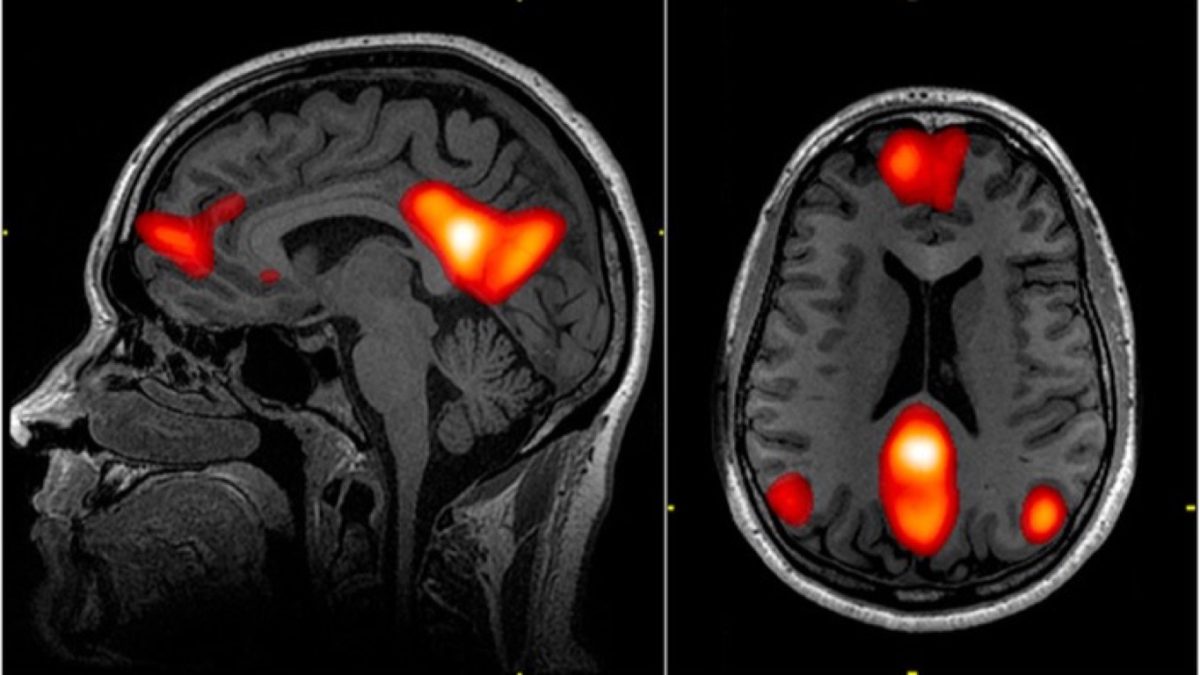
In 2001, Marcus Raichle at Washington University identified the Default Mode Network (DMN): an interconnected coalition of cortical hubs—the posterior cingulate cortex (PCC), medial prefrontal cortex (mPFC), and angular gyrus—that ignites whenever the brain is not engaged in goal-directed external tasks.
The DMN is the neurological conductor of the narrative self: it orchestrates autobiographical memory, rumination, mental time travel (remembering the past and imagining the future), theory of mind, and the cognitive construct we call the ego.
When Robin Carhart-Harris and David Nutt conducted the first fMRI scans of human volunteers under the influence of psilocybin and LSD, they anticipated seeing hyperactive neural fireworks. Instead, they observed the exact opposite: psychedelics induce a profound, dramatic collapse of blood flow and oscillatory synchrony within the Default Mode Network.
As the functional connectivity of the DMN disintegrates, the subjective psychological boundary between ‘self’ and ‘world’ evaporates entirely: ego dissolution. The individual no longer feels like a localized homunculus trapped behind the eyes; they experience a radical oceanic boundlessness, feeling inextricably unified with the cosmos.
The Entropic Brain Hypothesis and Global Hyperconnectivity
Carhart-Harris formulated the Entropic Brain Hypothesis: normal adult waking consciousness exists in a constrained, sub-critical, low-entropy state, heavily filtered and disciplined by top-down predictive priors to ensure pragmatic biological survival.
Psychedelics act as informational sledgehammers against the DMN’s predictive filtering mechanism, shifting brain activity toward high thermodynamic and informational entropy. While internal modular connectivity decreases, global anatomical cross-talk between previously segregated sensory networks explodes:
- Visual regions cross-communicate with auditory cortices, generating vivid synesthesia (tasting colors, seeing sounds).
- Repressed emotional trauma and buried autobiographical memories break through into conscious awareness.
- The brain temporarily returns to a hyper-plastic state resembling the unconstrained, imaginative mind of early childhood.
The Neuroplastic Reset: Healing Depression and Addiction
Clinical trials across the world have revealed that a single high-dose psychedelic session can produce rapid, sustained remissions in treatment-resistant depression, severe PTSD, and chemical addiction. Rigid, ruminative depression is fundamentally a pathological hyper-rigidity of the DMN—an endless, toxic predictive loop.
By temporarily disassembling the DMN and stimulating brain-derived neurotrophic factor (BDNF) and dendritic spinogenesis via TrkB pathways, psychedelics act like rebooting a frozen computer, allowing patients to escape entrenched cognitive ruts and rewrite the narrative architecture of their minds.