For centuries, Western philosophical orthodoxy—from Aristotle’s scala naturae to Descartes’ clockwork animal-automata—relegated non-human creatures to the status of unfeeling biological machines devoid of conscious awareness. In July 2012, at the University of Cambridge, an international consortium of prominent neuroscientists, in the presence of Stephen Hawking, signed the historic Cambridge Declaration on Consciousness: officially proclaiming that humans are not unique in possessing the neurological substrates that generate conscious experience. Across convergent evolutionary paths separated by hundreds of millions of years, nature has engineered alien minds right here on Earth.
The Cephalopod Mind: An Alien Consciousness
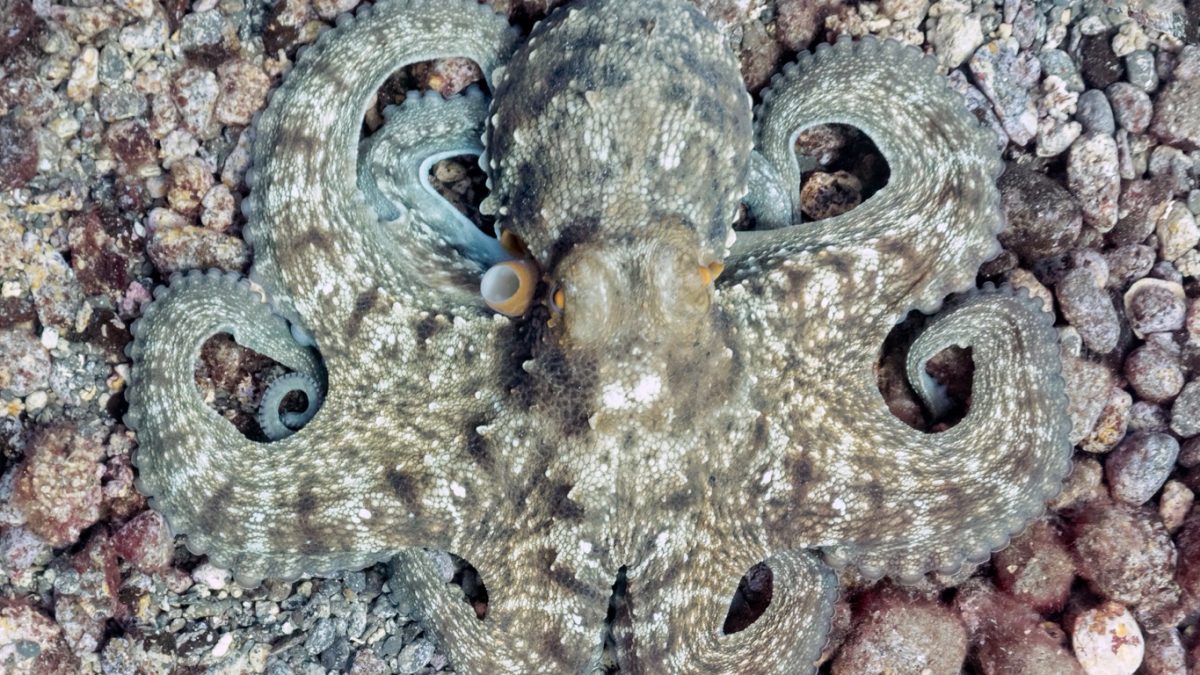
The last common ancestor between humans and the common octopus (Octopus vulgaris) was a primitive, microscopic, flatworm-like bilaterian living roughly 600 million years ago in the Precambrian seas. That creature possessed barely a rudimentary clump of neurons. The vertebrate brain and the cephalopod nervous system evolved completely independently from scratch:
“If we want to understand other minds, the cephalopods are an island of mental complexity in the sea of invertebrate animals. Meeting an octopus is probably the closest we will ever come to meeting an intelligent alien.” — Peter Godfrey-Smith, Other Minds
An octopus possesses approximately 500 million neurons—comparable to a dog or a small primate. But its anatomical distribution is radically decentralized:
- Episodic-Like Memory: Scrub jays recall not just where they cached food, but what they cached (perishable mealworms vs non-perishable seeds) and when (how long ago).
- Theory of Mind: Ravens re-cache their food only if they observe another raven watching them, demonstrating attribution of mental knowledge states to others.
- Tool Manufacturing: New Caledonian crows craft hooked twigs and compound tools to extract grubs from tree bark, understanding displacement principles (Aesop’s fable water-pitcher experiments).
- Subjective Experience in Crows: In 2020, Andreas Nieder at the University of Tübingen recorded single-neuron activity in the crow nidopallium endopalliale (NCL), proving that crow neurons track subjective perceptual reports rather than physical sensory inputs—the definitive electrophysiological signature of conscious awareness!
The Cambridge Declaration and the Moral Sphere
The 2012 Cambridge Declaration concluded unambiguously:
“The absence of a neocortex does not appear to preclude an organism from experiencing affective states. Convergent evidence indicates that non-human animals have the neuroanatomical, neurochemical, and neurophysiological substrates of conscious states along with the capacity to exhibit intentional behaviors. Consequently, the weight of evidence indicates that humans are not unique in possessing the neurological substrates that generate consciousness.”
The realization that consciousness is not an exclusive human birthright shatters anthropocentrism. Subjective awareness is a broad, magnificent evolutionary continuum that emerged whenever animal nervous systems needed to synthesize sensory data to navigate a perilous world. We are not solitary spectators in an unfeeling cosmos; we are members of an immense, shared tapestry of earthly sentience.
- Only one-third of its neurons reside in the central brain encircling its esophagus.
- The remaining two-thirds are distributed throughout its eight semi-autonomous arms!
Each arm contains its own local neural circuitry, sensory tactile receptors, and chemical detectors, capable of exploring crevices, manipulating objects, and tasting prey entirely without central brain micro-management. Yet octopuses exhibit rich, centralized play behavior, individual personalities, escape room problem-solving, tool use (carrying coconut shells as armor), and instantaneous dynamic camouflage controlled by thousands of dermal chromatophores under direct neural control.
The Corvid Marvel: Consciousness Without a Cortex
For decades, human arrogance assumed that high-level intelligence and conscious metacognition strictly required the six-layered mammalian neocortex. The avian lineage demolished this assumption.
Corvids (crows, ravens, jays) and parrots possess no cerebral neocortex. Instead, their forebrains are dominated by the pallium (specifically the nidopallium and mesopallium). Research by Suzana Herculano-Houzel revealed that avian brains pack neurons at astonishing densities—up to four times the neuronal packing density of primate cortices! A raven’s brain, despite weighing a fraction of a chimpanzee’s, contains roughly the same number of forebrain neurons.
In behavioral laboratories at Cambridge and Tübingen:
- Episodic-Like Memory: Scrub jays recall not just where they cached food, but what they cached (perishable mealworms vs non-perishable seeds) and when (how long ago).
- Theory of Mind: Ravens re-cache their food only if they observe another raven watching them, demonstrating attribution of mental knowledge states to others.
- Tool Manufacturing: New Caledonian crows craft hooked twigs and compound tools to extract grubs from tree bark, understanding displacement principles (Aesop’s fable water-pitcher experiments).
- Subjective Experience in Crows: In 2020, Andreas Nieder at the University of Tübingen recorded single-neuron activity in the crow nidopallium endopalliale (NCL), proving that crow neurons track subjective perceptual reports rather than physical sensory inputs—the definitive electrophysiological signature of conscious awareness!
The Cambridge Declaration and the Moral Sphere
The 2012 Cambridge Declaration concluded unambiguously:
“The absence of a neocortex does not appear to preclude an organism from experiencing affective states. Convergent evidence indicates that non-human animals have the neuroanatomical, neurochemical, and neurophysiological substrates of conscious states along with the capacity to exhibit intentional behaviors. Consequently, the weight of evidence indicates that humans are not unique in possessing the neurological substrates that generate consciousness.”
The realization that consciousness is not an exclusive human birthright shatters anthropocentrism. Subjective awareness is a broad, magnificent evolutionary continuum that emerged whenever animal nervous systems needed to synthesize sensory data to navigate a perilous world. We are not solitary spectators in an unfeeling cosmos; we are members of an immense, shared tapestry of earthly sentience.