By the late nineteenth century, modern microscopy had revealed that every organ in the human body—liver, muscle, kidneys, lungs—was composed of individual, bounded cellular units, cementing Theodor Schwann and Matthias Schleiden’s universal Cell Theory. Yet the brain remained a maddening exception. Viewed through optical microscopes, nervous tissue appeared as an impenetrable, tangled mesh of fibers. The scientific consensus held that the brain was a single continuous, unbroken fluid syncytium—until an eccentric Spanish artist turned histological genius, Santiago Ramón y Cajal, dipped brain sections into silver nitrate and uncovered the cellular architecture of consciousness.
Golgi’s Black Reaction: The Silver Miracle
In 1873, in the kitchen of a hospital for the chronically ill in Abbiategrasso, Italy, Italian physician Camillo Golgi stumbled upon a chemical miracle: the reazione nera (black reaction). By hardening brain tissue in potassium dichromate and impregnating it with silver nitrate, silver chromate microcrystals precipitated inside nervous tissue.
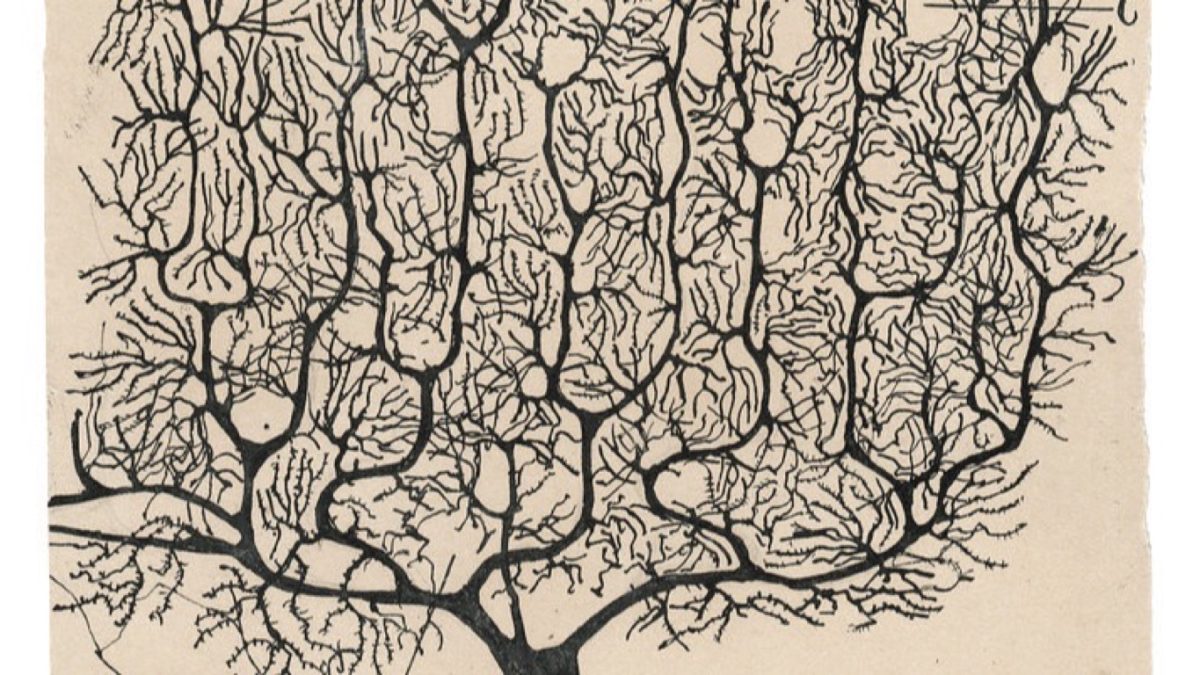
The true genius of the Golgi stain was its capricious selectivity: for reasons still not completely understood today, it stains barely 1 to 3 percent of the cells in any tissue slice, leaving the remaining 98 percent completely transparent. Instead of an impenetrable black blob, isolated individual cells emerged against an amber background in breathtaking, complete silhouette—dendritic arborizations, cell bodies, and fine axons stretching across cortical layers.
Yet Golgi misinterpreted his own discovery. A staunch dogmatist, he insisted that the axonal branches fused into a continuous interconnected web: the Reticular Theory.
Cajal: The Don Quixote of the Microscope
In 1887, Santiago Ramón y Cajal, a professor of anatomy in Zaragoza, Spain, visited Madrid and observed Golgi-stained brain tissue under a microscope. He was immediately captivated. Returning home, he constructed a primitive laboratory in his attic and modified Golgi’s silver protocol, applying it to embryonic and neonatal avian and mammalian brains, where myelin sheets had not yet obscured neural contours.
Working twelve hours a day, peering through brass monoculars and drawing with calligraphic ink, Cajal observed that nerve fibers never fused. Axons ended in delicate free endings—club-shaped terminals, basket weaves, and climbing fibers—clinging tightly to the dendrites of neighboring cells, but separated by an irreducible, microscopic gap:
“Against the defender of the reticular network, nature showed itself as an impenetrable forest, but with patience and the silver stain, the dense thicket revealed itself to be made of distinct, individual trees whose branches never fused.” — Santiago Ramón y Cajal
The Neuron Doctrine and the Law of Dynamic Polarization
Cajal’s findings established the cornerstone of modern neuroscience: the Neuron Doctrine (formalized and coined by Heinrich Wilhelm Waldeyer in 1891):
- Structural Unit: The neuron is the fundamental anatomical, physiological, genetic, and metabolic unit of the nervous system.
- Contiguity, Not Continuity: Neurons do not fuse into a syncytium; they communicate across narrow specialized junctions (later christened synapses by Sir Charles Sherrington).
- The Law of Dynamic Polarization: Nerve signals flow in a strictly one-way directional path: received by the branched dendrites and cell body (soma), integrated, and transmitted outward along the single axon toward the terminal arborization.
Cajal also discovered dendritic spines—the tiny mushroom-like thorns covering dendrites—correctly hypothesizing that these were the specific sites of contact where signals jumped between cells, and that learning involves the physical sprouting and strengthening of these connections (anticipating synaptic plasticity by half a century).
The 1906 Nobel Prize: A Bitter Duel
In 1906, the Nobel Committee awarded the Nobel Prize in Physiology or Medicine jointly to Camillo Golgi and Santiago Ramón y Cajal “in recognition of their work on the structure of the nervous system.”
The ceremony in Stockholm erupted into dramatic intellectual combat. Golgi delivered his Nobel lecture first, launching a bitter, obstinate attack on the Neuron Doctrine, defending his discredited reticular network. Cajal followed with a gracious, masterfully argued presentation supported by hundreds of meticulous anatomical drawings. History decisively vindicated Cajal. In the 1950s, the advent of electron microscopy revealed the synaptic cleft ($20text{–}40 text{ nm}$ wide), confirming beyond all doubt that the seat of mind is woven from eighty-six billion individual cellular galaxies.