For hundreds of millions of years, the subjective contents of the animal mind were physically quarantined within the biological skull. Thoughts, memories, and volitions could express themselves only through the mechanical bottleneck of muscles and vocal cords—moving fingers, stepping legs, or pushing air through larynxes. In the twenty-first century, Brain-Computer Interfaces (BCIs) have broken this evolutionary boundary. By decoding the millivolt action potentials of cortical neurons in real time, neuroengineers have allowed paralyzed human beings to move robotic limbs, speak through artificial speech decoders, and navigate digital worlds using pure thought alone.
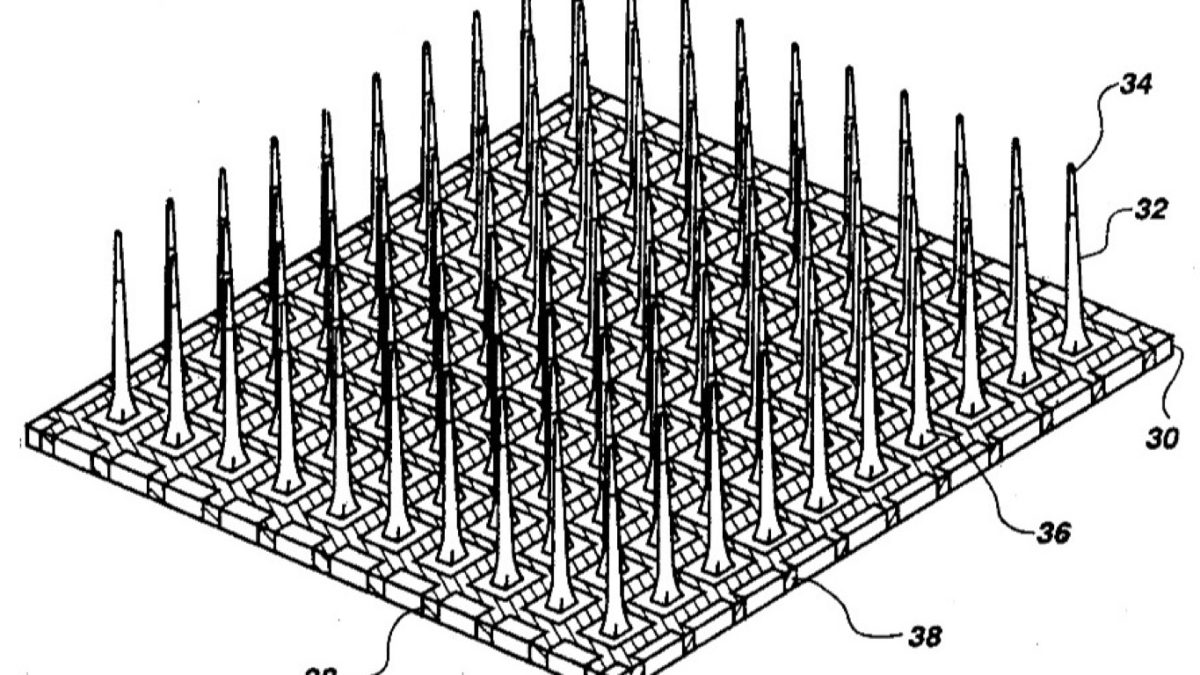
The Utah Array: The Silicon Bed of Nails
In the late 1980s, Richard Normann at the University of Utah developed the technological platform that launched modern clinical BCI: the Utah Electrode Array. A 4-by-4 millimeter square of silicon bristling with one hundred conductive micro-needles (1 to 1.5 mm long), tipped with platinum or iridium oxide.
In 2004, the landmark BrainGate clinical trial, led by John Donoghue and Leigh Hochberg, implanted a Utah array into the primary motor cortex (M1) of Matthew Nagle, a young man paralyzed from the neck down by a spinal cord injury. When Nagle imagined moving his paralyzed hand, pyramidal neurons in M1 fired action potentials. A bedside signal processor translated these population vectors into digital coordinates, enabling Nagle to move a computer cursor, play video games, check email, and open robotic prosthetic fingers—the first human to control external technology directly with cortical thoughts.
Neuralink and Flexible Thread Robotics
While the Utah array proved the concept, its rigid silicon spikes suffered from critical clinical drawbacks: brain micromotion causes chronic tissue shearing, triggering glial scarring that encapsulates the electrodes in astrocytic scar tissue within years, degrading signal quality. Furthermore, 100 channels offered low bandwidth.
In 2019, Elon Musk’s neurotechnology venture Neuralink unveiled an industrial revolution in BCI engineering:
- Who owns your neural data? Can your subconscious mental states be subpoenaed or harvested by corporate algorithms?
- What happens to personal agency when a machine learning model predicts and executes your intention before you consciously register it?
- Could high-bandwidth bidirectional links allow external hackers to inject false sensory qualia or manipulate emotional states?
BCIs prove that the boundary of the human skull is porous. As biological synapses merge with digital silicon, human consciousness is stepping into an unprecedented cybernetic horizon where mind transcends the biological substrate of flesh.
- Ultra-Flexible Polyimide Threads: Thousands of micron-thin electrode threads (4 to 6 micrometers wide, thinner than a red blood cell) that flex naturally with cortical pulsation, virtually eliminating tissue shearing and immune rejection.
- The Surgical Insertion Robot: A high-speed, optical-coherence-tomography-guided surgical robot that uses an ultra-fine needle to insert threads into the cortex at a rate of six threads (192 electrodes) per minute, actively avoiding blood vessels to prevent intracranial hemorrhages.
- The N1 Implant: A coin-sized hermetically sealed biocompatible titanium enclosure containing custom low-power application-specific integrated circuits (ASICs) that amplify, digitize, and wirelessly stream 1,024 channels of broadband neural data via Bluetooth, recharged wirelessly through the scalp via inductive coils.
In January 2024, Neuralink performed its first human clinical trial (the PRIME study) on Noland Arbaugh, a quadriplegic patient. Within weeks, Arbaugh was playing digital chess, navigating operating systems, and playing video games for hours purely through mental motor intention.
Decoding Language: From Mind to Text
At UC San Francisco, neurosurgeon Edward Chang pioneered intracranial speech decoders for anarthric patients (individuals who have lost the mechanical ability to speak due to stroke or ALS). Placing high-density electrocorticography (ECoG) grids over the speech sensorimotor cortex:
Chang’s team trained recurrent neural networks to decode the intended articulatory vocal tract gestures (movements of tongue, lips, and vocal cords). By 2023, Chang’s team achieved real-time decoding rates exceeding 78 words per minute—approaching normal conversational speed (150 wpm)—animating a personalized digital avatar that synthesized the patient’s own pre-injury voice!
The Cybernetic Frontier and Neuroethics
Brain-Computer Interfaces are rapidly advancing from restorative medical prosthetics into cognitive augmentations. Bidirectional BCIs not only read motor intentions, but write sensory feedback directly into somatosensory cortex via intracortical microstimulation (ICMS), providing prosthetic hands with the tactile sensation of pressure and texture.
Yet this technological symbiosis raises haunting neuroethical frontiers: Neurorights. When thoughts can be digitized, decoded, and wirelessly transmitted:
- Who owns your neural data? Can your subconscious mental states be subpoenaed or harvested by corporate algorithms?
- What happens to personal agency when a machine learning model predicts and executes your intention before you consciously register it?
- Could high-bandwidth bidirectional links allow external hackers to inject false sensory qualia or manipulate emotional states?
BCIs prove that the boundary of the human skull is porous. As biological synapses merge with digital silicon, human consciousness is stepping into an unprecedented cybernetic horizon where mind transcends the biological substrate of flesh.