For decades following Cajal’s discovery of the synapse, neurophysiology was torn between two warring camps: the “Sparks,” led by John Carew Eccles, who insisted that transmission across the synaptic gap must be pure, instantaneous electrical conduction; and the “Soups,” led by Henry Dale, who argued that chemicals bridge the chasm. On Easter Sunday in 1921, Austrian pharmacologist Otto Loewi awoke from a dream with a laboratory experiment that settled the debate forever, opening the vast, kaleidoscopic realm of neurotransmitters that color every thought, desire, and agony of human consciousness.
Loewi’s Dream: The Discovery of Vagusstoff
Loewi isolated two beating frog hearts in saline baths. Heart 1 retained its vagus nerve; Heart 2 was denervated. Loewi electrically stimulated the vagus nerve of Heart 1, causing its beat to slow dramatically. He then pipetted the bathing fluid from Heart 1 and transferred it into the chamber containing Heart 2.
To his astonishment, Heart 2 slowed down immediately, matching the rhythm of Heart 1 without any direct electrical connection! A chemical substance released by the stimulated nerve into the fluid—which Loewi named Vagusstoff (“vagus substance”), later identified by Henry Dale as acetylcholine—had transmitted the command across space.
The Molecular Architecture of the Synaptic Cleft
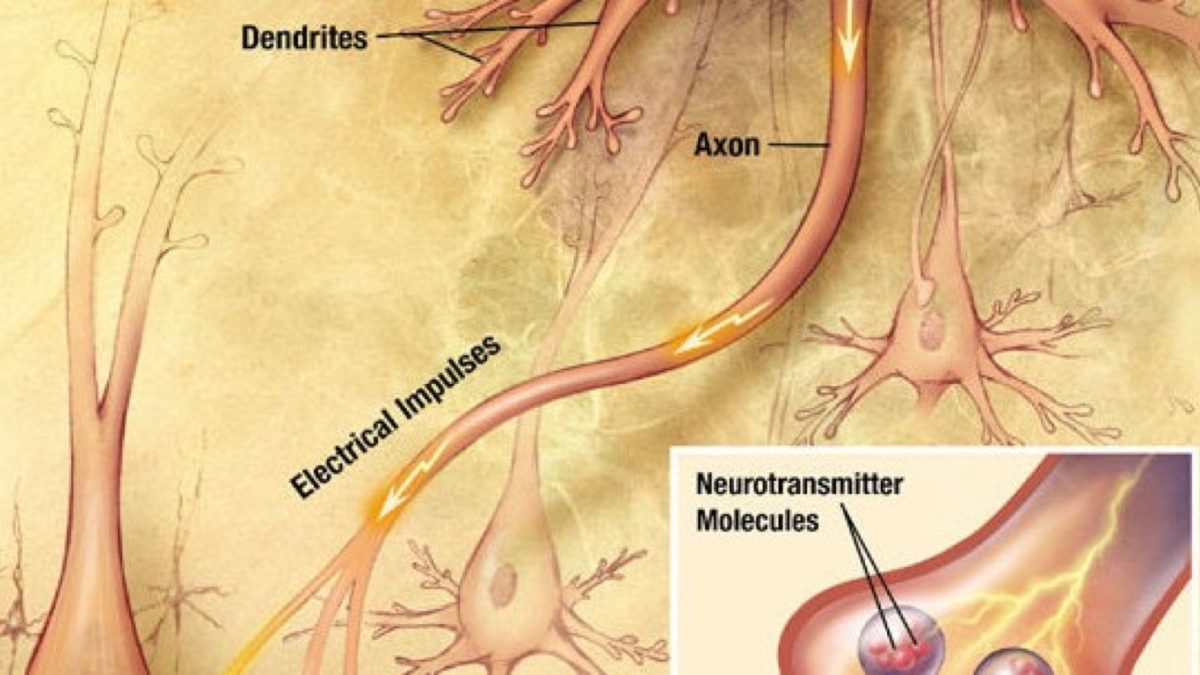
Electron microscopy in the 1950s revealed the physical anatomy of the chemical synapse: a synaptic cleft measuring barely 20 to 40 nanometers wide. The presynaptic terminal contains thousands of membrane-bound spheres: synaptic vesicles, each packed with approximately 5,000 neurotransmitter molecules.
- Glutamate: The master excitatory currency of the brain ($sim 80%$ of cortical synapses), driving cognitive processing and synaptic plasticity via NMDA receptors.
- GABA ($gamma$-aminobutyric acid): The master inhibitory governor, preventing runaway epileptic excitation and sculpting cortical rhythms through hyperpolarizing chloride influx.
- Dopamine: The molecular engine of anticipation, reward prediction error ($RPE = text{Reward}_{text{received}} – text{Reward}_{text{predicted}}$), motivation, and executive salience produced in the substantia nigra and ventral tegmental area (VTA).
- Serotonin (5-HT): Synthesized in the brainstem raphe nuclei, modulating mood, emotional resilience, social dominance, and psychedelic altered states via $5-text{HT}_{2A}$ receptor agonism.
- Norepinephrine: The vigilance broadcaster of the locus coeruleus, sharpening sensory signal-to-noise ratios and arousal.
By transforming binary electrical spikes into an analog chemical palette, the synapse endows the brain with extraordinary computational flexibility, allowing physical matter to synthesize the rich emotional tapestry of the human soul.
- Calcium Influx: When an action potential invades the axon terminal, depolarization triggers voltage-gated $text{Ca}^{2+}$ channels to open. Calcium ions flood into the presynaptic cytoplasm.
- SNARE-Mediated Exocytosis: Calcium binds to synaptotagmin, actuating SNARE protein complexes (synaptobrevin, syntaxin, SNAP-25) to fuse the vesicle membrane with the presynaptic terminal, dumping neurotransmitters into the cleft in microseconds.
- Receptor Activation: Neurotransmitter molecules diffuse across the cleft, binding to specialized post-synaptic receptors:
- Ionotropic Receptors (Ligand-Gated Channels): Fast millisecond gating, causing direct ion fluxes (e.g., AMPA, NMDA, $text{GABA}_A$).
- Metabotropic Receptors (G-Protein Coupled Receptors – GPCRs): Slower, modulatory cascades activating second messengers (cyclic AMP, $text{IP}_3$), remodeling the biochemical internal state of the neuron.
- Clearance: Signals are terminated swiftly by enzymatic degradation (e.g., acetylcholinesterase) or high-affinity reuptake transporters.
The Neurotransmitter Spectrum: The Chemistry of Consciousness
Human conscious experience is not an undifferentiated electric hum; it is textured and modulated by distinct neurotransmitter families:
- Glutamate: The master excitatory currency of the brain ($sim 80%$ of cortical synapses), driving cognitive processing and synaptic plasticity via NMDA receptors.
- GABA ($gamma$-aminobutyric acid): The master inhibitory governor, preventing runaway epileptic excitation and sculpting cortical rhythms through hyperpolarizing chloride influx.
- Dopamine: The molecular engine of anticipation, reward prediction error ($RPE = text{Reward}_{text{received}} – text{Reward}_{text{predicted}}$), motivation, and executive salience produced in the substantia nigra and ventral tegmental area (VTA).
- Serotonin (5-HT): Synthesized in the brainstem raphe nuclei, modulating mood, emotional resilience, social dominance, and psychedelic altered states via $5-text{HT}_{2A}$ receptor agonism.
- Norepinephrine: The vigilance broadcaster of the locus coeruleus, sharpening sensory signal-to-noise ratios and arousal.
By transforming binary electrical spikes into an analog chemical palette, the synapse endows the brain with extraordinary computational flexibility, allowing physical matter to synthesize the rich emotional tapestry of the human soul.