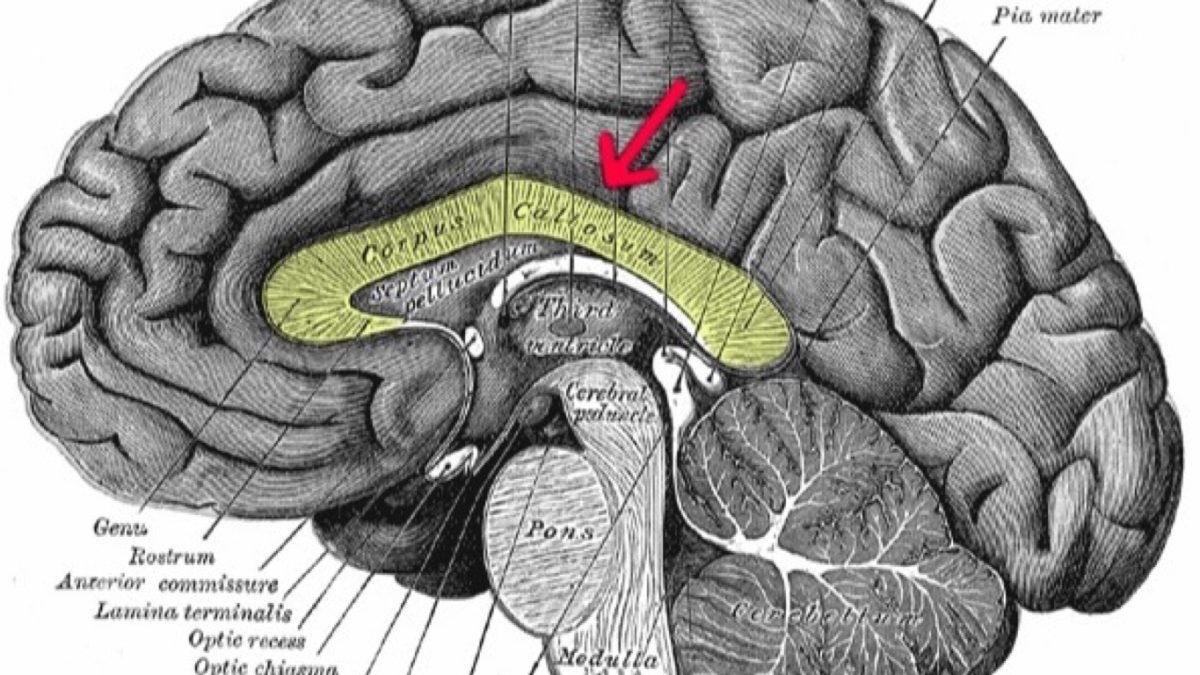
One of the deepest intuitions of human existence is the unity of the conscious self: we perceive ourselves as a single, indivisible ‘I’ navigating reality. In the 1960s, at the California Institute of Technology, neurobiologist Roger Sperry and his brilliant graduate student Michael Gazzaniga conducted a series of experiments on patients who had undergone a radical surgical procedure to treat intractable epilepsy: severing the corpus callosum—the two-hundred-million-axon superhighway connecting the left and right cerebral hemispheres. Their findings shattered the dogma of psychological indivisibility: inside a single human skull resided not one, but two independent streams of conscious awareness.
The Bridge Between the Hemispheres: The Corpus Callosum
The human brain is physically bifurcated into two cerebral hemispheres joined by a massive crescent-shaped commissural tract: the corpus callosum. In healthy individuals, the two halves communicate at rates exceeding four billion impulses per second, exchanging perceptual, emotional, and cognitive data to create the illusion of seamless unified awareness.
In the 1940s, neurosurgeon William Van Wagenen performed partial callosotomies on severe epileptics to prevent localized seizures from propagating into catastrophic generalized status epilepticus. Surprisingly, initial neurological tests showed virtually no deficits in daily life: patients walked, talked, and solved puzzles normally, leading Karl Lashley to famously joke that the only function of the corpus callosum was to transmit epileptic seizures from one side to the other, or keep the two hemispheres from sagging!
The Caltech Split-Screen Paradigm
Roger Sperry and Michael Gazzaniga realized that everyday behavior concealed subtle deficits because split-brain patients constantly moved their eyes, allowing both hemispheres to sample the visual field. To isolate the hemispheres, they built a specialized tachistoscope:
- The right hand (left hemisphere) correctly pointed to a chicken.
- The left hand (right hemisphere) correctly pointed to a snow shovel.
When asked why his left hand was pointing to a shovel, the speaking left hemisphere did not admit ignorance. Instead, it instantly fabricated a plausible post-hoc rationalization: “Oh, that’s simple. The chicken claw goes with the chicken, and you need a shovel to clean out the chicken coop!”
Gazzaniga dubbed this left-hemisphere module the Interpreter. Its role is to construct coherent causal narratives to explain our actions, emotions, and decisions—even when the true causes originate entirely outside conscious linguistic awareness.
Dual Consciousness and Sperry’s Nobel Prize
Sperry and Gazzaniga proved that the right hemisphere was not an unconscious biological appendage, but a fully sentient, conscious mind capable of non-verbal reasoning, spatial geometry, emotional depth, facial recognition, and independent volition. In some patients, the two hands actively competed: the left hand would pull up trousers while the right hand pulled them down, or the left hand would slap a spouse while the right hand embraced them (alien hand syndrome).
“Each hemisphere is indeed a conscious system in its own right, perceiving, thinking, remembering, reasoning, willing, and emoting, all at a characteristically human level.” — Roger Sperry, 1974
Awarded the 1981 Nobel Prize in Physiology or Medicine, Sperry shattered the illusion of the indivisible Cartesian soul. If a surgical scalpel slicing through a bundle of white matter fibers can split the human mind into two autonomous conscious entities, consciousness cannot be an immaterial, indivisible ghost; it is an emergent property woven from the physical architecture of the brain.
- Visual information flashed to the Right Visual Field (RVF) projects exclusively to the visual cortex of the Left Hemisphere (which controls the right hand and harbors fluent speech).
- Visual information flashed to the Left Visual Field (LVF) projects exclusively to the visual cortex of the Right Hemisphere (which controls the left hand and is essentially mute).
When the word “RING” was flashed to the right visual field, patient W.J. effortlessly read aloud: “Ring.” But when the word “KEY” was flashed to the left visual field, W.J. reported: “I didn’t see anything.” Yet when asked to reach under an opaque screen with his left hand and select an object matching the word, his left hand immediately grasped the key out of a pile of items!
When Gazzaniga asked why he was holding a key, the speaking left hemisphere—completely blind to the visual stimuli presented to the right—replied: “Oh, I don’t know, my fingers just picked it up.”
The Left-Brain Interpreter
In another classic experiment, Gazzaniga presented two simultaneous pictures: a chicken claw to the left hemisphere (RVF) and a snowy landscape to the right hemisphere (LVF). The patient was asked to choose related pictures from an array:
- The right hand (left hemisphere) correctly pointed to a chicken.
- The left hand (right hemisphere) correctly pointed to a snow shovel.
When asked why his left hand was pointing to a shovel, the speaking left hemisphere did not admit ignorance. Instead, it instantly fabricated a plausible post-hoc rationalization: “Oh, that’s simple. The chicken claw goes with the chicken, and you need a shovel to clean out the chicken coop!”
Gazzaniga dubbed this left-hemisphere module the Interpreter. Its role is to construct coherent causal narratives to explain our actions, emotions, and decisions—even when the true causes originate entirely outside conscious linguistic awareness.
Dual Consciousness and Sperry’s Nobel Prize
Sperry and Gazzaniga proved that the right hemisphere was not an unconscious biological appendage, but a fully sentient, conscious mind capable of non-verbal reasoning, spatial geometry, emotional depth, facial recognition, and independent volition. In some patients, the two hands actively competed: the left hand would pull up trousers while the right hand pulled them down, or the left hand would slap a spouse while the right hand embraced them (alien hand syndrome).
“Each hemisphere is indeed a conscious system in its own right, perceiving, thinking, remembering, reasoning, willing, and emoting, all at a characteristically human level.” — Roger Sperry, 1974
Awarded the 1981 Nobel Prize in Physiology or Medicine, Sperry shattered the illusion of the indivisible Cartesian soul. If a surgical scalpel slicing through a bundle of white matter fibers can split the human mind into two autonomous conscious entities, consciousness cannot be an immaterial, indivisible ghost; it is an emergent property woven from the physical architecture of the brain.