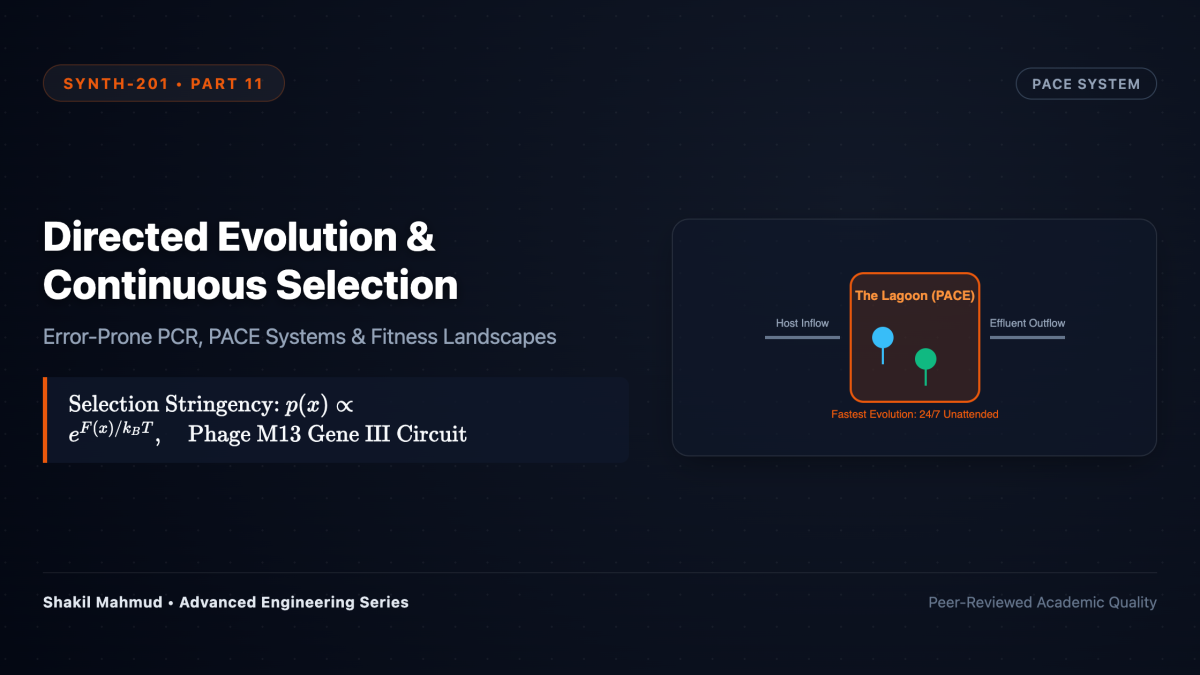
Rational protein design often humbles the human engineer: the atomic physics of macromolecular folding, allosteric networks, and solvent entropy are too subtle to predict from first principles alone. When rational design stalls, synthetic biology turns to the most powerful optimization algorithm in the universe: Darwinian Natural Selection. Awarded the 2018 Nobel Prize in Chemistry to Frances Arnold, Directed Evolution accelerates billions of years of biological adaptation into laboratory timescales. In this installment, we explore error-prone mutagenesis, fitness landscapes, and David Liu’s autonomous PACE technology.
1. The Directed Evolution Cycle and Fitness Landscapes
Directed evolution operates as an iterative engineering algorithm mimicking natural selection:
[
ext{Parent Gene} xrightarrow{ ext{Mutagenesis}} ext{Variant Library } (10^7 – 10^{10}) xrightarrow{ ext{Selection / Screening}} ext{Enriched Winners} xrightarrow{ ext{Iterate}} ext{Evolved Enzyme}
]
Mathematically, the process navigates an (N)-dimensional Sequence Fitness Landscape (mathcal{F}: mathcal{A}^L o mathbb{R}^+), mapping a peptide sequence of length (L) to a fitness score (catalytic turnover (k_{ ext{cat}}/K_m), thermostability (T_m), or stereoselectivity (ee)).
Because sequence space is astronomically vast ((20^{300} approx 10^{390}) variants for a modest 300-residue enzyme), the landscape cannot be searched globally. Instead, directed evolution performs an adaptive random walk along adaptive fitness peaks:
- Error-Prone PCR (epPCR): Polymerase chain reaction performed under conditions that compromise polymerase fidelity—adding manganese ions (( ext{Mn}^{2+})), altering unequal dNTP ratios, or using engineered error-prone polymerases—introducing (1 – 3) point mutations per gene.
- DNA Shuffling (Stemmer Recombination): Fragmenting homologous mutant genes with DNase I and reassembling them via primer-less PCR to recombine beneficial mutations while purging deleterious ones.
2. Phage-Assisted Continuous Evolution (PACE)
Traditional directed evolution requires manual pipetting, plating, growth, and selection over several days per cycle. In 2011, David Liu’s laboratory developed Phage-Assisted Continuous Evolution (PACE): an autonomous system that completes dozens of rounds of Darwinian evolution per day without human intervention.
The molecular circuit of PACE is engineered into the life cycle of bacteriophage M13:
- The Selection Phage (SP): The viral genome carries the target evolving gene (e.g., an RNA polymerase, Cas9, or enzyme). Crucially, the essential viral coat protein, Gene III ((pIII)), is deleted from the phage genome. Without (pIII), progeny phages are non-infectious.
- The Host Cell & Accessory Plasmid (AP): The host E. coli carry an Accessory Plasmid where the expression of (pIII) is driven strictly by the desired biochemical activity of the evolving gene. For example, if evolving a T7 RNAP to recognize a novel promoter, (pIII) transcription is placed under the control of that novel promoter.
- The Mutagenesis Plasmid (MP): An inducible plasmid inside the host cell that temporarily depresses DNA proofreading (suppressing (dnaQ) and overexpressing cytidine deaminases), boosting the mutation rate by (300{,}000)-fold without killing the host.
3. Dynamics of the Continuous Chemostat Lagoon
The evolutionary competition takes place in a continuously flowing vessel called the Lagoon. Host E. coli flow continuously into the lagoon from a turbidostat chemostat, while spent culture flows out. The mean residence time of the host cells in the lagoon (( au_{ ext{flow}} approx 10 – 20 ext{ min})) is shorter than the host division time (( au_{ ext{cell}} approx 30 ext{ min})), ensuring that host cells are washed out before they can accumulate chromosomal mutations.
However, the phage replication cycle is ultra-fast (( au_{ ext{phage}} approx 10 ext{ min})). Only selection phages carrying an evolving gene variant that successfully activates (pIII) expression produce infectious progeny that survive washout. In PACE, proteins undergo hundreds of generations of continuous Darwinian evolution over a single weekend, conquering previously unimaginable catalytic functions.