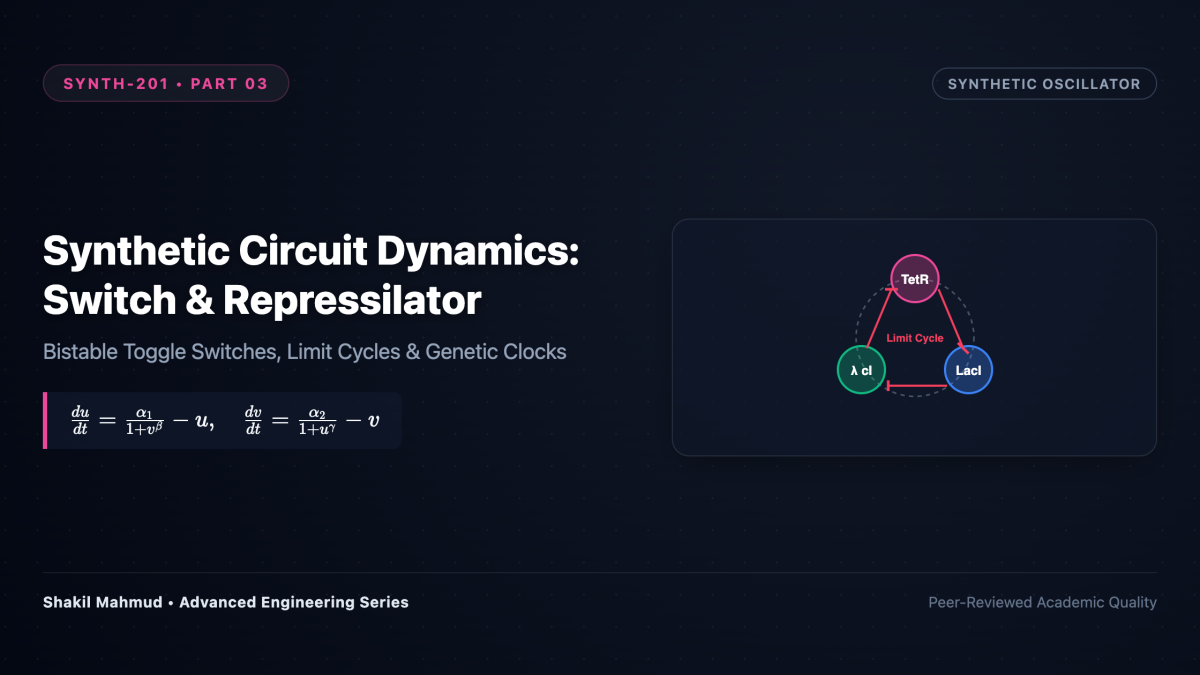
The year 2000 marks the official birth of modern synthetic biology, defined by the publication of two seminal papers in Nature: the bistable genetic Toggle Switch by Timothy Gardner, Charles Cantor, and James Collins, and the synthetic biological clock, the Repressilator, by Michael Elowitz and Stanislas Leibler. These milestone circuits proved that living cells could be programmed with deliberate nonlinear dynamical behaviors: bistability (memory) and stable limit cycle oscillations (clocks). In this article, we rigorously analyze the phase-space dynamics and bifurcations of these landmark systems.
1. The Gardner-Cantor-Collins Synthetic Toggle Switch
The genetic toggle switch consists of two mutually repressing transcriptional repressor genes, (u) (e.g., (cI)) and (v) (e.g., (LacI)), arranged in a closed feedback loop:
[
ext{Gene } 1 xrightarrow{ ext{Repressed by } v} u qquad ext{and} qquad ext{Gene } 2 xrightarrow{ ext{Repressed by } u} v
]
The dimensionless dynamical equations governing normalized concentrations (u) and (v) are:
[
rac{du}{dt} = rac{alpha_1}{1 + v^beta} – u
]
[
rac{dv}{dt} = rac{alpha_2}{1 + u^gamma} – v
]
where (alpha_1, alpha_2) are effective promoter strengths and (beta, gamma) are the Hill cooperativity coefficients of repression.
2. Nullcline Analysis and Pitchfork Bifurcations
Steady states correspond to intersections of the Nullclines (dot{u} = 0) and (dot{v} = 0):
[
u = rac{alpha_1}{1 + v^beta}, quad v = rac{alpha_2}{1 + u^gamma}
]
In the symmetric case ((alpha_1 = alpha_2 = alpha) and (beta = gamma)), substituting yields the single fixed-point equation:
[
u = rac{alpha}{1 + left( rac{alpha}{1 + u^beta}
ight)^beta}
]
The Jacobian matrix evaluated at an equilibrium point ((u^*, v^*)) is:
[
mathbb{J} = begin{pmatrix} -1 & -rac{alpha beta (v^*)^{beta-1}}{(1 + (v^*)^beta)^2} -rac{alpha beta (u^*)^{beta-1}}{(1 + (u^*)^beta)^2} & -1 nd{pmatrix} = begin{pmatrix} -1 & -a -b & -1 nd{pmatrix}
]
The eigenvalues obey (det(mathbb{J} – lambda mathbb{I}) = (-1 – lambda)^2 – ab = 0 implies lambda = -1 pm sqrt{ab}).
If (beta = gamma = 1) (no cooperativity), (ab < 1) for all parameters, so (lambda < 0) everywhere: the system has only one unique stable fixed point. No memory or bistability is possible without cooperativity!
When (beta > 1) and promoter strength (alpha) exceeds a critical threshold (alpha_{ ext{crit}}), the system undergoes a Pitchfork / Cusp Bifurcation. The central symmetric state becomes an unstable saddle point ((lambda_1 > 0, lambda_2 < 0)), giving birth to two new stable fixed points:
- State 1 (High (u), Low (v)): Gene 1 is ON, silencing Gene 2.
- State 2 (Low (u), High (v)): Gene 2 is ON, silencing Gene 1.
Transient chemical or thermal pulses (e.g., IPTG or heat) flip the switch irreversibly between states, creating the first 1-bit non-volatile cellular RAM.
3. The Elowitz-Leibler Repressilator: Limit Cycle Oscillations
While mutual repression of two genes generates bistability, a cyclical cascade of three mutually repressing genes produces stable oscillations. In the Repressilator, three repressors form an odd-numbered loop:
[
ext{TetR} dashv ext{LacI} dashv lambda,cI dashv ext{TetR}
]
Letting (m_i) and (p_i) ((i in {1, 2, 3})) denote the mRNA and protein concentrations:
[
rac{dm_i}{dt} = rac{alpha}{1 + p_j^n} – m_i, qquad rac{dp_i}{dt} = -beta(p_i – m_i) quad ext{where } (i, j) in {(1,3), (2,1), (3,2)}
]
Linear stability analysis of the unique symmetric equilibrium point (p_1^* = p_2^* = p_3^* = p^*) reveals that when cooperativity (n > 2) and protein-to-mRNA ratio (beta) is sufficiently large, the eigenvalues cross the imaginary axis into the right-half plane via a Supercritical Hopf Bifurcation:
[
ext{Re}(lambda) > 0 quad iff quad rac{alpha n (p^*)^{n-1}}{(1 + (p^*)^n)^2} > rac{4}{3} left(1 + rac{1}{beta}
ight)
]
By the Poincaré-Bendixson theorem extended to monotone cyclic systems, the trajectories cannot escape to infinity nor collapse to a point; they are trapped on a stable Limit Cycle. In living E. coli, the synthetic genetic clock ticks smoothly with a period of several hours, flashing green fluorescent protein (GFP) synchronously with every cellular breath.