While microbial engineering revolutionized industrial fermentation, Mammalian Synthetic Biology has unlocked the ultimate frontier of medicine: programming human cells to act as autonomous, living therapeutics. Rather than administering dumb chemical molecules that diffuse indiscriminately throughout the patient, oncologists now infuse living human T-cells engineered with synthetic sensory receptors, genetic kill logic, and memory circuits. In this installment, we explore the molecular architecture of CAR-T Cells and Wendell Lim’s modular Synthetic Notch (synNotch) receptors.
1. The Architecture of Chimeric Antigen Receptors (CARs)
Natural T-Cell Receptors (TCRs) recognize intracellular peptides presented on cell surfaces by Major Histocompatibility Complex (MHC) Class I molecules. Cancer cells frequently escape immune surveillance by downregulating MHC expression. A Chimeric Antigen Receptor (CAR) is a synthetic modular fusion protein that bypasses MHC restriction, recognizing intact native surface antigens with antibody-like specificity:
- Extracellular Antigen Recognition Domain: A Single-Chain Variable Fragment (scFv) derived from the variable light ((V_L)) and heavy ((V_H)) chains of a monoclonal antibody joined by a flexible ((Gly_4Ser)_3) linker.
- Hinge and Transmembrane Domain: Derived from CD8(alpha) or CD28, projecting the scFv away from the plasma membrane at optimal distance.
- Intracellular Signaling Endodomain: In modern 2nd-generation and 3rd-generation CARs, the primary activation motif (three immunoreceptor tyrosine-based activation motifs [ITAMs] from CD3(zeta)) is linked in tandem to one or more Costimulatory Domains (e.g., CD28 for rapid peak cytotoxicity, or 4-1BB / CD137 for prolonged mitochondrial biogenesis, persistent survival, and immune memory).
When the scFv binds a tumor antigen (such as CD19 on malignant B-cells), receptors cluster at the immunological synapse. Lck kinase phosphorylates the CD3(zeta) ITAMs, triggering Zap70 recruitment, intracellular calcium flux, and perforin/granzyme-mediated apoptosis of the tumor target.
2. The Problem of On-Target, Off-Tumor Toxicity
While CAR-T therapies (e.g., Kymriah, Yescarta) have achieved miraculous complete remission rates in hematologic liquid cancers, treating solid tumors remains notoriously difficult. Solid tumor antigens (e.g., EGFR, HER2, CEA) are rarely unique to cancer cells; they are shared with healthy normal tissues. Infusing conventional CAR-T cells targeting HER2 can cause lethal cross-reactive destruction of lung and heart tissues—a fatal complication known as On-Target, Off-Tumor Toxicity.
3. Wendell Lim’s Synthetic Notch (synNotch) Receptors
To overcome off-tumor toxicity, Wendell Lim’s laboratory at UCSF engineered Synthetic Notch (synNotch) receptors. Natural Notch is a conserved developmental receptor that undergoes regulated intramembrane proteolysis upon physical engagement with its ligand Delta.
A synNotch receptor strips away the natural extracellular and intracellular Notch domains, retaining only the regulatory core:
[
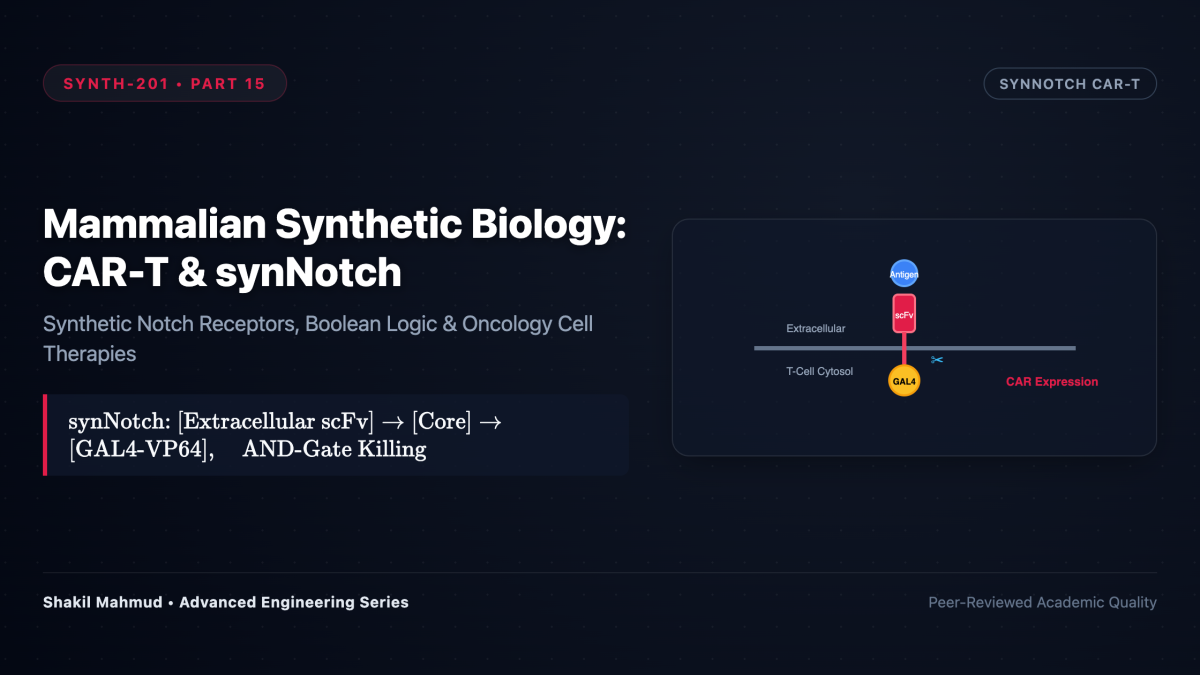
ext{synNotch} = [ ext{Custom Extracellular scFv}] – [ ext{Notch Core (LNR + HD + TMD)}] – [ ext{Orthogonal Transcription Factor (e.g., Gal4-VP64 / tTA)}]
]
The activation mechanism is purely mechanical:
- When the extracellular scFv binds its target antigen on a target cell, physical mechanical tension ((sim 5 – 20 ext{ pN})) pulls on the receptor, unfolding the protective regulatory domain.
- Unfolding exposes hidden cleavage sites for membrane-associated ADAM metalloproteases and (gamma)-secretase complexes.
- Proteolysis releases the intracellular transcription factor (e.g., Gal4), which translocates to the nucleus to drive the transcription of custom target genes from an engineered Gal4-UAS promoter.
4. Combinatorial Boolean Logic for Precision Oncology
By wiring synNotch receptors to downstream CAR expression, synthetic biologists construct a cellular Boolean AND-Gate:
[
ext{T-Cell recognizes Antigen A via synNotch} xrightarrow{ ext{Proteolysis & Transcription}} ext{Induces expression of CAR targeting Antigen B}
]
[
ext{Induced CAR binds Antigen B} xrightarrow{ ext{Immunological Synapse}} ext{Perforin/Granzyme Lysis}
]
The therapeutic consequences are revolutionary:
- Healthy tissue with Antigen A alone: synNotch activates, inducing the CAR, but without Antigen B, the cell remains harmless.
- Healthy tissue with Antigen B alone: No synNotch activation occurs; the cell lacks the CAR and remains completely inactive.
- Tumor tissue with Antigen A AND Antigen B: synNotch induces the CAR, the CAR finds Antigen B, and the tumor is eradicated with surgical molecular specificity.