When first adapted as a genome engineering tool in 2012–2013, CRISPR-Cas9 was primarily operated as programmable molecular shears: generating double-strand breaks (DSBs) repaired haphazardly by error-prone non-homologous end joining (NHEJ). In synthetic biology, however, double-strand breaks are blunt and hazardous. Modern molecular bioengineering has transcended cleavage, transforming Cas9 into a universal, programmable DNA-homing chassis. In this treatise, we explore dCas9, base editing chemistry, prime editing, and targeted epigenetic modulation.
1. Catalytically Inactive dCas9: CRISPRi and CRISPRa
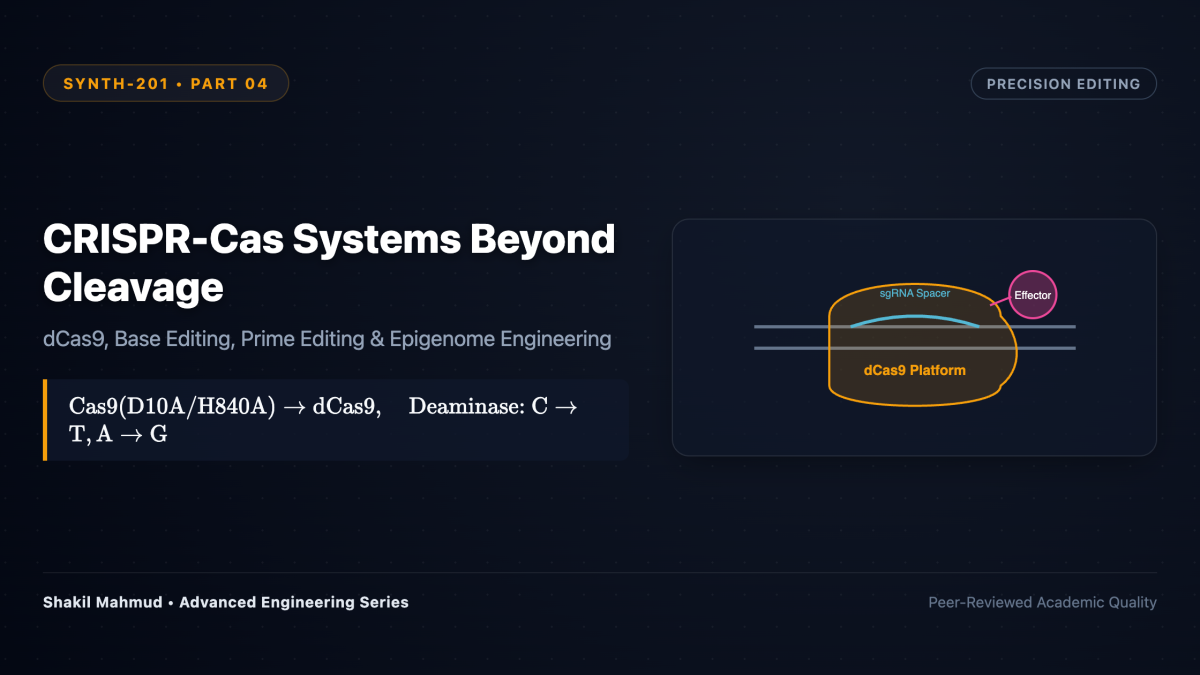
Wild-type Streptococcus pyogenes Cas9 contains two distinct endonuclease catalytic domains: the RuvC domain (which cleaves the non-target DNA strand) and the HNH domain (which cleaves the target strand complementary to the guide RNA). Introducing two point mutations:
[
ext{D10A (Aspartate } o ext{ Alanine in RuvC)} quad ext{and} quad ext{H840A (Histidine } o ext{ Alanine in HNH)}
]
completely abolishes endonuclease cleavage activity while preserving high-affinity RNA-guided DNA binding ((K_d sim 10 – 100 ext{ pM})). The resulting protein is deactivated Cas9 (dCas9).
Synthetic biologists deploy dCas9 as an addressable genetic scaffold:
- CRISPR Interference (CRISPRi): Targeting dCas9 to an open reading frame or promoter physically blocks RNA polymerase elongation, silencing transcription by up to (99.9%) without altering a single genomic base pair.
- CRISPR Activation (CRISPRa): Fusing dCas9 to transcriptional transactivation domains (e.g., VP64, p65, Rta—the VPR tripartite activator, or the SunTag peptide array) recruits endogenous RNA polymerase II, upregulating silent genes by hundreds of folds.
2. Base Editing: Direct Nucleotide Transitions Without DSBs
Developed by David Liu’s laboratory, Base Editors engineer precise point mutations by tethering a single-stranded DNA deaminase to Cas9 nickase (Cas9n D10A, which cuts only the unedited strand to bias mismatch repair):
- Cytosine Base Editors (CBE): Fuse Cas9n with cytidine deaminase (e.g., rAPOBEC1) and a Uracil DNA Glycosylase Inhibitor (UGI). In the unwound R-loop window ((sim) positions 4–8 of the protospacer), cytidine is hydrolytically deaminated into uracil:
[
ext{Cytosine} xrightarrow{ ext{APOBEC1}} ext{Uracil}
]
Subsequent replication or mismatch repair converts the ( ext{U:G}) pair into a ( ext{T:A}) base pair, achieving an exact ( ext{C} o ext{T}) (or ( ext{G} o ext{A})) transition. - Adenine Base Editors (ABE): Because no natural enzyme deaminates adenine in DNA, Liu evolved a transfer-RNA adenosine deaminase (TadA) to accept single-stranded DNA, deaminating adenine into inosine:
[
ext{Adenine} xrightarrow{ ext{TadA*}} ext{Inosine (read as Guanosine)}
]
Repair machinery replaces ( ext{I:T}) with ( ext{G:C}), delivering precise ( ext{A} o ext{G}) (or ( ext{T} o ext{C})) transitions with virtually zero indels.
3. Prime Editing: The Search-and-Replace Molecular Word Processor
Base editors are limited to transition mutations and cannot perform transversions (( ext{C} o ext{G}), ( ext{A} o ext{C})), insertions, or deletions. In 2019, Anzalone et al. unveiled Prime Editing. A prime editor consists of a Cas9 nickase (H840A) fused to an engineered Moloney Murine Leukemia Virus (M-MLV) Reverse Transcriptase (RT), guided by a prime editing guide RNA (pegRNA).
The pegRNA is extended at its 3′ end with a Primer Binding Site (PBS) and a Reverse Transcription Template containing the desired edit. The execution unfolds across four physical steps:
[
ext{Binding} implies ext{Non-target strand nicking} implies ext{PBS hybridization} implies ext{De novo reverse transcription}
]
The newly reverse-transcribed 3′ flap displaces the endogenous 5′ flap. Cellular flap endonucleases excise the unedited 5′ flap, permanently incorporating arbitrary transitions, transversions, insertions (up to dozens of bp), or deletions without double-stranded breaks or exogenous donor DNA templates.
4. Targeted Epigenome Engineering
Beyond nucleotide sequences, cellular phenotypes are governed by the epigenome. Fusing dCas9 to chromatin-modifying enzymes allows durable, inheritable transcriptional reprogramming:
- Epigenetic Silencing: Fusing dCas9 with the KRAB repressor and DNA methyltransferases (DNMT3A-DNMT3L) deposits dense 5-methylcytosine ((5 ext{mC})) marks at CpG islands, inducing heterochromatin condensation that silences oncogenes permanently across dozens of cell divisions.
- Epigenetic Re-activation: Fusing dCas9 to ten-eleven translocation dioxygenases (TET1) demethylates (5 ext{mC}) to 5-hydroxymethylcytosine ((5 ext{hmC})), reopening compact chromatin and restoring tumor suppressor gene expression.