By the mid-twenty-first century, a burgeoning global population of ten billion people combined with accelerating climate instability will demand a fifty percent increase in agricultural caloric output from shrinking arable land. Traditional selective breeding has reached its biological plateau. To engineer a second Green Revolution, Plant Synthetic Biology rewires the fundamental thermodynamic machinery of primary production: supercharging photosynthesis, installing synthetic C4 carbon-concentrating mechanisms, and engineering crops that fix their own nitrogen directly from air.
1. Chloroplast Genetic Engineering (Transplastomics)
Unlike nuclear transformation, which integrates foreign DNA haphazardly into chromosomes with variable expression and risks environmental transgenic escape via windborne pollen, Chloroplast Transformation (Transplastomics) offers profound engineering advantages:
- Maternal Inheritance: In almost all angiosperms, plastids are inherited strictly through the maternal ovule; pollen contains zero plastid DNA, eliminating transgenic gene flow into wild relatives.
- Astronomical Expression Levels: A single plant cell contains up to 100 chloroplasts, each housing approximately 100 copies of the circular plastome ((10{,}000) genome copies per cell). Recombinant proteins can accumulate to over 40% of total soluble leaf protein.
- Polycistronic Operons: Chloroplasts evolved from cyanobacterial endosymbionts and retain prokaryotic transcription machinery, allowing synthetic biologists to express multi-gene metabolic operons from a single synthetic promoter.
DNA is delivered into chloroplasts using high-velocity biolistic gold microprojectiles (gene guns), integrating into the inverted repeat region of the plastome via targeted double homologous recombination.
2. Overcoming the Fatal Flaw of Rubisco: Synthetic Photorespiratory Bypasses
The enzyme responsible for nearly all carbon fixation on Earth is Rubisco (Ribulose-1,5-bisphosphate carboxylase-oxygenase). Despite its evolutionary ubiquity, Rubisco is notoriously sluggish ((k_{ ext{cat}} sim 3 ext{ s}^{-1})) and catalytically promiscuous: approximately once out of every four catalytic cycles, Rubisco binds atmospheric ( ext{O}_2) instead of ( ext{CO}_2):
[
ext{RuBP} + ext{O}_2 xrightarrow{ ext{Oxygenation}} 3 ext{-PGA} + 2 ext{-Phosphoglycolate (2PG)}
]
The byproduct, 2-phosphoglycolate (2PG), is a potent metabolic toxin that inhibits key chloroplast enzymes. To detoxify 2PG, the plant executes native Photorespiration—a convoluted recycling pathway shuttling metabolites across chloroplasts, peroxisomes, and mitochondria, which dissipates up to (25 – 40%) of the plant’s net photosynthetic energy.
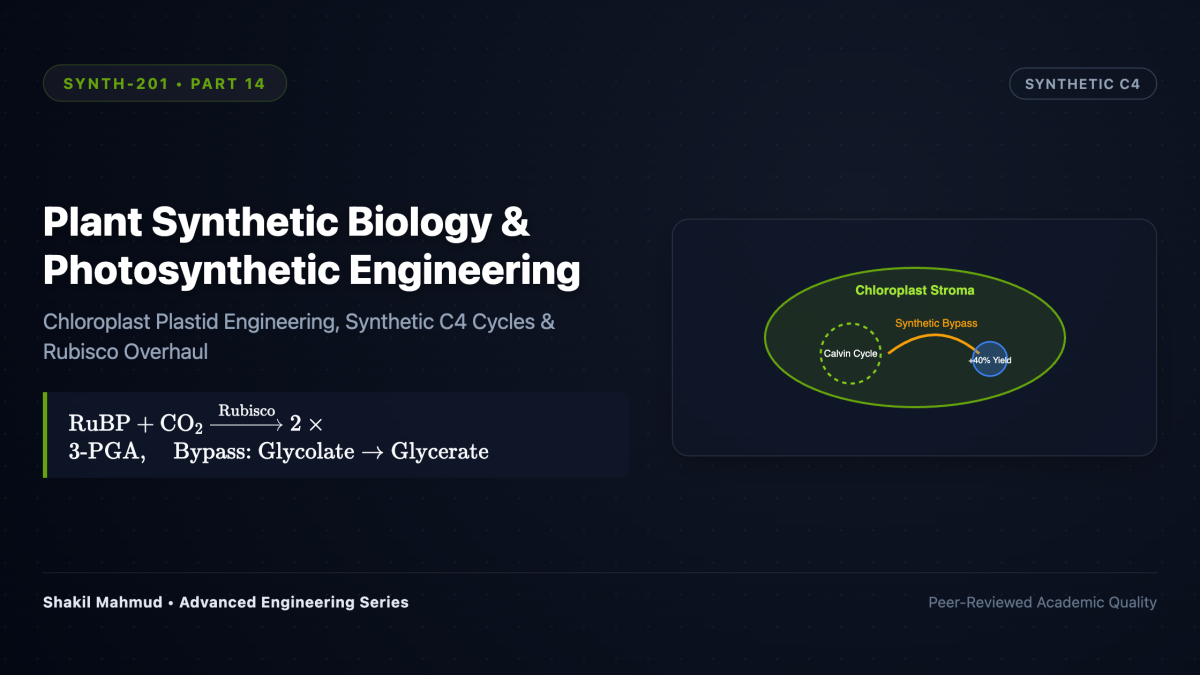
To eliminate this massive thermodynamic loss, South et al. (Science, 2019) engineered the APVO Synthetic Photorespiratory Bypass:
[
2 ext{-PG} xrightarrow{ ext{Glycolate Oxidase}} ext{Glyoxylate} xrightarrow{ ext{Malate Synthase}} ext{Malate} xrightarrow{ ext{Decarboxylation}} ext{Glycerate} + ext{CO}_2
]
Confined entirely within the chloroplast stroma, this synthetic pathway metabolizes glycolate into ( ext{CO}_2) right next to Rubisco, releasing trapped carbon while consuming less ATP. Transgenic field trials demonstrated a staggering 40% increase in crop biomass yield.
3. Engineering Biological Nitrogen Fixation (*nif* Clusters)
Crops consume over 100 million tons of synthetic nitrogen fertilizer annually, produced via the energy-intensive industrial Haber-Bosch process ((sim 2%) of global energy consumption, driving severe greenhouse emissions and aquatic eutrophication). Legumes fix nitrogen via symbiotic root nodules, but major staple cereals (rice, wheat, maize) cannot.
Synthetic biologists are transferring the 16-gene *nif* (Nitrogen Fixation) Operon from the diazotroph Klebsiella oxytoca directly into plant mitochondria or chloroplasts. The target is the oxygen-sensitive multi-protein complex Nitrogenase:
[
ext{N}_2 + 8 ext{H}^+ + 8e^- + 16 ext{ATP} xrightarrow{ ext{MoFe-Nitrogenase}} 2 ext{NH}_3 + ext{H}_2 + 16 ext{ADP} + 16 ext{P}_i
]
Because the Fe-protein component of nitrogenase is irreversibly destroyed by molecular oxygen (( ext{O}_2)), synthetic circuits couple nitrogenase expression to circadian dark cycles or target localization to root mitochondria where intense respiratory oxygen consumption maintains localized micro-aerobic niches, aiming for self-fertilizing cereal crops that render industrial ammonia fertilizers obsolete.