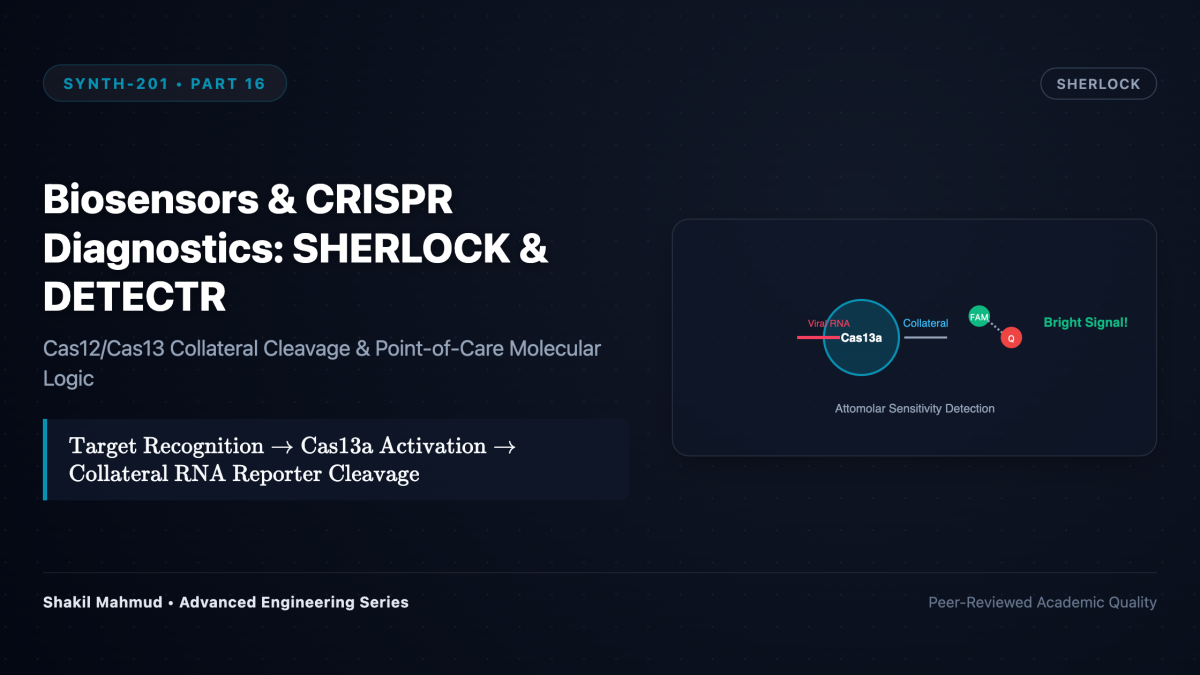
Rapid, sensitive, and decentralized pathogen detection is humanity’s primary shield against global pandemics and biosecurity threats. Traditional PCR tests require expensive laboratory thermocyclers, skilled technicians, and turnaround times of days, while rapid antigen lateral flow tests suffer from poor analytical sensitivity. By harnessing the non-canonical collateral cleavage behavior of specialized CRISPR enzymes, synthetic biologists engineered SHERLOCK and DETECTR: room-temperature molecular diagnostic platforms that detect single viral molecules with attomolar sensitivity.
1. Collateral (Trans) Cleavage in Cas12 and Cas13 Enzymes
While Cas9 cleaves only the specific double-stranded DNA sequence complementary to its guide RNA and remains tightly bound, the discovery of Type V and Type VI CRISPR systems revealed a startling enzymatic phenomenon known as Collateral (Trans) Cleavage:
- Cas12a (Cpf1 – Type V): Guided by a single crRNA, Cas12a recognizes a target double-stranded DNA (dsDNA) adjacent to a 5′-TTTV PAM. Upon binding and cleaving the target in cis, the RuvC catalytic pocket undergoes an allosteric conformational shift into a constitutively active, hyper-promiscuous state that cleaves any nearby single-stranded DNA (ssDNA) at rates of (10^4) turnovers per second.
- Cas13a (C2c2 – Type VI): An RNA-guided, RNA-targeting ribonuclease containing two Higher Eukaryotes and Prokaryotes Nucleotide-binding (HEPN) domains. Upon base pairing with a target single-stranded RNA (ssRNA), the HEPN domains form an external catalytic cleft that non-specifically degrades bystander single-stranded RNA (ssRNA) reporters.
2. The Molecular Mechanism of SHERLOCK and DETECTR
Synthetic biologists realized that collateral cleavage acts as an enormous biological catalytic amplifier: a single viral recognition event triggers the destruction of tens of thousands of bystander reporter molecules.
- SHERLOCK (Specific High-Sensitivity Enzymatic Reporter UnLOCKing): Developed by Feng Zhang’s team at the Broad Institute:
[
ext{Viral RNA} xrightarrow{ ext{RPA + T7 RNAP}} ext{Amplified RNA} xrightarrow{ ext{Cas13a} + ext{crRNA}} ext{Collateral Activation} xrightarrow{ ext{Cleave Reporter}} ext{Fluorescence / Lateral Flow}
]
The reporter consists of a short ssRNA molecule flanked by a fluorophore (e.g., FAM) and a quencher (e.g., Iowa Black). In the intact reporter, fluorescence is quenched by Förster Resonance Energy Transfer (FRET). When Cas13a is activated by target viral RNA, it hydrolyzes the reporter, releasing unquenched, brilliant fluorescent photons. - DETECTR (DNA Endonuclease-Targeted CRISPR Trans Reporter): Developed by Jennifer Doudna’s laboratory, utilizing Cas12a and a fluorescent ssDNA reporter to diagnose DNA viruses (e.g., HPV, adenovirus) or bacteria.
3. Isothermal Amplification and Attomolar Sensitivity
To detect clinical pathogens directly from raw patient swabs without PCR thermal cycling, CRISPR diagnostics are coupled to Recombinase Polymerase Amplification (RPA) or Loop-Mediated Isothermal Amplification (LAMP) at a constant temperature of (37^circ ext{C} – 42^circ ext{C}).
In RPA, a bacteriophage recombinase (uvsX) forms complexes with oligonucleotide primers, invading double-stranded DNA at room temperature, while a strand-displacing DNA polymerase (Bsu or Sau) copies the template. Over a 20-minute incubation, RPA amplifies viral targets by over a billion-fold, driving the overall analytical sensitivity down to attomolar concentrations ((10^{-18} ext{ M}), or (sim 1 – 2 ext{ copies per microliter})).
4. Paper-Based Lateral Flow Strips for Point-of-Care Testing
By replacing the fluorophore-quencher pair with a biotin-fluorescein reporter, CRISPR diagnostics interface directly with commercial cellulose lateral flow strips (identical to home pregnancy tests):
- Intact reporters are captured at the first control line by anti-rabbit antibodies conjugated to gold nanoparticles.
- Cleaved reporters flow freely past the control line, binding to streptavidin at the test line.
The entire diagnostic sequence—from nasal swab lysis to a visible purple line on paper—takes less than 30 minutes at room temperature without power, centrifuges, or instruments, democratizing gold-standard molecular diagnostics worldwide.