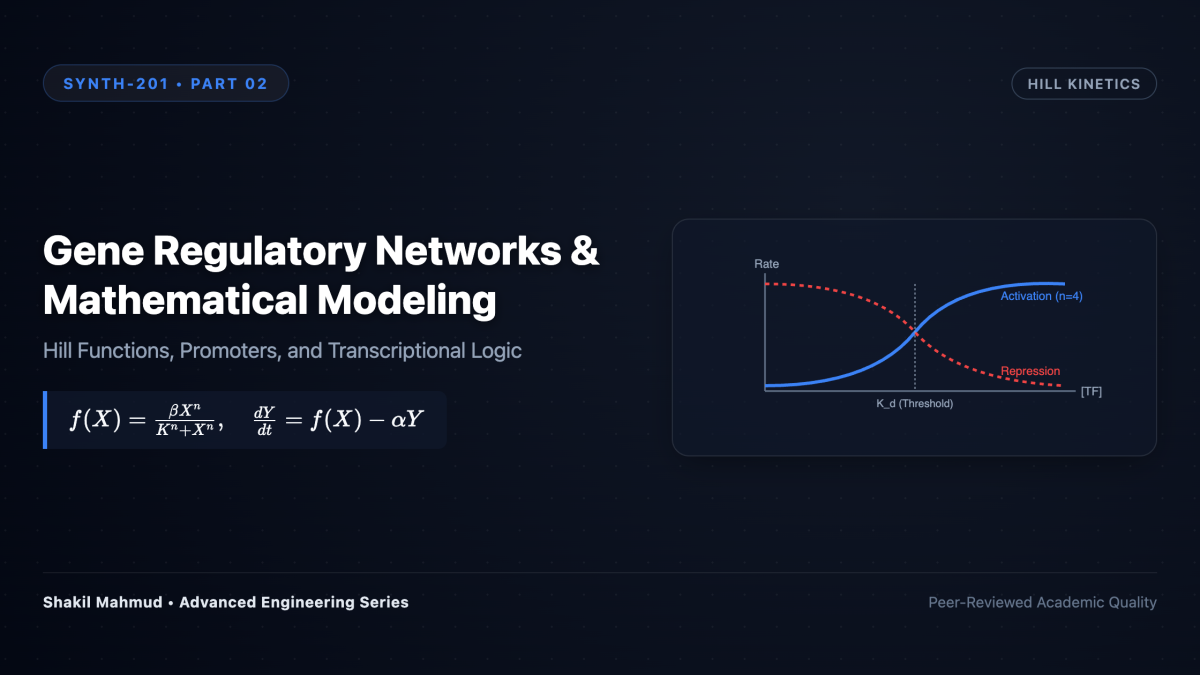
At the molecular scale, cellular decision-making is computed by interconnected networks of promoters, transcription factors, and RNA polymerases. Designing functional genetic circuits without predictive mathematics is impossible: trial-and-error in live cells is far too slow and noisy. In this treatise, we derive the mathematical foundations of Gene Regulatory Networks (GRNs), formulate Hill kinetic functions from chemical equilibrium binding states, and establish the ODE systems governing transcriptional dynamics.
1. Transcriptional and Translational Kinetics (The Central Dogma ODEs)
Consider a synthetic gene where transcription factor (X) regulates the expression of protein (Y). The process unfolds through transcription of mRNA (m_Y) and subsequent ribosomal translation into protein (Y). The biochemical reactions are:
[
ext{Gene } Y xrightarrow{f(X)} m_Y xrightarrow{gamma_m} mptyset, qquad m_Y xrightarrow{beta_p} Y xrightarrow{gamma_p} mptyset
]
where (f(X)) is the regulated transcription rate, (gamma_m) is the mRNA degradation rate, (beta_p) is the translation rate per mRNA molecule, and (gamma_p) is the protein degradation/dilution rate. The dynamics are described by coupled Ordinary Differential Equations (ODEs):
[
rac{d m_Y}{dt} = f(X) – gamma_m m_Y
]
[
rac{d Y}{dt} = beta_p m_Y – gamma_p Y
]
In rapidly dividing bacteria, mRNA decays on timescales of minutes ((gamma_m gg gamma_p)), while proteins are stable and diluted primarily by cell division (( au_{1/2} sim 30 – 60 ext{ min})). Applying the Quasi-Steady-State Approximation (QSSA) to mRNA ((dm_Y/dt approx 0 implies m_Y^* = f(X)/gamma_m)), the system collapses to a single effective differential equation:
[
rac{d Y}{dt} = rac{beta_p}{gamma_m} f(X) – gamma_p Y quiv beta , g(X) – alpha Y
]
where (beta) is the maximal protein synthesis rate and (alpha = gamma_p) is the total decay rate.
2. Derivation of Hill Functions for Cooperative Promoters
The regulatory input function (g(X)) depends on the binding equilibrium of transcription factor (X) to operator sites on the promoter. Suppose (n) molecules of repressor (X) bind cooperatively to promoter site (P):
[
P + n X xrightleftharpoons[k_{ ext{off}}]{k_{ ext{on}}} P cdot X_n
]
The dissociation equilibrium constant is (K_d^n = rac{[P] [X]^n}{[P cdot X_n]}). The total promoter concentration is conserved: ([P_{ ext{tot}}] = [P] + [P cdot X_n]). The fraction of active (unbound) promoters is:
[
heta_{ ext{active}} = rac{[P]}{[P_{ ext{tot}}]} = rac{[P]}{[P] + [P]rac{[X]^n}{K_d^n}} = rac{1}{1 + left(rac{[X]}{K_d}
ight)^n} = rac{K_d^n}{K_d^n + [X]^n}
]
This yields the classic Hill Repression Function:
[
g_{ ext{rep}}(X) = rac{1}{1 + left(X / K_d
ight)^n}
]
Conversely, for an activator where transcription requires the bound complex (P cdot X_n), the fraction of active promoters yields the Hill Activation Function:
[
g_{ ext{act}}(X) = rac{[P cdot X_n]}{[P_{ ext{tot}}]} = rac{left(X / K_d
ight)^n}{1 + left(X / K_d
ight)^n} = rac{X^n}{K_d^n + X^n}
]
The parameter (n) is the Hill Coefficient, quantifying molecular cooperativity:
- (n = 1): Non-cooperative, hyperbolic Michaelis-Menten response.
- (n > 1): Positive cooperativity producing an ultrasensitive, sigmoidal threshold switch. As (n o infty), the response converges to a sharp Heaviside step function (Theta(X – K_d)), mimicking digital boolean logic.
3. Transcriptional Logic Gates (AND, OR, NAND, NOR)
By engineering promoter architectures with multiple operator sites, synthetic biologists implement combinatorial boolean logic in living cells:
- OR Gate (Independent Activators): Promoters containing tandem binding sites for activators (A) and (B) drive transcription if either factor binds:
[
f_{ ext{OR}}(A, B) = beta rac{rac{A^n}{K_A^n} + rac{B^n}{K_B^n} + rac{A^n B^n}{K_A^n K_B^n}}{1 + rac{A^n}{K_A^n} + rac{B^n}{K_B^n} + rac{A^n B^n}{K_A^n K_B^n}}
] - AND Gate (Obligate Heterodimers): Transcription occurs only when both inputs (A) and (B) bind simultaneously to adjacent domains:
[
f_{ ext{AND}}(A, B) = beta rac{A^n B^n}{K_{AB}^{2n} + A^n B^n}
]
Through systematic cascades of these logic gates, living cells compute environmental conditions, evaluate boolean health states, and trigger programmed cellular responses.