For centuries, biology was an observational and descriptive science: cataloging the phenotypes of organisms shaped by four billion years of blind evolutionary tinkery. In the dawn of the twenty-first century, Synthetic Biology inaugurated an audacious paradigm shift: treating molecular biology as an engineering discipline. By applying systematic abstraction hierarchies, standardization, decoupling, and mathematical modeling, synthetic biologists assemble predictable genetic circuits from standardized, interchangeable DNA components. In this inaugural treatise of SYNTH-201, we derive the foundational principles of engineering molecular life.
1. The Engineering Abstraction Hierarchy in Biological Design
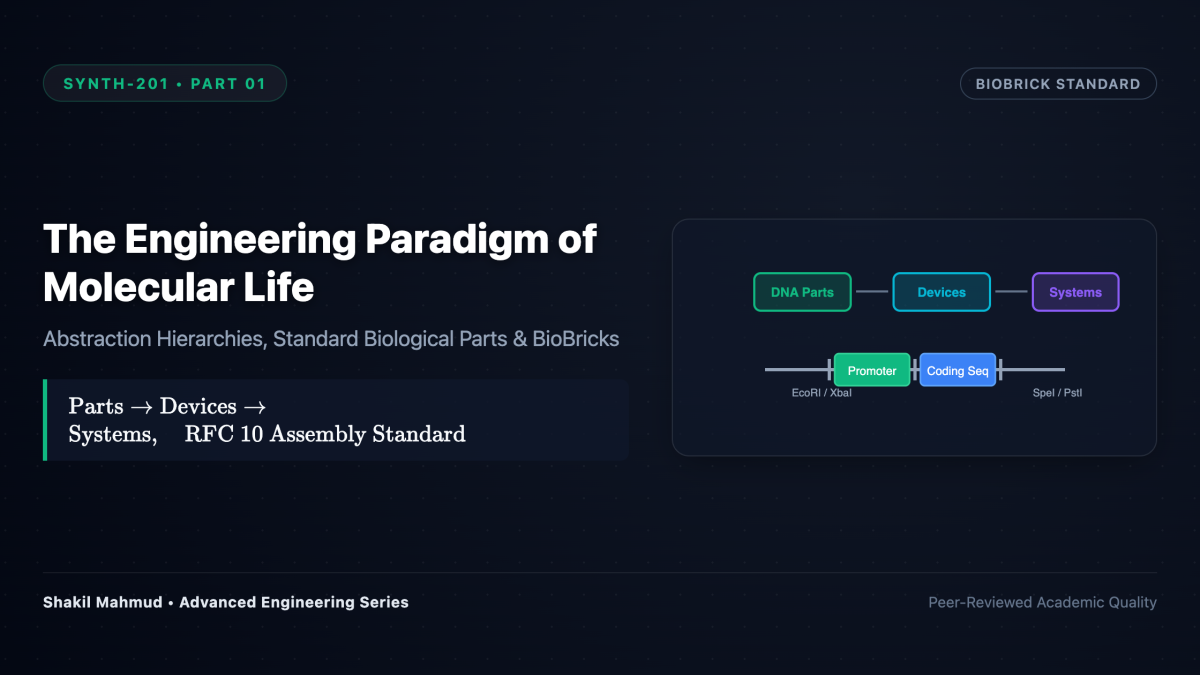
Just as computer engineering decouples semiconductor solid-state physics from high-level software algorithms through transistors, logic gates, and instruction sets, synthetic biology organizes the bewildering complexity of cellular biochemistry into an Abstraction Hierarchy:
- DNA & Chemical Substrates: The physical nucleotide sequences ( ext{A, T, C, G}) synthesized phosphoramidite chemistry or enzymatic polymerization.
- Biological Parts: Discrete, functional genetic elements that encode basic molecular operations. These include promoters (RNA polymerase binding), ribosome binding sites (RBS / Shine-Dalgarno sequences), coding sequences (CDS / open reading frames), and transcriptional terminators.
- Biological Devices: Integrated assemblies of parts designed to perform defined input-output transformations (e.g., inverters, logic gates, biosensors).
- Synthetic Systems: Multi-device networks orchestrating complex cellular programs (e.g., metabolic pathways, synchronized oscillators, multicellular pattern formation).
Crucially, Decoupling ensures that a specialist designing a metabolic genetic circuit does not need to re-engineer DNA chemical synthesis, while Standardization allows biological parts characterized in one laboratory to function identically in host cells across the world.
2. The BioBrick Standard and Idempotent Assembly (RFC 10)
The earliest standardized physical assembly system was formulated by Tom Knight at MIT as the BioBrick Standard (RFC 10). Every BioBrick part is flanked by a standard Prefix and Suffix containing four non-palindromic restriction enzyme recognition sequences:
- Prefix (5′): Contains (EcoRI) ((G{downarrow}AATTC)) and (XbaI) ((T{downarrow}CTAGA)).
- Suffix (3′): Contains (SpeI) ((A{downarrow}CTAGT)) and (PstI) ((CTGC A{downarrow}G)).
The mathematical brilliance of RFC 10 lies in the compatible sticky ends generated by (XbaI) and (SpeI):
[
XbaI: quad 5′ ext{-T} quad ext{CTAGA-}3′ qquad ext{and} qquad SpeI: quad 5′ ext{-ACTAG} quad ext{T-}3′
]
Both enzymes leave a complementary (5′ ext{-CTAG}) overhang. When annealed and ligated, they form a mixed Scar Site ((5′ ext{-ACTAGA-}3′)):
[
ext{Ligation Product: } quad 5′ ext{-T} + ext{CTAGT-}3′ implies 5′ ext{-ACTAGA-}3′
]
This 6-base-pair scar cannot be cut by either (XbaI) or (SpeI). Because the resulting combined construct retains the original intact (EcoRI) and (XbaI) sites on its prefix and the intact (SpeI) and (PstI) sites on its suffix, the operation is Idempotent: two parts are joined into a composite part that is itself a valid BioBrick part ready for iterative rounds of assembly.
3. Modularity, Context Dependence and Orthogonality
While mechanical and electronic components operate predictably regardless of surroundings, biological parts suffer from Context Dependence: the transcriptional output of a promoter is influenced by local DNA supercoiling, upstream read-through, epigenetic chromatin packing, and competition for host resources (RNA polymerases, ribosomes, and ATP pools). Achieving true engineering predictability requires Orthogonality:
[
rac{partial mathcal{O}_i}{partial mathcal{I}_j} = 0 quad orall , j
eq i
]
Synthetic circuits utilize orthogonal molecular machineries—such as bacteriophage T7 RNA polymerases, heterologous transcription factors from extremophiles, and orthogonal ribosomes with altered anti-Shine-Dalgarno motifs—that operate in complete biochemical isolation from host chromosomal regulation.