At the core of synthetic biology lies the ability to write genetic software physically: printing custom DNA molecules from digital sequences designed on a computer screen. From single oligonucleotides to megabase synthetic chromosomes, modern biotechnology relies on organic phosphoramidite chemistry, enzymatic template-free synthesis, and seamless molecular assembly protocols. In this treatise, we explore the chemical cycles of DNA synthesis and the molecular mechanisms of Gibson and Golden Gate Assembly.
1. The Solid-Phase Phosphoramidite Synthesis Cycle
Automated chemical synthesis builds oligonucleotides in the (3′ o 5′) direction (the reverse of biological polymerases) anchored to a controlled-pore glass (CPG) solid support. Each nucleotide addition is driven by an iterative four-step cycle:
- Deprotection (Detritylation): The acid-labile (5′)-dimethoxytrityl (DMT) protecting group on the growing 5′-hydroxyl chain is removed using (3%) trichloroacetic acid (TCA) in dichloromethane:
[
ext{CPG-Sugar-}5′ ext{-O-DMT} xrightarrow{ ext{TCA}} ext{CPG-Sugar-}5′ ext{-OH} + ext{DMT}^+ ext{ (orange cation, } lambda = 498 ext{ nm)}
] - Activation & Coupling: The incoming phosphoramidite monomer (protected with DMT at 5′ and diisopropylamino-cyanoethyl at 3′) is activated by an acidic nucleophile (e.g., 5-ethylthio-1H-tetrazole). The activated phosphoramidite attacks the free 5′-OH group, forming an unstable trivalent phosphite triester linkage ((>99%) coupling efficiency).
- Capping: Approximately (0.5 – 1%) of unreacted 5′-OH sites fail to couple. To prevent the accumulation of deletion sequences ((n-1, n-2)), unreacted chains are permanently acetylated using acetic anhydride and N-methylimidazole.
- Oxidation: The unstable trivalent phosphite triester (P( ext{III})) is oxidized to the stable pentavalent phosphate triester (P( ext{V})) using iodine (( ext{I}_2)) in the presence of water and pyridine.
The cycle yields oligonucleotides up to (150 – 200 ext{ nt}). Beyond this length, cumulative coupling inefficiencies ((0.995^{200} approx 0.36)) necessitate molecular assembly methods to construct full-length genes.
2. Gibson Isothermal Assembly
Developed by Daniel Gibson at the J. Craig Venter Institute in 2009, Gibson Assembly joins multiple overlapping double-stranded DNA fragments seamlessly in a single isothermal reaction at (50^circ ext{C}) using three synchronized enzymes:
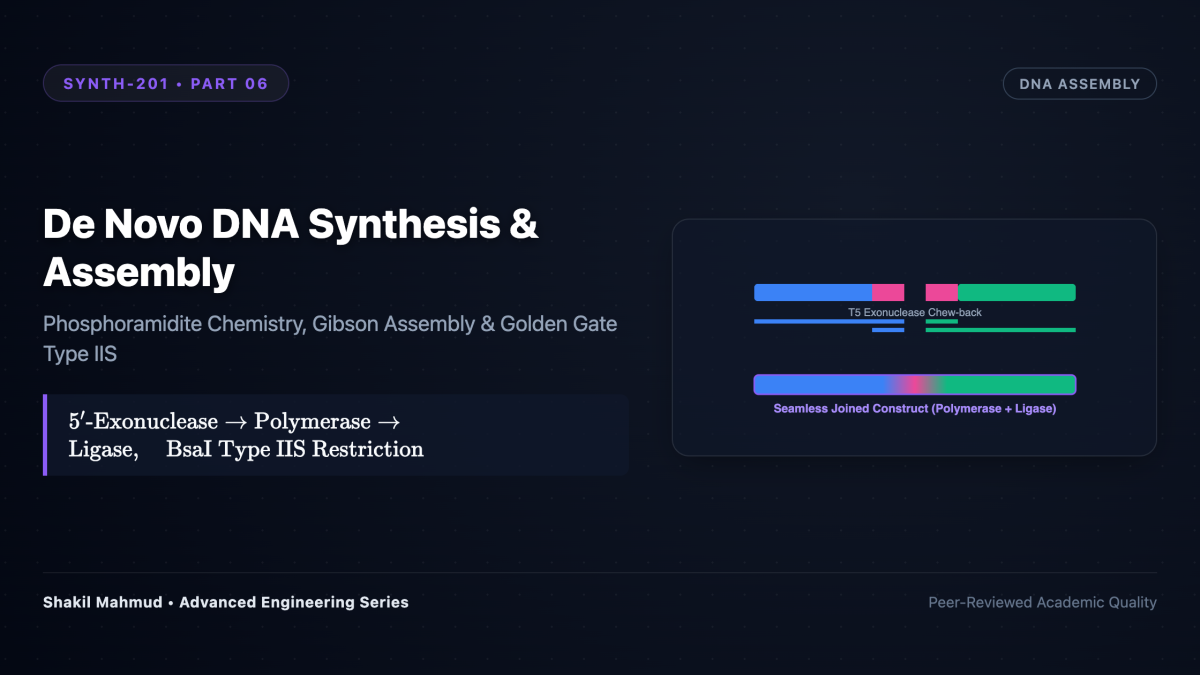
- T5 Exonuclease ((5′ o 3′)): Chews back the (5′) ends of adjacent DNA fragments sharing a (20 – 40 ext{ bp}) sequence homology, exposing single-stranded (3′) overhangs. Because T5 exonuclease is heat-labile, it gradually denatures at (50^circ ext{C}), preventing runaway over-digestion.
- Phusion DNA Polymerase: The exposed single-stranded homologous overhangs specifically anneal to each other. Phusion polymerase fills in the remaining gaps.
- Taq DNA Ligase: Covalently seals the phosphodiester nicks, producing a continuous, seamless double-stranded construct devoid of restriction scars.
Gibson assembly routinely joins 5 to 10 overlapping fragments spanning hundreds of kilobase pairs in a single one-pot incubation.
3. Golden Gate Cloning and Type IIS Restriction Enzymes
While Gibson assembly relies on terminal sequence homology, Golden Gate Assembly utilizes Type IIS Restriction Enzymes (e.g., (BsaI), (BsmBI), (BbsI)). Unlike traditional Type II enzymes that cut symmetrically within their palindromic recognition sequence, Type IIS enzymes bind to an asymmetric recognition site and cut at a precise, shifted offset outside the recognition site:
[
BsaI ext{ Recognition: } quad 5′ ext{-GGTCTC}(N)_1 downarrow (N)_4 ext{-}3′
]
This shifted cleavage generates arbitrary, user-defined 4-base-pair non-palindromic overhangs. By designing adjacent DNA parts with complementary 4-bp overhangs, up to 24 distinct parts can be assembled directionally in a predetermined order.
Crucially, because the recognition sites are placed in convergent orientations at the outer edges of the inserts, the enzyme site is excised and discarded during ligation. The assembled product lacks the (BsaI) site and cannot be re-cut, driving the reaction to (100%) completion in a continuous, one-pot digestion-ligation thermocycling protocol.