While transcriptional regulation with protein factors is effective, it suffers from significant signaling latency: transcribed mRNA must first be translated into protein before regulating downstream targets. In contrast, RNA Engineering operates at the speed of chemical base pairing. By folding RNA molecules into functional shapes that directly sense metabolites, small molecules, or target viral sequences, synthetic biologists engineer Riboswitches and Toehold Switches that execute nanosecond molecular computations.
1. Thermodynamics of RNA Secondary Structure and Nearest-Neighbor Free Energy
An RNA sequence folding into secondary structures (hairpins, internal loops, bulges, multi-branch junctions) minimizes its Gibbs free energy. The stability of an RNA duplex is calculated using the Nearest-Neighbor Thermodynamic Model:
[
Delta G^circ_{ ext{total}} = sum_{i} Delta G^circ_{ ext{stacking}}(i, i+1) + Delta G^circ_{ ext{initiation}} + Delta G^circ_{ ext{loops}}
]
Because base-stacking interactions between adjacent Watson-Crick and wobble pairs (( ext{G:U})) provide favorable negative enthalpies ((Delta H^circ < 0)), single-stranded RNA folds rapidly into energetic minima predicted by dynamic programming algorithms (Zuker's mfold / ViennaRNA package).
2. Natural Riboswitches: Aptamers and Expression Platforms
Natural riboswitches residing in the 5′ untranslated region (5′ UTR) of bacterial mRNAs consist of two modular domains:
- The Aptamer Domain: A highly conserved, tertiary-folded RNA pocket that selectively binds a target ligand (e.g., S-adenosylmethionine [SAM], thiamine pyrophosphate [TPP], lysine, or theophylline) with nanomolar affinity ((K_d sim 1 – 100 ext{ nM})).
- The Expression Platform: An adjacent downstream sequence that undergoes ligand-dependent structural switching, acting as either a transcriptional attenuator (forming an intrinsic rho-independent terminator hairpin) or a translational repressor (sequestering the Shine-Dalgarno Ribosome Binding Site within a stable stem).
3. De Novo Designed Toehold Switches
While natural riboswitches rely on specific evolved chemical aptamers, Alexander Green, Pamela Silver, and James Collins invented Toehold Switches (2014)—a revolutionary class of de novo engineered riboregulators that can be programmed to detect any arbitrary RNA sequence.
A toehold switch is composed of a synthetic mRNA hairpin with three critical geometric regions:
- The Toehold: A short, single-stranded (12 – 15 ext{ nt}) domain at the 5′ base of the hairpin.
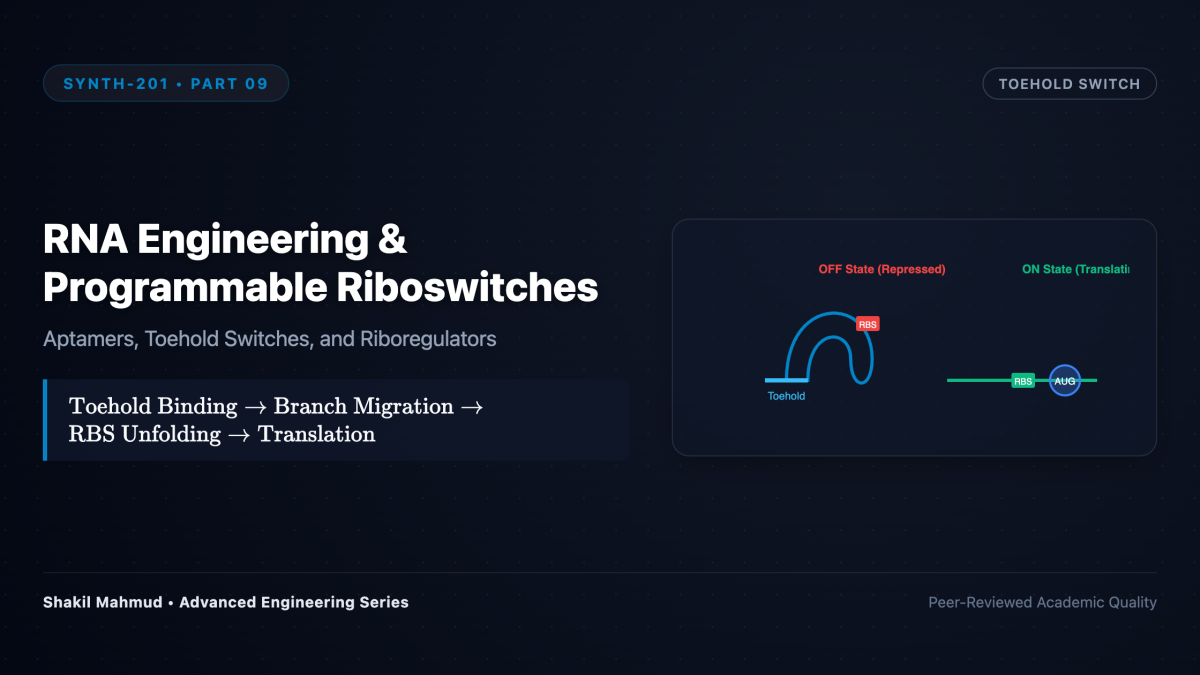
- The Stem-Loop: A stable duplex that sequesters the Ribosome Binding Site (RBS) and the start codon (( ext{AUG})) in its loop, completely preventing ribosomal 30S subunit docking (repressed OFF state, leakage (< 1%)).
- The Trigger RNA: A target RNA molecule possessing perfect complementarity to the toehold and the ascending stem strand.
Activation proceeds via Toehold-Mediated Strand Displacement:
[
ext{Hairpin} + ext{Trigger} xrightarrow{k_{ ext{bind}}} [ ext{Toehold Complex}] xrightarrow{ ext{Branch Migration}} ext{Trigger-Switch Duplex} + ext{Unfolded mRNA}
]
Because the trigger binds first to the exposed single-stranded toehold, the activation barrier is minuscule. Rapid branch migration unzips the hairpin stem, exposing the RBS and ( ext{AUG}) codon to ribosomes, turning translation ON with dynamic ranges exceeding 100-fold to 1,000-fold. Toehold switches operate with near-zero crosstalk, enabling synthetic biologists to multiplex dozens of independent sensory logic gates in cell-free diagnostic strips.