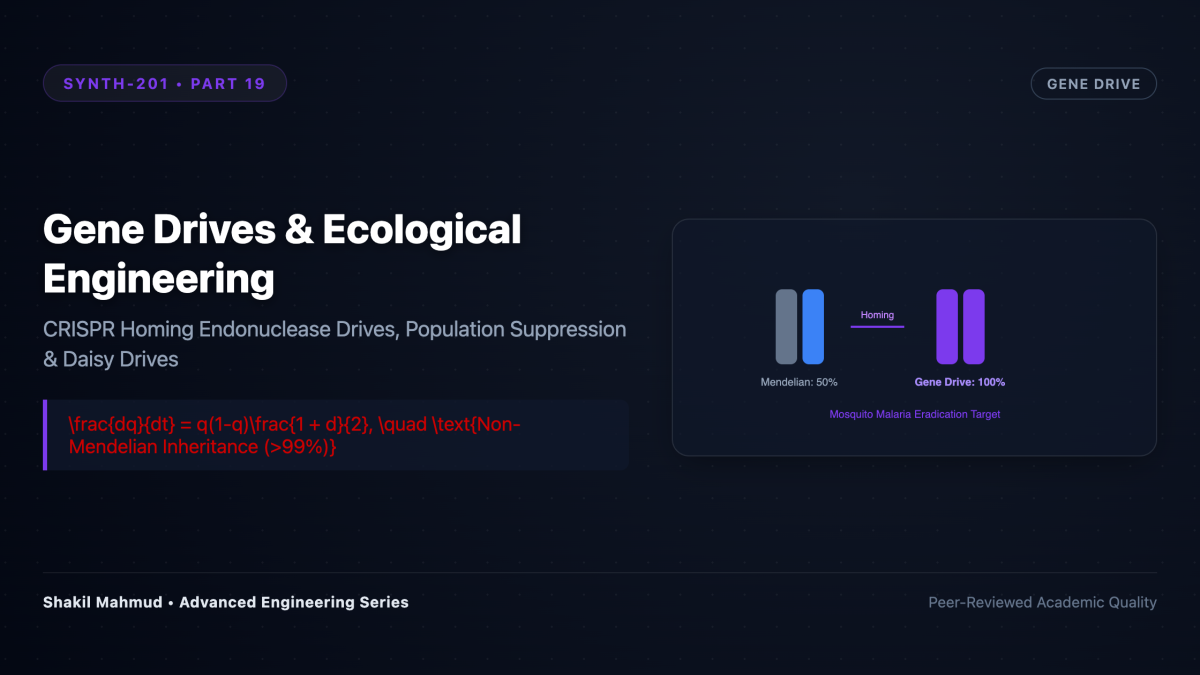
Gregor Mendel’s classical laws of genetics dictate that sexually reproducing diploid organisms transmit any given allele to exactly fifty percent of their progeny. In 2003, imperial geneticist Austin Burt proposed a daring theoretical mechanism capable of shattering this evolutionary speed limit: Synthetic Gene Drives. By coupling CRISPR-Cas9 endonuclease machinery to homology-directed repair in the germline, a synthetic gene drive copies itself into the opposing chromosome, achieving near-one-hundred-percent inheritance. In this article, we formulate the population genetics of gene drives, analyze malaria vector suppression, and explore ecological containment.
1. Super-Mendelian Inheritance and Homing Mechanics
In standard Mendelian inheritance, a heterozygote (Aa) crossing with wild-type (aa) yields offspring with genotypic frequencies (0.5 , Aa + 0.5 , aa). A neutral or deleterious mutation is eliminated by natural selection.
In a CRISPR Homing Gene Drive, the drive cassette contains: (1) Cas9 endonuclease, (2) guide RNA targeting the corresponding wild-type locus, and (3) flanking homology arms identical to sequences immediately surrounding the cut site. In the germline of a heterozygous individual ((D/+)):
- Cas9 and gRNA are expressed, generating a double-strand break (DSB) on the homologous wild-type ((+)) chromosome.
- The cell repairs the DSB using the sister drive chromosome ((D)) as a repair template via Homology-Directed Repair (HDR).
- The drive cassette is copied into the broken chromosome, converting a heterozygous germline cell ((D/+)) into a homozygous cell ((D/D)):
[
D/+ xrightarrow{ ext{CRISPR-Cas9 Cleavage + HDR}} D/D
]
Consequently, over (99%) of gametes inherit the drive allele rather than (50%). The allele frequency (q) evolves in a continuous-time panmictic population according to:
[
rac{dq}{dt} = q(1 – q) rac{d + s_d(1 – 2q)}{1 – s_d q^2}
]
where (d approx 1) is the homing conversion rate and (s_d) is the fitness cost of the drive. Even with a significant fitness penalty ((s_d approx 0.1 – 0.3)), the gene drive spreads rapidly through wild populations like an inexorable biological chain reaction.
2. Population Suppression Drives and Malaria Eradication
The primary humanitarian application of gene drives is eradicating vector-borne diseases, such as malaria transmitted by female Anopheles gambiae mosquitoes, which claims over 600,000 lives annually. Andrea Crisanti’s laboratory designed a Suppression Gene Drive targeting the female-specific exon of the doublesex (*dsx*) gene:
- Heterozygous females ((D/+)) and all males ((D/+, D/D)) are fully fertile and phenotypically normal, acting as silent drive carriers.
- Homozygous females ((D/D)) develop intersex phenotypes, possessing deformed proboscises that cannot bite humans and malformed oviducts that render them completely sterile.
In laboratory cage trials, releasing a modest (12.5%) seeding frequency of drive carriers resulted in (100%) drive spread within 7 to 11 generations, triggering a catastrophic sex-ratio collapse that led to complete, permanent population extinction with zero target-site resistance emergence.
3. Evolution of Resistance Alleles and Ecological Safeguards
The primary biological vulnerability of homing drives is Non-Homologous End Joining (NHEJ) repair. If the host cell repairs the Cas9 cut via error-prone NHEJ rather than HDR, small insertions or deletions (indels) are created. These indels mutate the gRNA binding sequence, generating Resistance Alleles that block Cas9 cleavage while preserving target gene function, causing the drive to stall.
To prevent runaway global propagation and ensure localized field trials, synthetic biologists engineer modular ecological safeguards:
- Split Drives: Separating the Cas9 enzyme onto a standard Mendelian chromosome while placing the gRNA and payload on the drive locus. The drive functions only in individuals carrying both unlinked parts, diluting out over generations.
- Daisy Drives: A serial cascade of unlinked drive elements ((C o B o A)) where each upstream element drives the next, exhausting itself over predetermined generational timescales.
- Synthetic Reversal Drives (ERACR): An autonomous overriding drive engineered with an alternative gRNA that recognizes and overwrites the primary drive cassette, restoring wild-type genomic sequences across ecosystems on demand.