For over half a century, the protein folding problem stood as one of the grandest unsolved challenges in biological physics: how does a linear one-dimensional sequence of amino acids fold spontaneously into a functional three-dimensional nanoscopic machine? Today, that historical paradigm has been overturned. Not only have deep neural networks like AlphaFold solved structure prediction, but generative diffusion models like RFdiffusion can now invent entirely novel protein architectures never seen in four billion years of earthly evolution. In this treatise, we explore computational protein design from Rosetta to generative foundation models.
1. The Thermodynamic Hypothesis and Levinthal’s Paradox
In 1961, Christian Anfinsen postulated the Thermodynamic Hypothesis: for small globular proteins, the native 3D tertiary structure corresponds to the unique, kinetically accessible global minimum of Gibbs free energy ((Delta G^circ)) under physiological conditions. However, Cyrus Levinthal noted a staggering paradox in 1969: a 100-residue peptide has (3^{198} approx 10^{95}) possible backbone conformations. If a folding protein sampled conformations randomly at picosecond timescales ((10^{-12} ext{ s})), finding the global minimum would require (10^{75} ext{ years})—vastly longer than the age of the universe! Nature avoids this through directed free energy funnels.
2. Physics-Based Computational Design: The Rosetta Energy Function
Developed by David Baker, the Rosetta software suite models proteins by balancing physical chemistry and statistical mechanics. The Rosetta energy function sums physical atomic potentials and knowledge-based statistical terms:
[
E_{ ext{Rosetta}} = sum w_{ ext{atr}} E_{ ext{atr}} + sum w_{ ext{rep}} E_{ ext{rep}} + sum w_{ ext{elec}} E_{ ext{elec}} + sum w_{ ext{hbond}} E_{ ext{hbond}} + sum w_{ ext{solv}} E_{ ext{solv}} + sum w_{ ext{rama}} E_{ ext{rama}}
]
where:
- (E_{ ext{atr}}, E_{ ext{rep}}): 6-12 Lennard-Jones van der Waals attractive and repulsive potentials.
- (E_{ ext{elec}}): Coulombic electrostatic interactions with distance-dependent dielectric screening.
- (E_{ ext{hbond}}): Explicit directional hydrogen bonding potentials based on orbital geometry.
- (E_{ ext{solv}}): Lazaridis-Karplus implicit solvation free energy penalty for burying polar atoms.
- (E_{ ext{rama}}): Ramachandran backbone dihedral angle propensity ((phi, psi)).
Rosetta executes Monte Carlo Simulated Annealing with rotamer library sampling to design custom amino acid sequences that pack stably into target backbone scaffolds.
3. The Generative Deep Learning Revolution: RFdiffusion
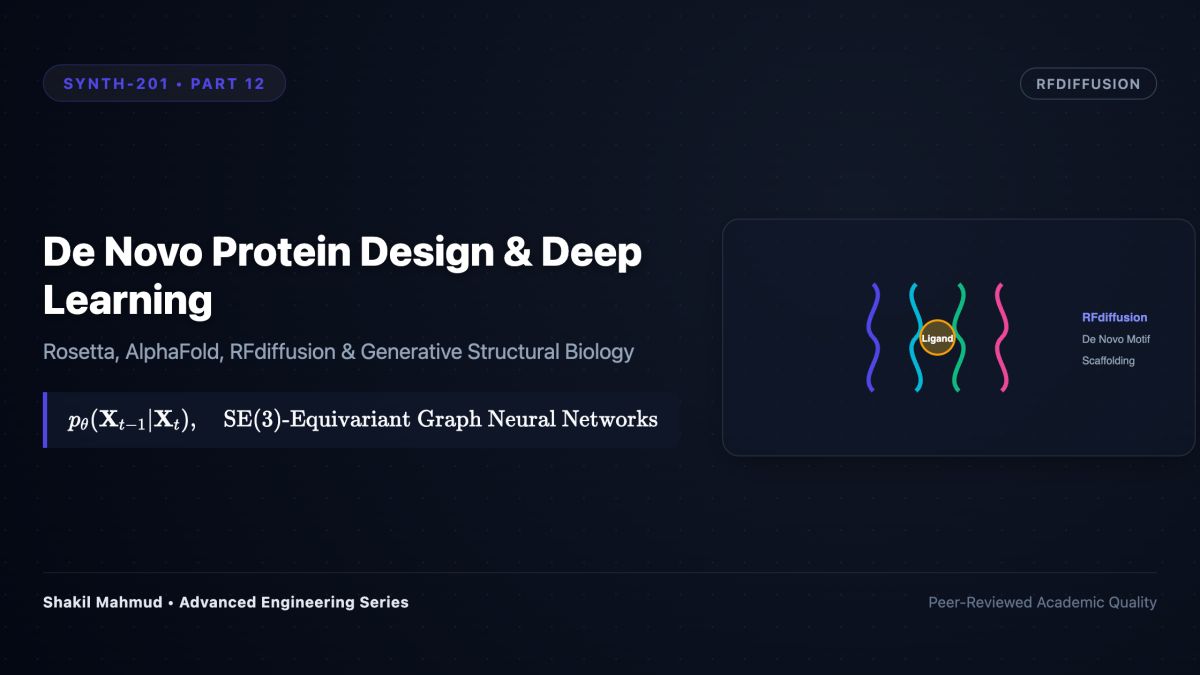
In 2020–2021, DeepMind’s AlphaFold2 revolutionized biology by predicting tertiary atomic coordinates directly from multiple sequence alignments (MSAs) using transformer architectures (Evoformer) and invariant point attention (IPA). Building upon this structural revolution, the Baker laboratory engineered RFdiffusion (2023)—a generative denoising diffusion probabilistic model (DDPM) that creates proteins de novo.
Operating over the special Euclidean group ( ext{SE}(3)), RFdiffusion represents protein backbones as rigid-body coordinate frames (T = (mathbf{R}, mathbf{x}) in ext{SO}(3) imes mathbb{R}^3) for each residue. Starting from pure Gaussian random spatial noise (T_T), the neural network iteratively reverses the diffusion process:
[
p_ heta(T_{t-1} | T_t) = mathcal{N}left( T_{t-1}; , mu_ heta(T_t, t), , Sigma_ heta(T_t, t)
ight)
]
By conditioning the reverse diffusion process on target viral antigens (e.g., SARS-CoV-2 spike, influenza hemagglutinin) or enzyme active-site catalytic residues, RFdiffusion generates custom nanomolar binders, target-specific antibodies, and catalytic protein scaffolds with atomic precision, inaugurating a golden age of programmable macromolecular medicine.