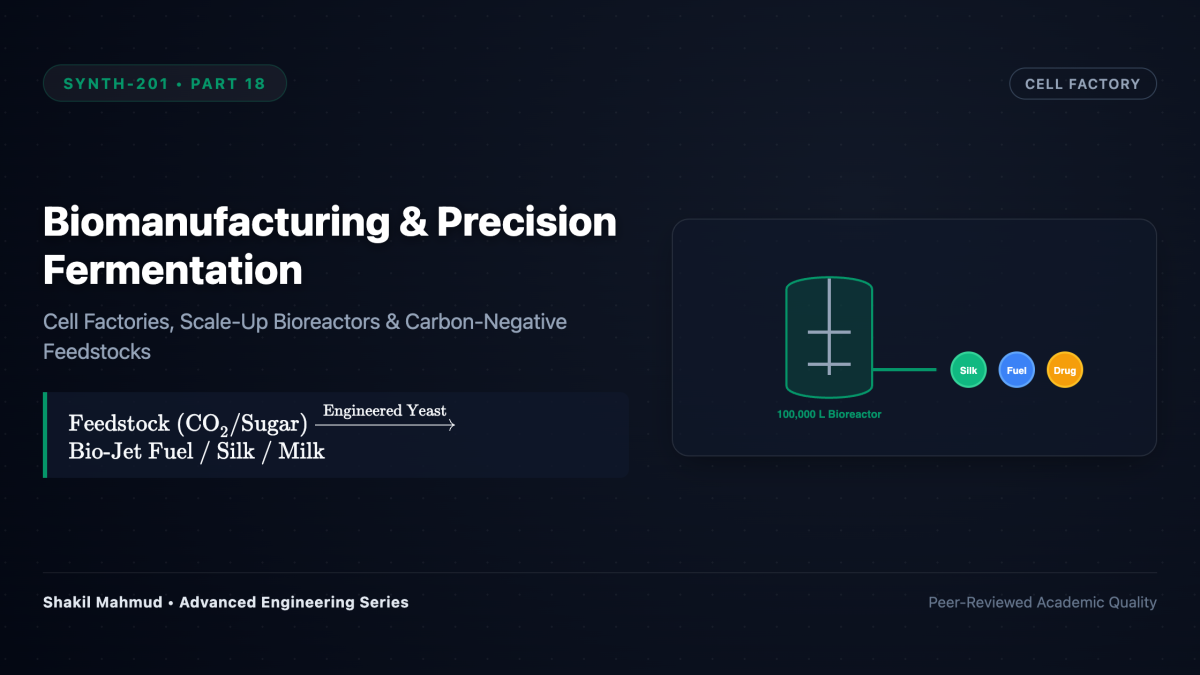
Modern civilization is constructed on petrochemistry: liquid fuels, industrial plastics, fertilizers, and consumer synthetics are cracked from fossil hydrocarbons pumped out of subterranean strata, emitting billions of tons of carbon dioxide. Precision Fermentation and Biomanufacturing represent the grand transition to a bio-based circular economy: replacing smokestacks and chemical factories with cellular bio-foundries that convert sugars, agricultural wastes, and industrial exhaust gases into high-performance materials, clean fuels, and animal-free foods.
1. Bioreactor Transport Phenomena and Scaling Challenges
Transitioning a genetic circuit from a 10-milliliter laboratory shake flask to a commercial 500,000-liter Industrial Bioreactor faces severe chemical engineering transport limits:
- Oxygen Mass Transfer: In dense aerobic cultures, the Volumetric Oxygen Mass Transfer Coefficient ((k_L a)) dictates microbial respiration:
[
ext{OTR} = k_L a (C^* – C_L) ge ext{OUR} = q_{O_2} X
]
where (C^*) is oxygen saturation, (C_L) is dissolved oxygen, (q_{O_2}) is specific uptake, and (X) is biomass density. In colossal vessels, power input to impellers ((P/V propto N^3 D^5)) generates lethal mechanical shear that ruptures fragile host membranes before sufficient oxygen can dissolve. - Heat Dissipation: Microbial metabolic reactions are exergonic. For dense cultures ((X > 100 ext{ g/L})), biological metabolic heat release exceeds the surface cooling capacity of bioreactor water jackets, demanding heat-tolerant thermophilic synthetic chassis.
2. Precision Fermentation: Animal-Free Dairy and Functional Proteins
Traditional livestock farming is an extraordinarily inefficient thermodynamic converter: a cow consumes over 20 calories of grain feed and thousands of liters of fresh water to produce a single calorie of bovine milk protein, while burping millions of tons of methane. In Precision Fermentation, the genes encoding bovine whey ((beta ext{-lactoglobulin})) and casein micelle proteins ((alpha_{s1}, beta, kappa ext{-casein})) are codon-optimized and transformed into food-grade methylotrophic yeasts (*Komagataella phaffii / Pichia pastoris* or *Trichoderma reesei*):
[
ext{Methanol / Glucose Feed} + ext{Engineered Yeast} xrightarrow{ ext{Secretory Pathway}} ext{Pure Native Recombinant Bovine Protein}
]
Because the recombinant yeast expresses molecular chaperones and signal peptidase sequences, the proteins fold into authentic three-dimensional tertiary structures with exact post-translational phosphorylation and disulfide bonding, delivering molecularly identical cheese and dairy products that melt, stretch, and foam without raising a single animal.
3. High-Performance Bio-Materials: Engineered Spider Silk (Spidroin)
Dragline spider silk is one of the most miraculous materials in physics: possessing a tensile strength greater than high-grade steel ((1.5 – 2 ext{ GPa})) and a toughness exceeding Kevlar ((160 ext{ MJ/m}^3)), while being completely biodegradable. Spiders are cannibalistic and cannot be farmed.
Synthetic biologists engineer E. coli and silkworms to express high-molecular-weight Spidroin Proteins (comprising repetitive poly-alanine crystalline (beta)-sheet blocks embedded in flexible glycine-rich amorphous motifs). The harvested recombinant silk proteins are dissolved in fluorinated solvents and extruded through microfluidic spinnerets that mimic natural spider duct shear forces, spinning ultra-light structural fibers for aerospace composites, ballistic armor, and surgical biodegradable sutures.
4. Gas Fermentation: Carbon-Negative Chemicals from Industrial Off-Gas
Rather than consuming arable food sugars, cutting-edge third-generation biomanufacturing utilizes Gas Fermentation. Companies like LanzaTech engineer acetogenic autotrophic bacteria (e.g., Clostridium autoethanogenum) that utilize the ancient Wood-Ljungdahl metabolic pathway:
[
4 ext{CO} + 2 ext{H}_2 ext{O} o ext{CH}_3 ext{COOH} + 2 ext{CO}_2, qquad 2 ext{CO}_2 + 6 ext{H}_2 o ext{CH}_3 ext{COOH} + 2 ext{H}_2 ext{O}
]
Installed directly at the exhaust stacks of steel mills and petrochemical refineries, these bioreactors capture toxic carbon monoxide and greenhouse ( ext{CO}_2) before they enter the atmosphere, converting industrial emissions into aviation jet fuel, ethylene, and acetone at industrial kiloton scale.