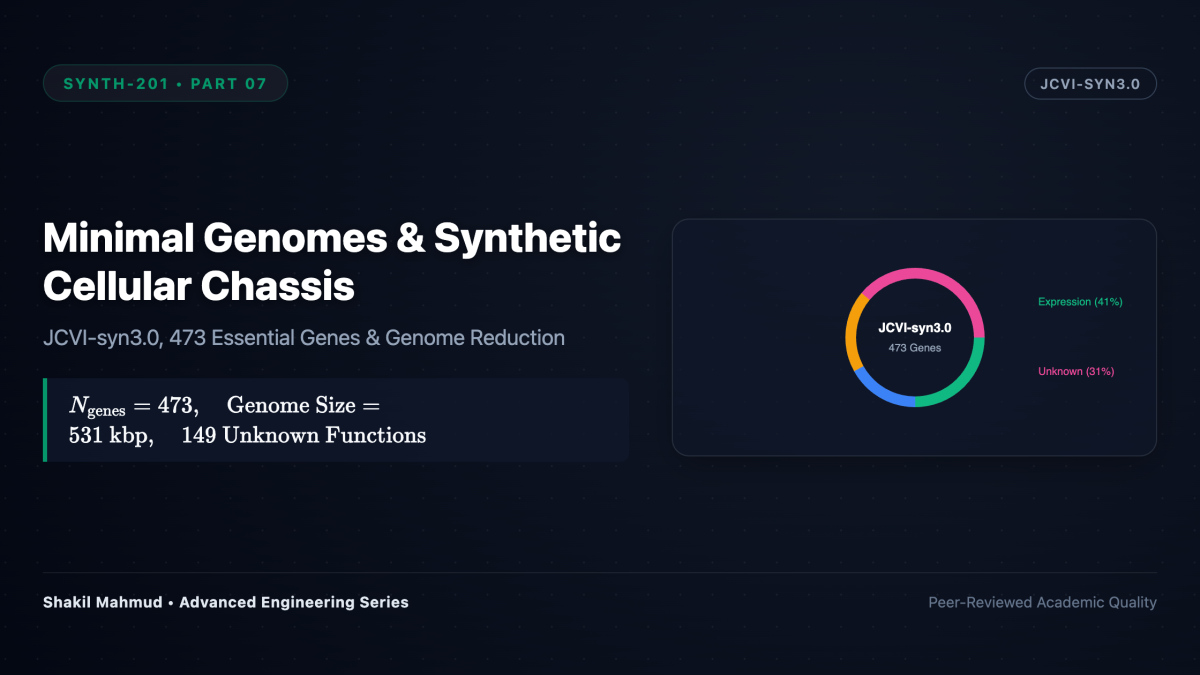
What is the absolute minimal set of genetic instructions required to sustain autonomous cellular life? In 2016, following two decades of pioneering work led by Craig Venter, Hamilton Smith, and Clyde Hutchison, the J. Craig Venter Institute unveiled JCVI-syn3.0: a viable, self-replicating synthetic organism possessing a chemically synthesized genome stripped down to only 473 genes—smaller than any freely living organism known in nature. In this treatise, we explore the methodology of minimal genome design, whole-genome transplantation, and the enigma of essential genes with unknown functions.
1. The Path from syn1.0 to syn3.0
The journey toward synthetic life unfolded across three monumental technical leaps:
- JCVI-syn1.0 (2010): The team chemically synthesized the entire (1.08 ext{ Mbp}) genome of Mycoplasma mycoides from scratch in yeast, adding watermark cryptographic sequences to prove its synthetic origin. The naked synthetic genome was transplanted into a recipient Mycoplasma capricolum cell, completely replacing the host chromosome. The resulting cell was operated entirely by the synthetic DNA software, replicating autonomously as M. mycoides.
- Global Transposon Bombardment (Tn5): To determine which genes were non-essential, researchers saturated the genome with transposon insertions. If a gene can be disrupted without lethality, it is non-essential. However, transposon mutagenesis revealed Quasi-Essential Genes (whose deletion causes extreme growth defects) and Synthetic Lethal Pairs (redundant gene pairs where either gene alone can be deleted, but deleting both is fatal).
- JCVI-syn3.0 (2016): Through systematic iterative design-build-test cycles, the genome was pared down to (531 ext{ kbp}) encoding 473 genes (and 19 RNA genes), with a doubling time of approximately 3 hours.
2. Functional Taxonomy of the 473 Minimal Genes
Classifying the 473 genes of JCVI-syn3.0 illuminates the irreducible core operating system of biological life:
[
begin{array}{|l|c|r|}
hline
extbf{Functional Category} & extbf{Number of Genes} & extbf{Percentage}
hline
ext{Expression of Genetic Information (Translation, RNAP, Ribosomes)} & 195 & 41.2%
ext{Preservation of Genetic Information (DNA Replication, Repair)} & 38 & 8.0%
ext{Cell Membrane Structure & Transport Systems} & 84 & 17.8%
ext{Metabolism & Intermediary Energy Pathways} & 79 & 16.7%
hline
extbf{Unknown / Uncharacterized Function} & mathbf{149} & mathbf{31.5%}
hline
nd{array}
]
The staggering revelation of JCVI-syn3.0 was that nearly one-third of the minimal genome (149 genes) has completely unknown biochemical functions. Despite over a century of molecular biology, humanity does not understand the molecular role of approximately 30% of the core genes indispensable for life itself.
3. Synthetic Cellular Chassis for Industrial Biotechnology
Wild-type microbes (such as wild E. coli or yeast) harbor millions of base pairs of genetic evolutionary baggage: cryptic prophages, stress response regulons, motility flagella, and non-essential metabolic pathways that dissipate ATP and precursor metabolites.
Streamlined synthetic chassis—such as E. coli MDS42 (with 42 insertion sequence elements and prophages deleted) or minimal Mycoplasma platforms—provide unparalleled engineering advantages:
- High Genetic Stability: Deletion of active transposons and mobile IS elements eliminates spontaneous insertion mutations, ensuring that multi-gene synthetic circuits remain stable over hundreds of industrial fermentor generations.
- Resource Re-allocation: Removing superfluous cellular machinery frees up ribosomes, RNA polymerases, and ATP, channeling up to (30 – 50%) more metabolic flux directly into heterologous biomanufacturing.