All earthly terrestrial biology is bound by a universal canonical cipher established billions of years ago: sixty-four triplet codons encoding precisely twenty standard amino acids. In synthetic biology, however, twenty chemical building blocks are far too restrictive: nature lacks chemical handles for bio-orthogonal copper-free click chemistry, fluorescent tags, photocrosslinkers, or heavy atoms for metallo-enzymology. By engineering Orthogonal Translation Systems (OTS), synthetic biologists have successfully expanded the genetic code, incorporating over two hundred Non-Canonical Amino Acids (ncAAs).
1. Amber Codon Suppression and Orthogonality
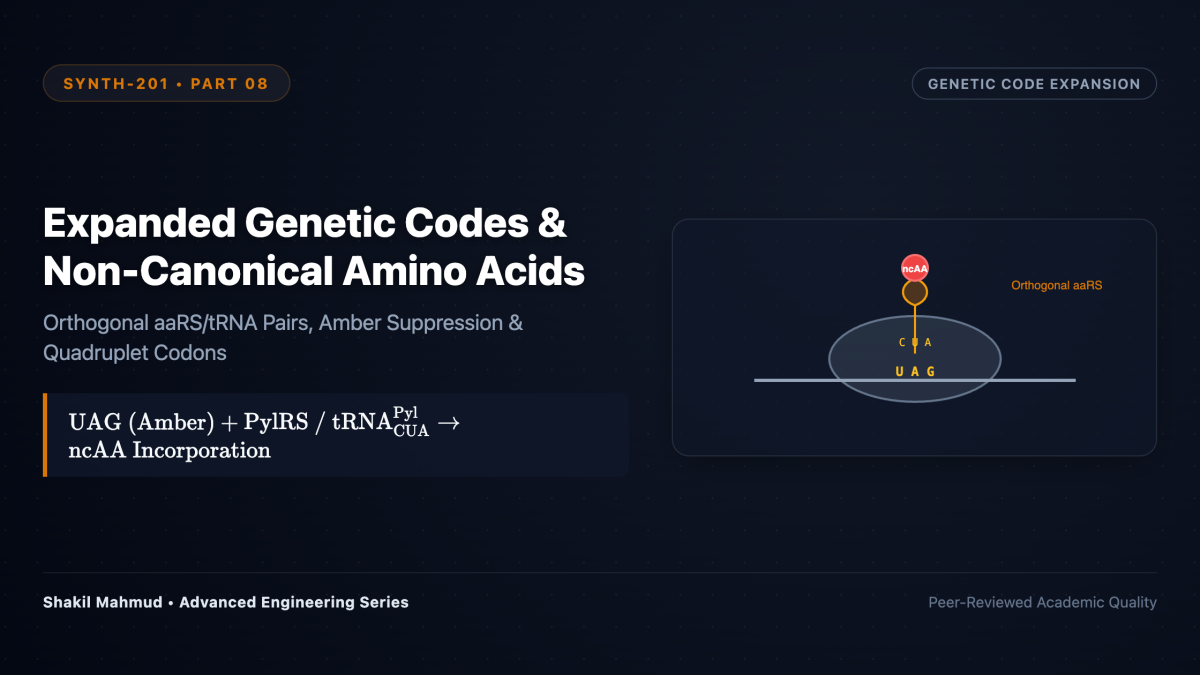
The standard genetic code contains three stop codons: Amber (( ext{UAG})), Ochre (( ext{UAA})), and Opal (( ext{UGA})). Because ( ext{UAG}) is the least frequently used termination signal in E. coli ((sim 7%) of essential genes), it represents the primary target for re-allocation. Incorporating an ncAA into a growing peptide requires an Orthogonal Pair composed of:
- An Orthogonal tRNA (( ext{tRNA}_{ ext{CUA}})) engineered with an anticodon complementary to ( ext{UAG}).
- An Orthogonal Aminoacyl-tRNA Synthetase (aaRS) that charges the orthogonal tRNA specifically with the synthetic ncAA.
True biochemical orthogonality requires satisfying two mutual exclusivity criteria simultaneously:
[
ext{aaRS}_{ ext{ortho}} ext{ charges } ext{tRNA}_{ ext{ortho}} ext{ with ncAA}, quad ext{but DOES NOT charge any endogenous host tRNAs}
]
[
ext{Endogenous host aaRSs DO NOT charge } ext{tRNA}_{ ext{ortho}} ext{ with any standard 20 amino acids}
]
Synthetic biologists typically import orthogonal pairs from phylogenetically divergent kingdoms. Prominent archetypes include the Methanocaldococcus jannaschii ( ext{TyrRS/tRNA}^{ ext{Tyr}}) pair (functional in bacteria) and the Methanosarcina mazei pyrrolysyl ( ext{PylRS/tRNA}^{ ext{Pyl}}) pair (functional in bacteria, yeast, and mammalian cells).
2. Genetically Recoded Organisms (GROs) and RF1 Elimination
In standard wild-type cells, amber suppression is in direct kinetic competition with Release Factor 1 (RF1 / prfA), which recognizes ( ext{UAG}) and hydrolyzes the peptidyl-tRNA bond, terminating translation early:
[
ext{Efficiency} = rac{k_{ ext{supp}} [ ext{ncAA-tRNA}_{ ext{CUA}}]}{k_{ ext{supp}} [ ext{ncAA-tRNA}_{ ext{CUA}}] + k_{ ext{term}} [ ext{RF1}]}
]
To eliminate termination competition and create a completely blank codon, George Church and Farren Isaacs generated C321.(Delta)A: a Genetically Recoded Organism (GRO). Using Multiplex Automated Genome Engineering (MAGE), all 314 instances of the ( ext{TAG}) stop codon across the entire E. coli chromosome were converted to the synonymous ( ext{TAA}) (Ochre) stop codon. With ( ext{TAG}) completely erased from the genome, the gene encoding RF1 was safely knocked out ((Delta prfA)).
In a GRO, ( ext{UAG}) ceases to mean “stop”; it is a dedicated, unambiguous 21st sense codon incorporated with (100%) chemical fidelity. Furthermore, GROs are biologically contained (synthetic auxotrophs dependent on synthetic ncAAs) and completely immune to viral infection: invading bacteriophages rely on ( ext{TAG}) for translation and fail to produce viable virions.
3. Beyond Triplets: Quadruplet 4-Base Codons
Because triplet permutations ((4^3 = 64)) are finite, synthetic biologists led by Jason Chin have engineered Orthogonal Ribosomes (ribo-Q1) capable of decoding Quadruplet (4-base) Codons (e.g., ( ext{UAGA}), ( ext{AGGA})).
By mutating the decoding center of 16S rRNA in the 30S ribosomal subunit, the expanded A-site accommodates an extended 4-base anticodon loop (( ext{tRNA}_{ ext{UCUA}})). Quadruplet decoding provides (4^4 = 256) possible codons, unlocking the potential to incorporate multiple distinct non-canonical amino acids simultaneously into synthetic designer polymers and artificial enzymes.