Humanity generates over one hundred zettabytes of digital data annually. Silicon magnetic tapes and flash memories face severe technological cliffs: they degrade within decades, consume megawatts of cooling power in hyperscale data centers, and face physical limits of raw material scarcity. Nature solved archival information storage four billion years ago: double-stranded DNA. With an information density exceeding two hundred petabytes per gram, DNA Digital Data Storage represents the ultimate long-term medium for civilization’s knowledge. In this treatise, we explore codec design, error-correcting mathematics, and random access retrieval.
1. Theoretical Information Density and Thermodynamics of DNA Storage
Because DNA consists of four distinct nitrogenous bases (( ext{A, C, G, T})), each nucleotide represents a quaternary digit (2 bits of raw Shannon entropy):
[
I_{ ext{max}} = log_2(4) = 2 quad ext{bits / nucleotide}
]
The molecular weight of a DNA nucleotide pair is approximately (660 ext{ g/mol}). The theoretical physical information density is:
[
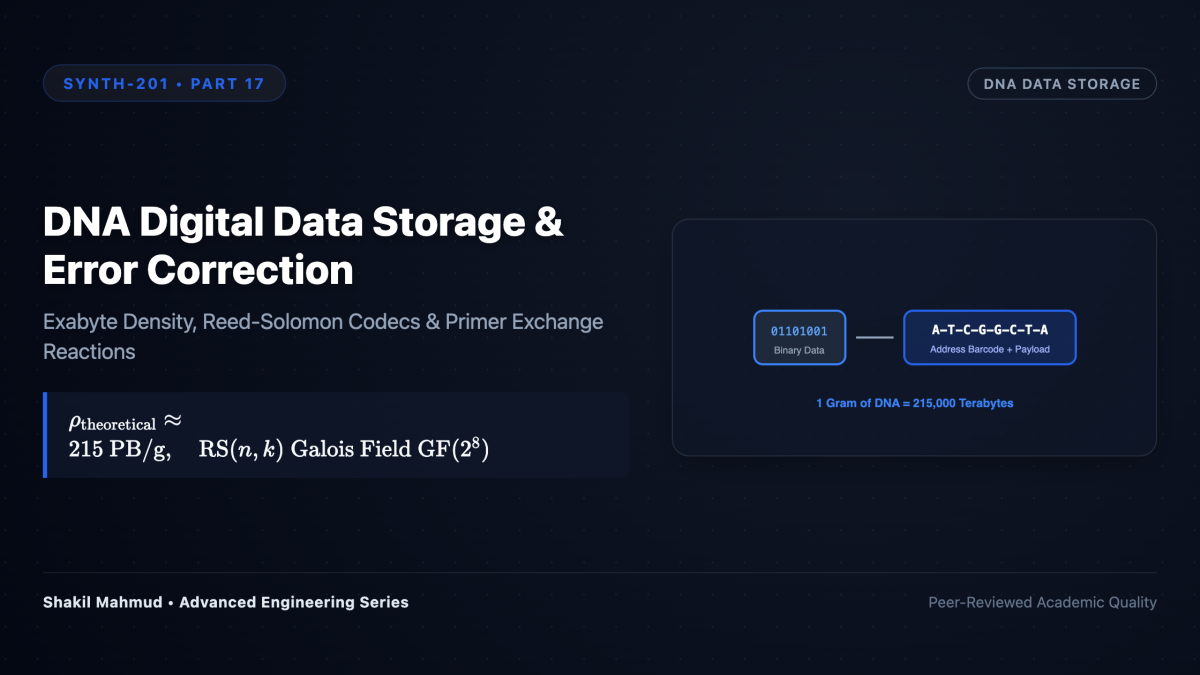
ho_{ ext{theoretical}} = rac{2 ext{ bits / bp} imes 6.022 imes 10^{23} ext{ bp/mol}}{660 ext{ g/mol}} approx 1.8 imes 10^{21} ext{ bits/g} approx 215{,}000 ext{ Terabytes / gram}
]
At this density, all of the world’s recorded digital information could be archived in a vessel smaller than a shoe box. Furthermore, while hard drives require electric power to prevent magnetic bit flips, DNA encapsulated in microscopic silica spheres (( ext{SiO}_2)) has an estimated half-life exceeding (10{,}000 – 100{,}000 ext{ years}) at ambient temperature without consuming a single watt of energy.
2. Mapping Constraints and DNA Fountain Error Correction
Translating arbitrary binary streams ((0)s and (1)s) into nucleotide sequences cannot be done naively due to physical synthesis and sequencing constraints:
- Homopolymer Runs: Consecutive identical bases (e.g., ( ext{AAAAAA}) or ( ext{GGGGGG})) cause severe phase synchronization slip errors during optical and nanopore sequencing. Codecs must strictly forbid runs of length (ge 3).
- GC Content: Sequences must maintain a balanced GC ratio ((sim 45% – 55%)) to ensure uniform annealing temperatures and prevent high-melting secondary hairpins.
To overcome random dropouts, insertions, and deletions during chemical synthesis, Erlich and Zielinski formulated the DNA Fountain Codec based on Luby Transform (LT) codes. The binary file is partitioned into source packets, randomly combined via Luby transform droplets, and prepended with a pseudo-random seed barcode. Droplets failing GC or homopolymer constraints are dynamically pruned. Reed-Solomon outer codes in the Galois field ( ext{GF}(2^8)) correct lingering substitution errors, achieving an unprecedented usable encoding density of 1.98 bits per nucleotide ((99%) of the theoretical Shannon bound) with zero data loss over multiple copy generations.
3. Random Access Retrieval and PCR Addressing
A global archive cannot require sequencing the entire multi-terabyte pool to retrieve a solitary file. Random access is achieved using PCR Primer Addressing:
[
ext{DNA Oligo} = [5′ ext{-Forward Primer Binding Site (20 bp)}] – [ ext{Data Payload (150 bp)}] – [3′ ext{-Reverse Primer Binding Site (20 bp)}]
]
Each digital file is assigned a unique, bio-orthogonal pair of forward and reverse primer sequences that possess zero homology to any other file in the library. When retrieving File (K), adding primers (F_K) and (R_K) amplifies the target payload by millions of fold, allowing standard Illumina or Oxford Nanopore sequencers to read and decode the requested file out of a complex chemical database in minutes.