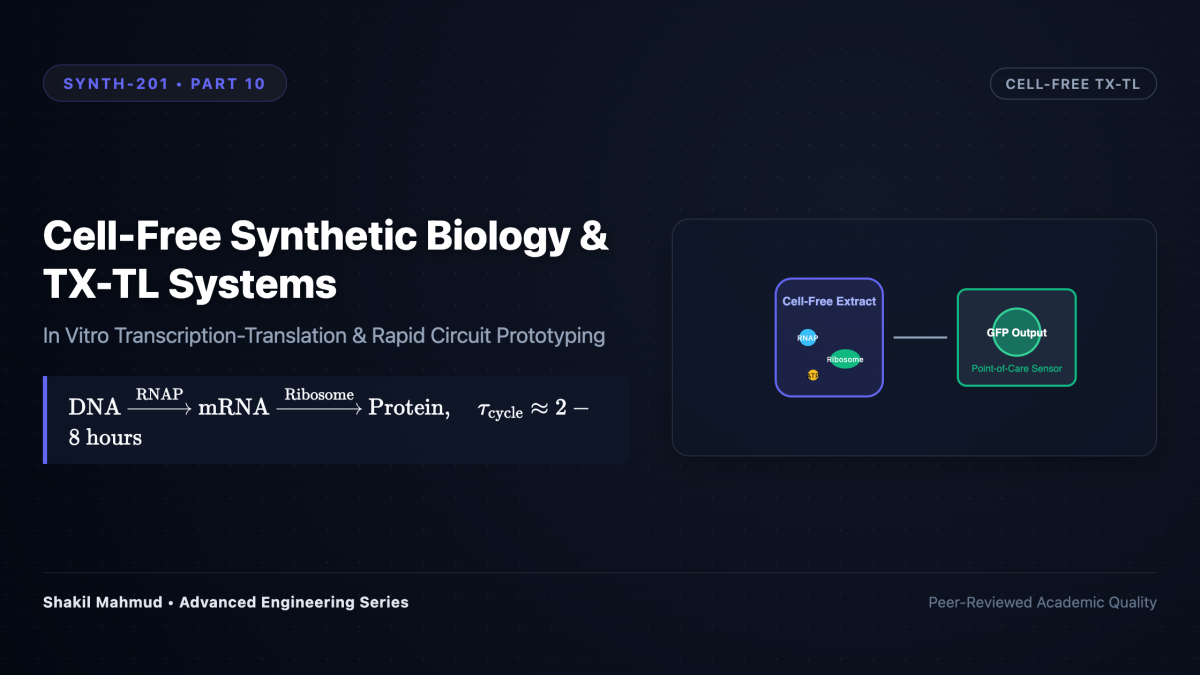
For decades, genetic engineering was constrained within the physical perimeter of living cells. While cells reproduce autonomously, their membrane walls represent an impenetrable barrier: toxic molecules kill the host, cell growth introduces evolutionary mutations, and delivering DNA circuits requires laborious transformation protocols. Cell-Free Synthetic Biology (TX-TL) breaks open the cellular chassis, liberating the core macromolecular transcription-translation machinery to operate in open test tubes and paper matrices. In this article, we explore cell-free energetics, the PURE system, and rapid diagnostic prototyping.
1. The Architecture of Cell-Free TX-TL Systems
A cell-free protein synthesis (CFPS) reaction extracts the vital enzymatic machinery of molecular life away from the living host. CFPS platforms fall into two primary archetypes:
- Crude Cell Extracts: Generated by lysing rapidly growing cells (e.g., E. coli, yeast, wheat germ, or Chinese hamster ovary cells), followed by high-speed centrifugation (S30 extracts) and clarification. The extract contains endogenous RNA polymerases, ribosomes, elongation factors, chaperones, and metabolic enzymes.
- The PURE System (Protein synthesis Using Recombinant Elements): Engineered by Takuya Ueda in 2001, the PURE system is a completely defined, reconstituted transcription-translation machine comprising:
[
ext{PURE System} = ext{T7 RNAP} + 70 ext{S Ribosomes} + 20 ext{ aaRSs} + 10 ext{ Translation Factors (IFs, EFs, RFs)} + ext{Energy System}
]
Over 30 individually purified recombinant proteins are assembled in stoichiometric ratios, yielding a pristine in vitro environment completely devoid of endogenous ribonucleases, proteases, or unknown inhibitory factors.
2. Metabolic Energetics and ATP Regeneration in Vitro
Translation is an energetically hungry process: peptide bond formation consumes 4 high-energy phosphate bonds per amino acid (1 ATP for aminoacylation, 2 GTP for elongation, 1 GTP for proofreading/translocation). Early cell-free reactions stalled within 30 minutes due to rapid ATP depletion and accumulation of inhibitory inorganic phosphate (( ext{P}_i)).
Modern cell-free systems solve this through secondary energy regeneration cascades:
- Creatine Phosphate / Creatine Kinase:
[
ext{Creatine Phosphate} + ext{ADP} xrightarrow{ ext{Creatine Kinase}} ext{Creatine} + ext{ATP}
] - PEP / Pyruvate Kinase: Phosphoenolpyruvate (PEP) transfers high-energy phosphate to ADP, generating pyruvate.
- PANOx / Maltodextrin Glycolysis: Feeding inexpensive starch polymers activates endogenous glycolytic enzymes within crude extracts, recycling inorganic phosphate and sustaining protein synthesis for up to 24 to 48 hours with protein yields exceeding (1 – 3 ext{ mg/mL}).
3. Rapid In Vitro Prototyping and Lyophilized Paper Diagnostics
The cardinal advantage of cell-free synthetic biology is Cycle Velocity:
[
ext{In Vivo Prototyping: } quad ext{Synthesis} o ext{Cloning} o ext{Transformation} o ext{Growth} o ext{Assay} quad (3 – 5 ext{ days})
]
[
ext{Cell-Free Prototyping: } quad ext{Linear PCR Product} + ext{TX-TL Extract} o ext{Plate Reader Fluorescent Output} quad (4 – 8 ext{ hours})
]
Because cell-free reactions do not require plasmid replication or cell survival, linear PCR products can be tested directly without molecular cloning. Furthermore, cellular extracts and synthetic toehold switches can be Lyophilized (Freeze-Dried) onto ordinary cellulose paper strips. These shelf-stable diagnostic test kits remain functional at room temperature for over a year without cold-chain storage, providing life-saving point-of-care pathogen detection across developing nations.